Clinical caution
YEARS is a decision-support pathway for selected stable patients with suspected PE. It should not delay urgent imaging, anticoagulation decisions, or advanced care in unstable patients or in patients with high clinical concern for massive PE.
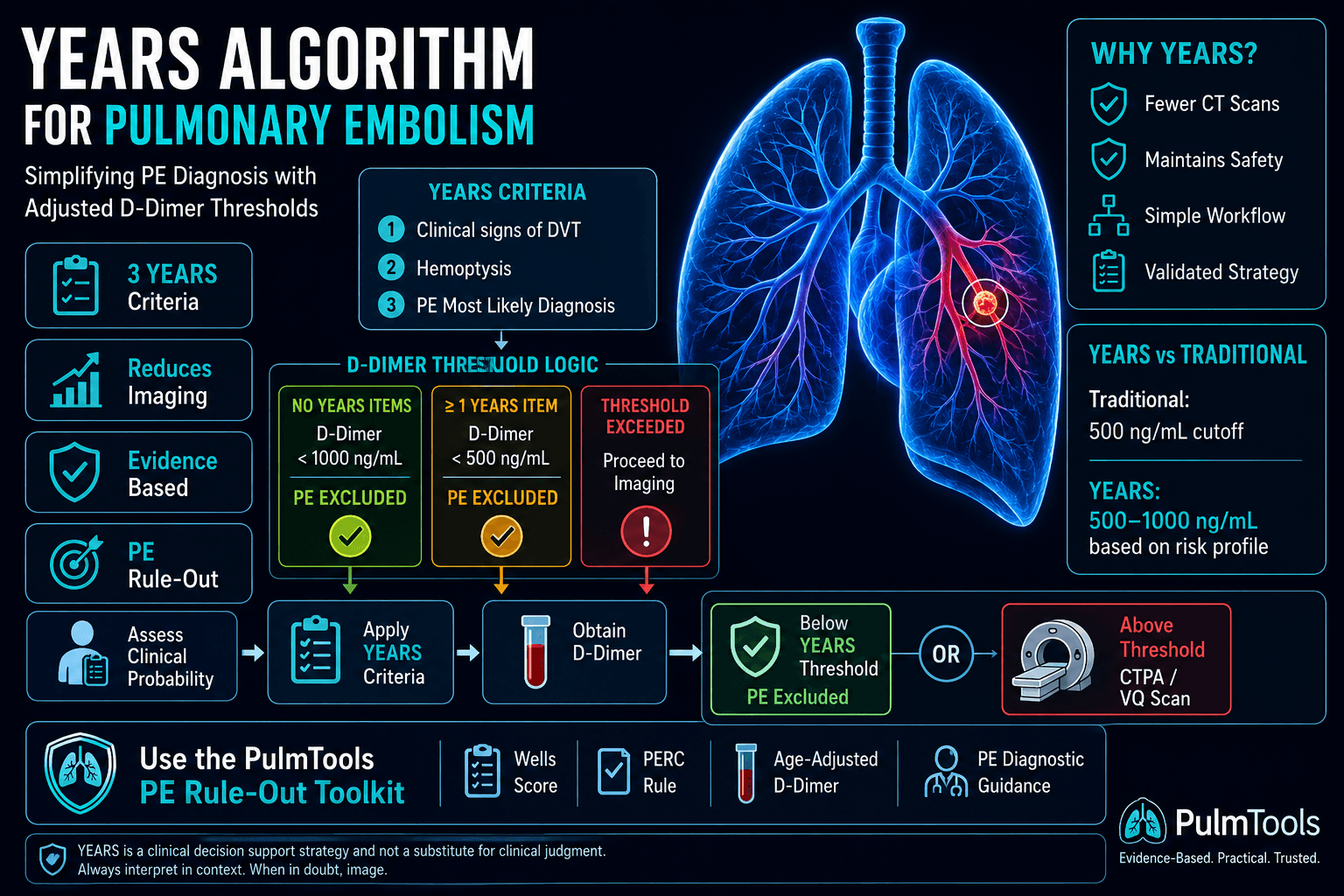
The YEARS algorithm sits between classic pretest probability tools and imaging. Instead of applying a single D-dimer cutoff to everyone, YEARS changes the D-dimer threshold based on three high-yield clinical findings. For the broader sequence, see the PulmTools pulmonary embolism diagnostic algorithm.
What is the YEARS algorithm?
The YEARS algorithm is a pulmonary embolism diagnostic pathway built to simplify PE evaluation and reduce unnecessary CT pulmonary angiography. It asks whether the patient has any of three YEARS criteria, then pairs that answer with a D-dimer threshold. If the D-dimer is below the appropriate threshold, PE can often be excluded without imaging.
This makes YEARS different from older approaches where D-dimer is a separate step after risk stratification. YEARS integrates the clinical criteria and the lab threshold into one practical decision pathway, but it still depends on symptoms, risk factors, assay units, and clinical judgment.
The three YEARS criteria
Clinical signs of DVT
Hemoptysis
PE is the most likely diagnosis
These three findings represent clinically meaningful signals that PE or thromboembolic disease may be more likely, and they should be interpreted alongside PE symptoms and clinical clues. The algorithm does not ask you to ignore the rest of the patient; it provides a compact structure for deciding which D-dimer threshold is safe to apply.
YEARS D-dimer thresholds
No YEARS criteria present
D-dimer < 1000
PE can be excluded
When none of the three YEARS items are present, the algorithm allows a higher D-dimer threshold in many protocols.
One or more YEARS criteria present
D-dimer < 500
PE can be excluded
When any YEARS item is present, the pathway uses the lower traditional D-dimer threshold before PE can be excluded.
If the D-dimer exceeds the appropriate YEARS threshold, the pathway moves toward imaging, usually CTPA, V/Q scanning, or another locally appropriate imaging strategy.
How the YEARS algorithm works
YEARS starts with suspected pulmonary embolism. The clinician checks for the three YEARS criteria. If there are no YEARS items and the D-dimer is below 1000 ng/mL FEU, PE can generally be excluded. If one or more YEARS items are present, the cutoff falls to 500 ng/mL FEU. If the D-dimer is above the relevant threshold, imaging is usually required. Positive D-dimer results still require context, because false-positive D-dimer elevations are common.
Suspected PE
Start with clinical context and a stable patient.
Apply YEARS
Count DVT signs, hemoptysis, and PE most likely.
Use threshold
1000 if no items, 500 if one or more items.
Image if above
Proceed to CTPA, V/Q, or local protocol pathway.
YEARS vs Wells Score
The Wells Score for pulmonary embolism is a broader pretest probability tool. It includes multiple clinical and historical features and can be interpreted using two-tier or three-tier systems. YEARS is more compact: it uses three items and directly changes the D-dimer cutoff.
| Feature | YEARS | Wells |
|---|---|---|
| Criteria | 3 | 7 |
| Risk style | Simplified pathway | Detailed score |
| D-dimer | Built into threshold logic | Usually separate after scoring |
| Imaging reduction | Major design goal | Depends on pathway used |
YEARS vs PERC
The PERC rule is not a general PE diagnostic pathway. PERC is used only when the clinician already believes the patient is very low risk. If PERC is negative in that setting, the goal is to avoid D-dimer and imaging completely.
YEARS is different. It is used after PE is suspected and it uses D-dimer as part of the rule-out strategy. Put simply: PERC tries to avoid the D-dimer in very-low-risk patients; YEARS uses D-dimer more intelligently in selected patients.
YEARS vs age-adjusted D-dimer
Age-adjusted D-dimer changes the cutoff based on age, usually for patients older than 50. YEARS changes the cutoff based on three clinical criteria. Both strategies try to reduce unnecessary imaging, but they are not the same rule. Which one is used depends on the clinical protocol, patient population, and local standards.
Both strategies are meant to reduce unnecessary imaging when used in the right patient. Neither should be used as a shortcut in unstable patients or patients with high clinical concern.
Benefits of the YEARS algorithm
- Reduces unnecessary CT pulmonary angiography in selected patients.
- Reduces iodinated contrast exposure when imaging can be avoided.
- Reduces radiation exposure from CT-based PE workups.
- Uses only three clinical criteria, making it easier to apply.
- Integrates D-dimer directly into the diagnostic pathway.
- Provides a clear next step when the threshold is exceeded.
Limitations of the YEARS algorithm
YEARS is not a replacement for clinical judgment. It should not be used as a shortcut in unstable patients, patients with high clinical concern, or situations where local protocol requires immediate imaging. The pathway also depends on the D-dimer assay, threshold units, and patient population.
If the D-dimer exceeds the appropriate YEARS threshold, PE is not excluded. At that point, the clinician should move toward imaging or a local protocol-based alternative. If the patient is very-low-risk from the start, a low-risk PE rule-out pathway using PERC may avoid D-dimer entirely.
Practical YEARS example
Consider a stable 35-year-old patient with pleuritic chest pain, no hemoptysis, no clinical signs of DVT, and an alternate diagnosis that seems more likely than PE. This patient has zero YEARS criteria. If the D-dimer is 850 ng/mL FEU, the YEARS threshold is 1000 ng/mL FEU, so PE can be excluded by the pathway.
Now change one feature: the clinician believes PE is the most likely diagnosis. That becomes one YEARS criterion. The threshold falls to 500 ng/mL FEU. With the same D-dimer of 850, PE is not excluded and imaging is generally required.
PulmTools clinical workflow
Use the PE Rule-Out Toolkit
Use PulmTools to connect Wells, PERC, D-dimer interpretation, age-adjusted thresholds, and PE diagnostic guidance in one bedside-friendly workflow. For a full branch-by-branch view, review the pulmonary embolism diagnostic algorithm.
Related PE resources
PE Rule-Out Toolkit
Use PulmTools to walk through Wells, PERC, D-dimer, and PE rule-out logic in one clinical workflow.
Read morePulmonary Embolism Diagnostic Algorithm
See the full PE workup pathway from pretest probability to imaging decisions.
Read moreD-Dimer for Pulmonary Embolism
Understand D-dimer sensitivity, false positives, negative rule-out value, and imaging triggers.
Read moreAge-Adjusted D-Dimer
Compare YEARS thresholds with age-adjusted D-dimer strategies in older adults.
Read moreWells Score for Pulmonary Embolism
Review the classic PE pretest probability score and how it differs from YEARS.
Read morePERC Rule for Pulmonary Embolism
Learn when very-low-risk patients can avoid D-dimer and imaging entirely.
Read morePE Likely vs PE Unlikely
Understand how two-tier Wells interpretation compares with YEARS threshold logic.
Read moreCTPA vs V/Q Scan
Compare imaging choices when YEARS or D-dimer thresholds do not exclude PE.
Read moreD-Dimer False Positives
Review common reasons D-dimer can be elevated without pulmonary embolism.
Read morePE Symptoms and Clinical Clues
Review the symptoms and risk clues that should trigger formal PE evaluation.
Read moreFrequently asked questions
What is the YEARS algorithm?
The YEARS algorithm is a pulmonary embolism diagnostic strategy that combines three clinical criteria with D-dimer thresholds to determine whether PE can be excluded or whether imaging is required.
What are the three YEARS criteria?
The three YEARS criteria are clinical signs of deep vein thrombosis, hemoptysis, and whether pulmonary embolism is the most likely diagnosis.
What D-dimer threshold is used in the YEARS algorithm?
In many YEARS pathways, PE can be excluded with a D-dimer below 1000 ng/mL FEU when no YEARS criteria are present, or below 500 ng/mL FEU when one or more YEARS criteria are present.
How does YEARS differ from Wells Score?
Wells Score uses a broader set of criteria to estimate pretest probability, while YEARS uses three clinical items and integrates D-dimer thresholds directly into the rule-out pathway.
How does YEARS differ from PERC?
PERC is used only in very-low-risk patients to avoid D-dimer and imaging. YEARS is a diagnostic pathway for selected stable patients with suspected PE that uses clinical criteria plus D-dimer thresholds.
Can the YEARS algorithm reduce CT scans?
Yes. The YEARS algorithm is designed to reduce unnecessary CT pulmonary angiography in selected patients while maintaining a safe PE rule-out strategy when applied appropriately.
This educational resource is for clinical learning and workflow support only. Always follow local protocols, supervising clinician direction, and patient-specific risk assessment.