Wells Score for Pulmonary Embolism:Complete Clinical Guide
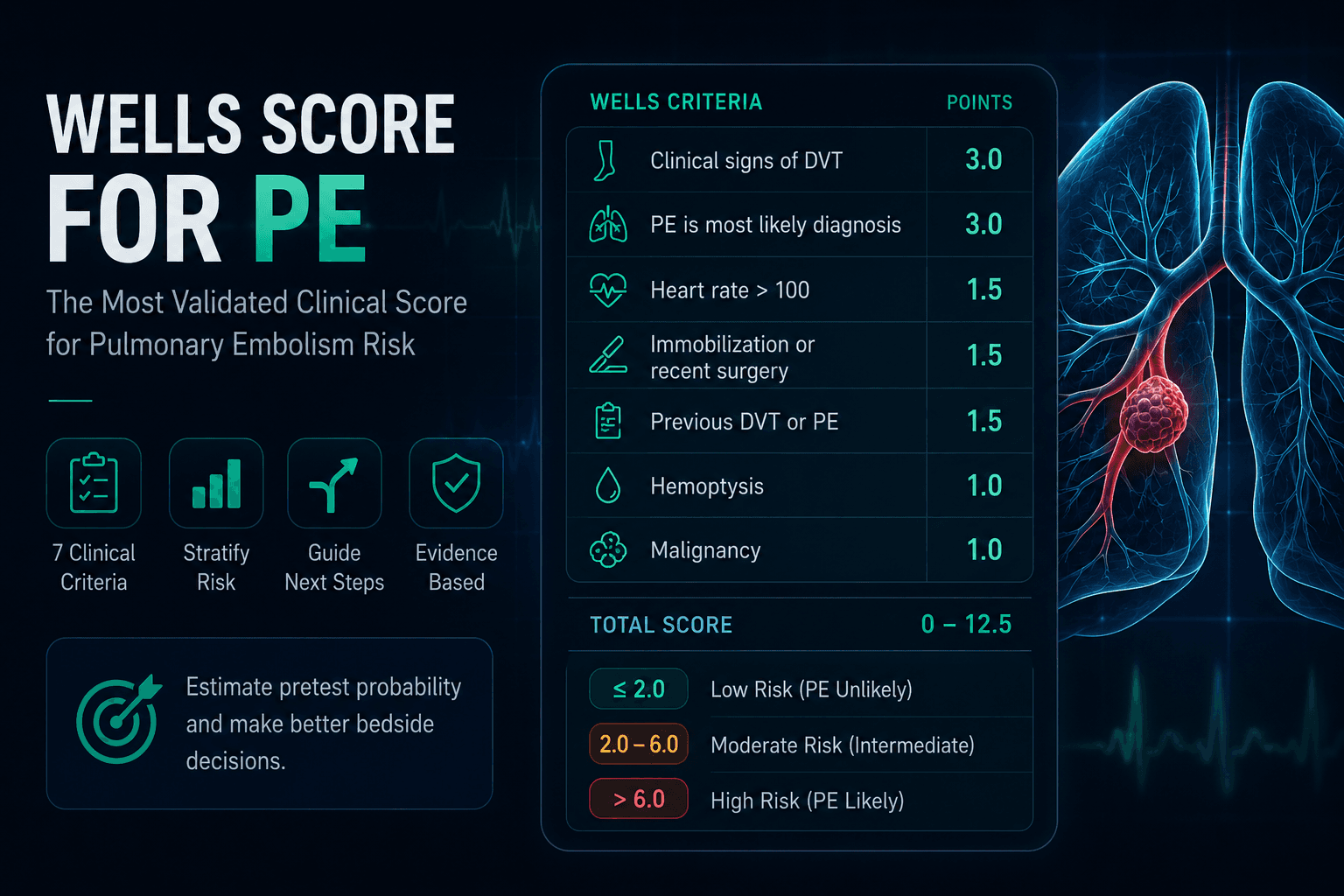
The Wells Score for pulmonary embolism is one of the most widely used clinical prediction rules for estimating pretest probability of PE. It helps clinicians determine whether pulmonary embolism is unlikely, intermediate risk, or likely before deciding on D-dimer testing, CT pulmonary angiography (CTPA), or other diagnostic pathways. It is the foundation of many modern PE rule-out algorithms.
Calculate Wells Score Instantly
Use the PulmTools PE Rule-Out Toolkit to calculate Wells Score, apply PERC criteria, review age-adjusted D-dimer thresholds, and receive pathway guidance.
Open Wells + PERC CalculatorWhat Is the Wells Score?
The Wells Score is a validated clinical decision rule designed to estimate the probability of pulmonary embolism before definitive testing. Rather than relying on imaging for every patient with chest pain, dyspnea, tachycardia, or hypoxemia, the Wells Score helps stratify risk and guide diagnostic testing.
The score combines clinical findings, historical risk factors, and physician judgment into a single numerical value that predicts the likelihood of PE.
Many modern pathways now simplify interpretation intoPE Likely versus PE Unlikely, making Wells easier to connect directly to D-dimer and imaging decisions.
Wells Score Criteria
| Criterion | Points |
|---|---|
| Clinical signs of DVT | 3.0 |
| PE most likely diagnosis | 3.0 |
| Heart rate greater than 100 bpm | 1.5 |
| Immobilization or surgery within 4 weeks | 1.5 |
| Previous DVT or PE | 1.5 |
| Hemoptysis | 1.0 |
| Malignancy | 1.0 |
How to Interpret Wells Score
Low Risk
Less than 2 points
Intermediate Risk
2 to 6 points
PE Likely
Greater than 6 points
Modern Two-Tier Interpretation
Many contemporary PE pathways simplify Wells into: PE Unlikely (≤4) and PE Likely (>4). This approach aligns closely with D-dimer and imaging decisions.
Learn more about PE Likely vs PE UnlikelyWells Score vs PERC
Wells Score and PERC are often used together, but they answer different clinical questions.
Wells estimates pretest probability. PERC helps determine whether PE can be excluded without D-dimer testing in carefully selected low-risk patients. If PERC is positive, the next step is oftenD-dimer testing.
Where Wells Fits in the PE Workup
Wells is usually the first major branching point in a structured PE evaluation. After estimating probability, clinicians may move to PERC, D-dimer, age-adjusted D-dimer, YEARS, or directly to imaging depending on risk.
Typical workflow
Symptoms → Wells Score → PERC (if low risk) → D-dimer → CTPA or V/Q scan when PE cannot be excluded.
Related PE Resources
PE Rule-Out Toolkit
Apply Wells, PERC, D-dimer, age-adjusted D-dimer, and PE rule-out logic in one workflow.
PE Likely vs PE Unlikely
Learn the modern two-tier Wells interpretation used by many PE pathways.
PERC Rule for Pulmonary Embolism
Review when low-risk patients may avoid D-dimer and imaging entirely.
D-Dimer for Pulmonary Embolism
Understand how D-dimer fits into the PE workup after Wells assessment.
Pulmonary Embolism Diagnostic Algorithm
See the complete PE evaluation pathway from symptoms to imaging.
CTPA vs V/Q Scan
Compare imaging options when PE cannot be excluded clinically.
Educational content only. Wells Score supports clinical decision-making but does not replace clinical judgment, local protocols, imaging, or specialist consultation when pulmonary embolism remains a serious concern.