Clinical caution
Imaging choice for suspected PE depends on patient stability, renal function, pregnancy status, contrast allergy, chest X-ray findings, local radiology availability, and institutional protocols. Decision rules should not delay urgent care in unstable patients or those with high clinical concern for massive PE.
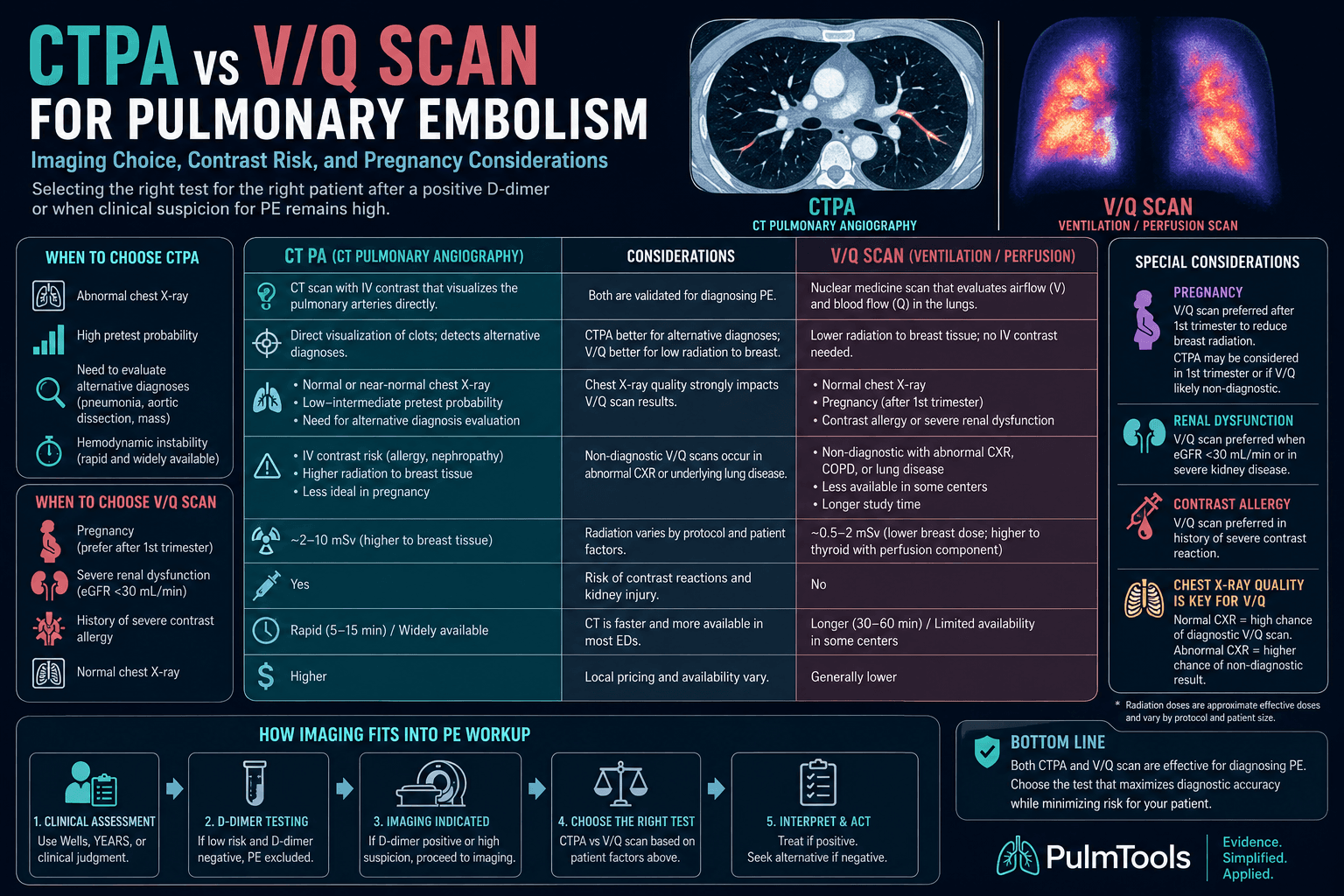
CTPA and V/Q scanning answer the same clinical question in different ways. CTPA directly visualizes pulmonary arteries using iodinated contrast. V/Q scanning compares ventilation and perfusion patterns to identify mismatched perfusion defects. The better test depends less on which one is “best” overall and more on which one is best for the patient.
Where imaging fits in the PE workup
Imaging usually follows a structured pathway. Clinicians first estimate pretest probability using gestalt, Wells Score, or another local protocol. Very-low-risk patients may be evaluated with PERC. Low- or intermediate-risk patients often move to D-dimer testing, age-adjusted D-dimer, or YEARS. Patients with a PE likely Wells result usually move more directly toward imaging. Imaging enters when PE cannot be excluded safely.
For the full branching pathway, see the PulmTools pulmonary embolism diagnostic algorithm.
Quick comparison: CTPA vs V/Q scan
| Feature | CTPA | V/Q scan |
|---|---|---|
| What it shows | Direct clot visualization in pulmonary arteries | Ventilation/perfusion mismatch pattern |
| Contrast | Requires iodinated IV contrast | No iodinated contrast |
| Renal concern | May be limited by kidney function | Often considered when contrast is undesirable |
| Chest X-ray dependency | Less dependent on normal CXR | Best when CXR is normal or near-normal |
| Alternate diagnosis | Can reveal pneumonia, mass, effusion, dissection clues | Primarily evaluates ventilation/perfusion mismatch |
What is CTPA?
CT pulmonary angiography is a contrast-enhanced CT scan timed to evaluate the pulmonary arteries. It is fast, widely available in many emergency departments, and directly shows filling defects that represent pulmonary emboli. It can also reveal alternate causes of dyspnea, chest pain, hypoxemia, or abnormal vital signs.
The tradeoff is that CTPA requires iodinated contrast and exposes the patient to ionizing radiation. It may be less desirable when the patient has severe renal dysfunction, a significant contrast allergy, or a pregnancy pathway that favors another imaging option.
What is a V/Q scan?
A ventilation/perfusion scan evaluates whether areas of the lung are ventilated but not perfused. A classic PE pattern is a perfusion defect with preserved ventilation. V/Q scanning does not require iodinated contrast and can be useful when CTPA is undesirable.
The main limitation is interpretability. V/Q performs best when the chest X-ray is normal or near-normal. Pneumonia, COPD, pulmonary edema, pleural effusion, atelectasis, or chronic parenchymal disease can make the result more likely to be indeterminate or less useful.
Renal dysfunction
V/Q is often considered when iodinated contrast is a concern.
Pregnancy
Imaging depends on CXR, protocol, availability, and risk tradeoffs.
Contrast allergy
V/Q can avoid iodinated contrast when CT contrast is unsafe.
Radiation
Radiation distribution differs between CT and nuclear imaging.
When CTPA is often preferred
- The patient can receive iodinated contrast.
- Renal function is acceptable for contrast-enhanced CT.
- Rapid direct pulmonary artery imaging is needed.
- The chest X-ray is abnormal and V/Q may be harder to interpret.
- Alternate chest diagnoses are clinically important.
- CT availability and local protocols favor CTPA.
When V/Q scan is often preferred
- Iodinated contrast allergy makes CTPA difficult or unsafe.
- Renal dysfunction makes contrast exposure undesirable.
- Pregnancy protocols favor V/Q after a normal chest X-ray.
- The chest X-ray is normal or near-normal.
- The patient can tolerate the scan and local nuclear medicine is available.
Pregnancy considerations
Pregnancy PE imaging requires protocol-driven decision-making. Many pathways begin with leg ultrasound if DVT symptoms are present, then use chest X-ray to guide chest imaging. If the chest X-ray is normal, V/Q scanning may be considered. If the chest X-ray is abnormal or an alternate diagnosis needs evaluation, CTPA may be favored.
The correct decision depends on local radiology expertise, availability, maternal risk, fetal considerations, and the clinical urgency of the case.
Renal dysfunction and contrast allergy
CTPA requires iodinated contrast, so kidney function and contrast allergy matter. In patients with severe renal dysfunction or a significant contrast reaction history, V/Q scanning may allow PE imaging without iodinated contrast. When CTPA is still necessary, clinicians should follow institutional contrast allergy and renal protection protocols.
Why chest X-ray matters for V/Q scanning
A normal chest X-ray makes V/Q scanning much more useful. If there is pneumonia, edema, effusion, atelectasis, COPD-related change, or other parenchymal abnormality, ventilation and perfusion patterns may be abnormal for reasons unrelated to PE. That increases the chance of a nondiagnostic result and may push the workup toward CTPA.
Positive D-dimer: does everyone need CTPA?
Not necessarily. A positive D-dimer means PE is not excluded in the appropriate diagnostic pathway. It does not automatically mean CTPA is the only next step, and it does not diagnose PE by itself. For more nuance, review the PulmTools guides to D-dimer interpretation in PE, age-adjusted D-dimer, and D-dimer false positives. Imaging choice depends on patient factors and local protocol. In many patients CTPA is the default next test, but V/Q may be a better option when contrast or radiation distribution matters.
PulmTools clinical workflow
Decide whether imaging is needed first
Use PulmTools to apply Wells, PERC, D-dimer, age-adjusted D-dimer, and PE diagnostic logic before moving to CTPA or V/Q scan selection. For the low-risk bedside sequence, see the low-risk PE rule-out pathway.
Related PE resources
PE Rule-Out Toolkit
Run Wells, PERC, D-dimer, and PE rule-out logic before deciding whether imaging is needed.
Read morePulmonary Embolism Diagnostic Algorithm
See how imaging fits into the complete PE workup after pretest probability and D-dimer.
Read moreD-Dimer for Pulmonary Embolism
Understand why positive D-dimer usually triggers imaging while negative D-dimer can avoid it.
Read moreYEARS Algorithm for Pulmonary Embolism
Review adjusted D-dimer thresholds and how YEARS can reduce unnecessary imaging.
Read moreWells Score for Pulmonary Embolism
Estimate PE pretest probability before ordering D-dimer or imaging.
Read morePERC Rule for Pulmonary Embolism
Identify very-low-risk patients who may not need D-dimer or imaging.
Read moreAge-Adjusted D-Dimer
Use age-adjusted thresholds before imaging decisions in selected older adults.
Read morePE Likely vs PE Unlikely
Understand when the two-tier Wells model points toward D-dimer versus imaging.
Read morePE Symptoms and Clinical Clues
Review the symptoms and risk clues that should trigger formal PE evaluation.
Read moreFrequently asked questions
Is CTPA or V/Q scan better for pulmonary embolism?
CT pulmonary angiography is often preferred when rapid direct imaging is needed and the patient can receive iodinated contrast. V/Q scanning may be preferred when contrast allergy, renal dysfunction, pregnancy considerations, or local protocols make CTPA less desirable.
When is CTPA preferred for suspected PE?
CTPA is commonly preferred when the patient is stable enough for CT, can receive iodinated contrast, has adequate renal function, and clinicians need direct visualization of pulmonary arteries or alternate chest diagnoses.
When is a V/Q scan preferred for suspected PE?
A V/Q scan may be preferred when iodinated contrast is contraindicated, renal function is a major concern, pregnancy-specific protocols favor lower breast radiation, or when the chest X-ray is normal and V/Q interpretation is likely to be useful.
Why does chest X-ray matter before V/Q scan?
V/Q scans are easier to interpret when the chest X-ray is normal or near normal. Significant parenchymal disease, effusion, pneumonia, or chronic lung disease can make V/Q results more likely to be nondiagnostic.
What imaging is used for PE in pregnancy?
Pregnancy PE imaging depends on local protocol, chest X-ray findings, availability, and patient-specific risk. V/Q scanning is often considered when the chest X-ray is normal, while CTPA may be preferred when chest imaging is abnormal or alternate diagnoses are important.
Can PE imaging be avoided after a negative D-dimer?
In appropriately selected low- or intermediate-risk patients, a negative D-dimer can help exclude PE and avoid imaging. High-risk or unstable patients should not rely on D-dimer alone to avoid imaging.
This educational resource is for clinical learning and workflow support only. Always follow local protocols, supervising clinician direction, and patient-specific risk assessment.