What does PE Likely vs PE Unlikely mean?
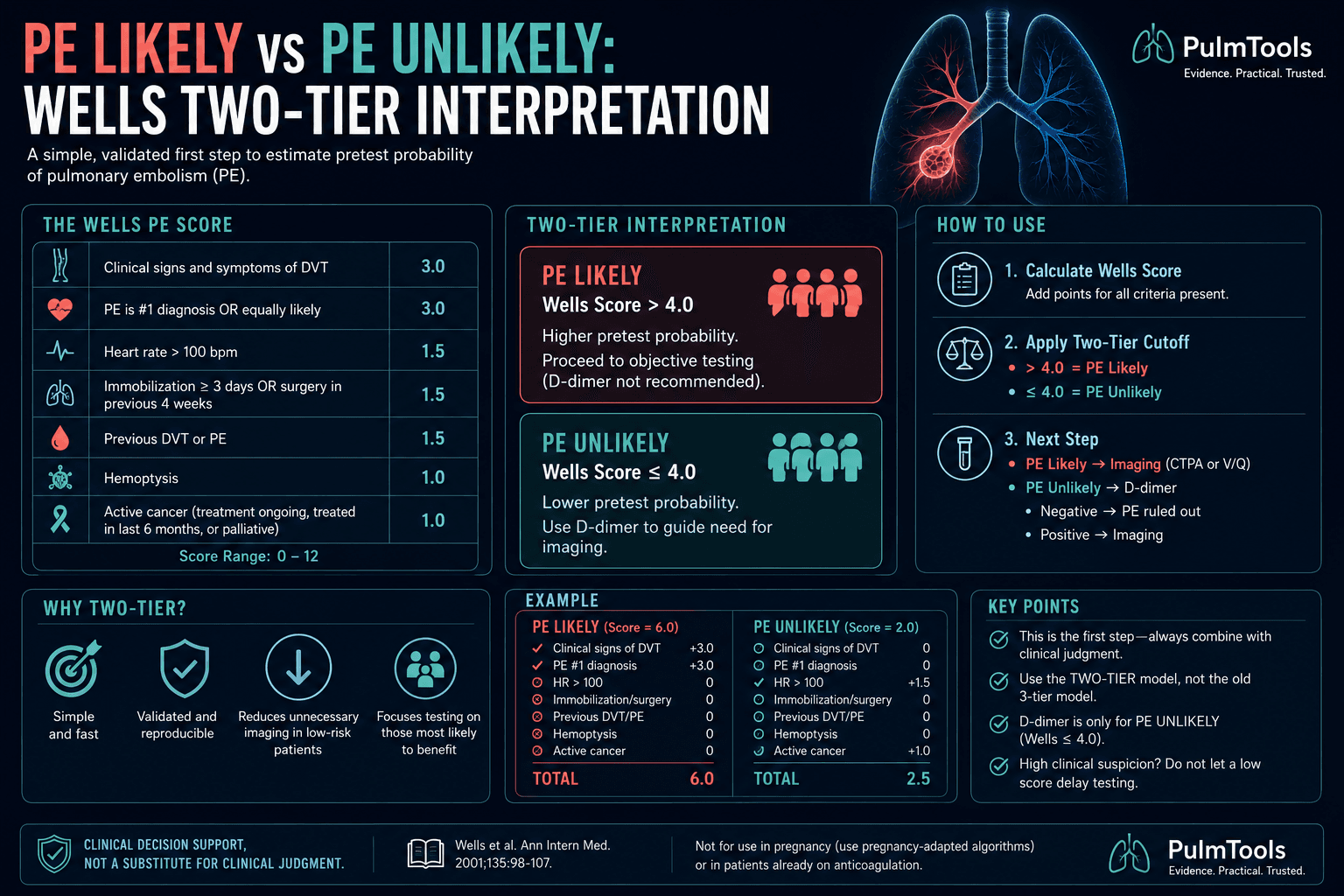
The two-tier Wells interpretation simplifies pulmonary embolism decision-making. Instead of separating patients into low, intermediate, and high risk categories, the score is divided into two clinically actionable groups. For the full sequence from symptoms to imaging, see the PulmTools pulmonary embolism diagnostic algorithm.
PE Unlikely
≤ 4
D-dimer testing is commonly used before imaging in appropriate stable patients, with age-adjusted thresholds considered in selected older adults.
PE Likely
> 4
Patients generally move toward imaging because PE probability is sufficiently elevated that D-dimer alone may not be appropriate. Imaging choice often becomes CTPA vs V/Q scan.
Why the two-tier model became popular
The two-tier Wells model aligns naturally with modern PE diagnostic pathways. Clinicians want to know whether D-dimer is appropriate or whether imaging should be considered. The PE Likely vs PE Unlikely framework answers that question quickly.
PE Unlikely pathway
Patients with Wells scores of 4 or less are often evaluated using D-dimer before imaging. A negative D-dimer may help safely exclude PE in selected low- and intermediate-risk patients. For the practical bedside version, review the low-risk PE rule-out pathway.
Learn more:
PE Likely pathway
When the Wells Score exceeds 4, many diagnostic pathways move directly toward imaging rather than relying on D-dimer alone. This reflects the higher pretest probability of pulmonary embolism and should be interpreted alongside the patient’s symptoms, clinical clues, and risk factors.
Imaging commonly includes:
- CT Pulmonary Angiography (CTPA)
- Ventilation-Perfusion (V/Q) Scan
See: CTPA vs V/Q Scan
Two-tier vs three-tier Wells interpretation
Historically, Wells Scores were often categorized as:
- Low Risk
- Intermediate Risk
- High Risk
Modern PE workflows frequently collapse those categories into a simpler PE Likely versus PE Unlikely approach because it more directly supports clinical decision-making.
Practical Workflow
Use the PulmTools PE Rule-Out Toolkit
Apply Wells Score, PERC, D-dimer, age-adjusted D-dimer, and PE diagnostic guidance in one streamlined workflow. Start with PE symptoms and clinical clues when the presentation is unclear.
Open ToolkitRelated PE Resources
PE Rule-Out Toolkit
Apply Wells, PERC, D-dimer, age-adjusted D-dimer, and PE rule-out logic in one workflow.
Pulmonary Embolism Diagnostic Algorithm
See how PE likely vs PE unlikely fits into the full diagnostic pathway.
D-Dimer for Pulmonary Embolism
Understand when D-dimer helps after a PE unlikely Wells result and when it should be avoided.
Age-Adjusted D-Dimer
Use age-adjusted thresholds in selected older adults when D-dimer testing is appropriate.
CTPA vs V/Q Scan
Compare imaging choices when PE is likely or cannot be excluded by D-dimer.
Low-Risk PE Rule-Out Pathway
Review the low-risk bedside sequence: gestalt, PERC, D-dimer, then imaging only if needed.
Educational content only. Always follow local protocols, supervising clinician guidance, and patient-specific clinical assessment.