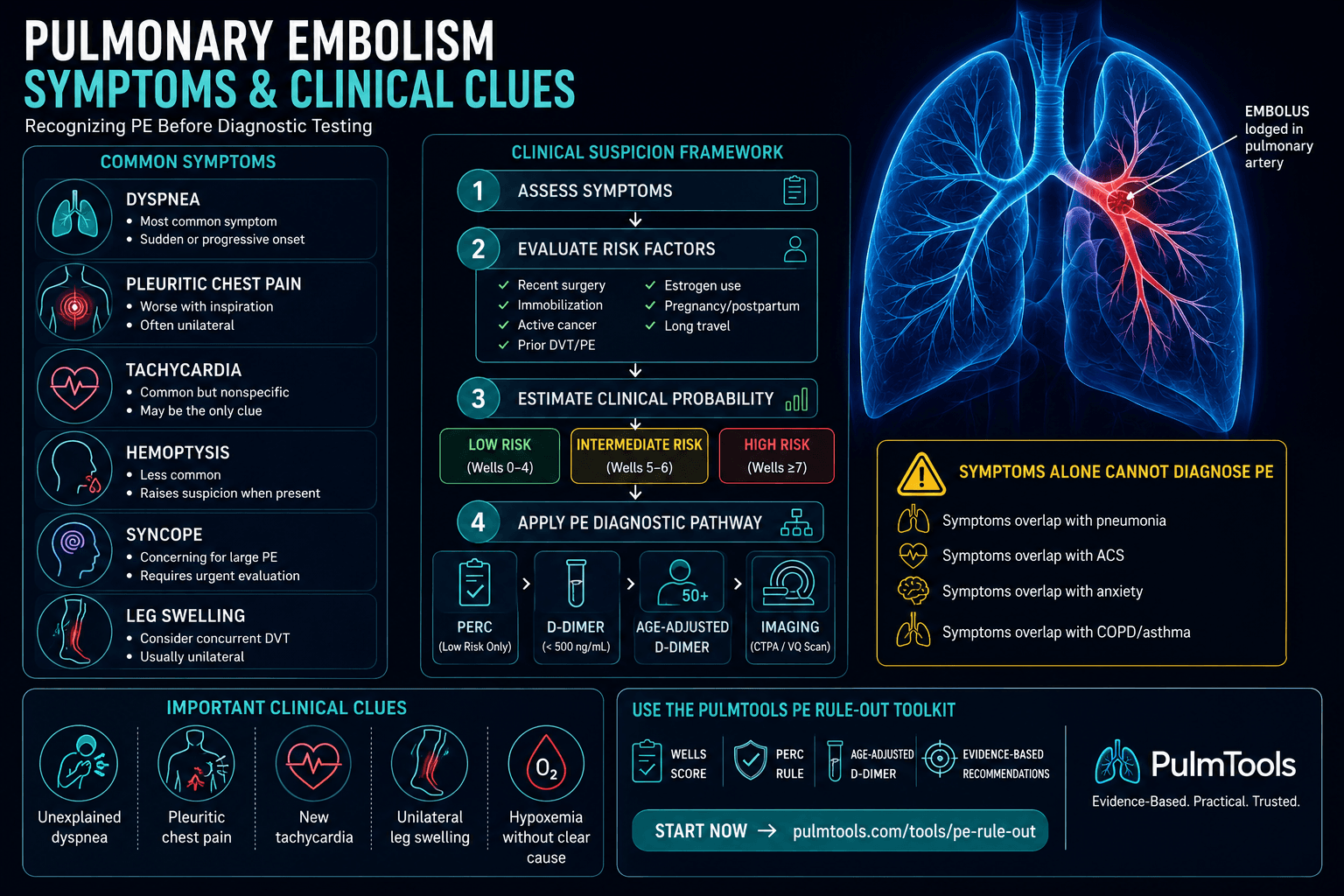
Common pulmonary embolism symptoms
Pulmonary embolism symptoms are often nonspecific and may overlap with pneumonia, COPD, asthma, acute coronary syndrome, anxiety, heart failure, and many other conditions. Symptoms should trigger structured clinical probability assessment rather than immediate assumptions. The next step is usually a pathway such as the PulmTools pulmonary embolism diagnostic algorithm.
Dyspnea
The most common symptom of pulmonary embolism.
Pleuritic Chest Pain
Often worsens with inspiration.
Tachycardia
A common but nonspecific finding.
Hemoptysis
Less common but raises suspicion.
Syncope
May indicate a larger or more severe PE.
Leg Swelling
Consider concurrent DVT, especially if unilateral.
Risk factors that increase suspicion
Symptoms alone do not diagnose PE. Clinical context matters because risk factors change pretest probability and determine whether tools such as Wells Score, PERC, or D-dimer are appropriate.
- Recent surgery
- Immobilization
- Active cancer
- Prior DVT or PE
- Pregnancy or postpartum status
- Estrogen therapy
- Long-distance travel
Symptoms alone are not enough
Pulmonary embolism shares symptoms with many common conditions. Clinical probability assessment is required before deciding on testing. In low-risk patients, the pathway may move through low-risk PE rule-out; in higher-risk patients, clinicians often move toward imaging rather than relying on D-dimer alone.
- Pneumonia
- Asthma
- COPD exacerbation
- Acute coronary syndrome
- Anxiety or panic attack
- Heart failure
When should PE be formally evaluated?
Patients with concerning symptoms and risk factors should undergo structured assessment rather than relying on symptoms alone. If PE is plausible, the workup usually starts with clinical probability and then branches into PERC, D-dimer, age-adjusted D-dimer, YEARS-style strategies, or imaging depending on risk.
Most modern pathways begin with clinical probability estimation, followed by tools such as:
PulmTools PE Rule-Out Toolkit
Apply Wells Score, PERC, D-dimer logic, age-adjusted D-dimer, and pulmonary embolism decision support in a single workflow. For patients who appear low risk after clinical assessment, review the low-risk PE rule-out pathway.
Open ToolkitRelated PE Resources
PE Rule-Out Toolkit
Apply Wells, PERC, D-dimer, age-adjusted D-dimer, and PE rule-out logic in one workflow.
Pulmonary Embolism Diagnostic Algorithm
See how symptoms and clinical clues feed into the complete PE workup.
Wells Score for Pulmonary Embolism
Estimate pretest probability after symptoms and risk factors raise suspicion.
PERC Rule for Pulmonary Embolism
Review when very-low-risk patients may avoid D-dimer and imaging.
Low-Risk PE Rule-Out Pathway
Use a practical bedside sequence for low-risk patients: gestalt, PERC, D-dimer, then imaging only if needed.
CTPA vs V/Q Scan
Compare imaging options when symptoms and pathway testing cannot exclude PE.
Educational content only. Symptoms alone cannot diagnose or exclude pulmonary embolism. Clinical assessment, diagnostic testing, and clinician judgment remain essential.