Introduction
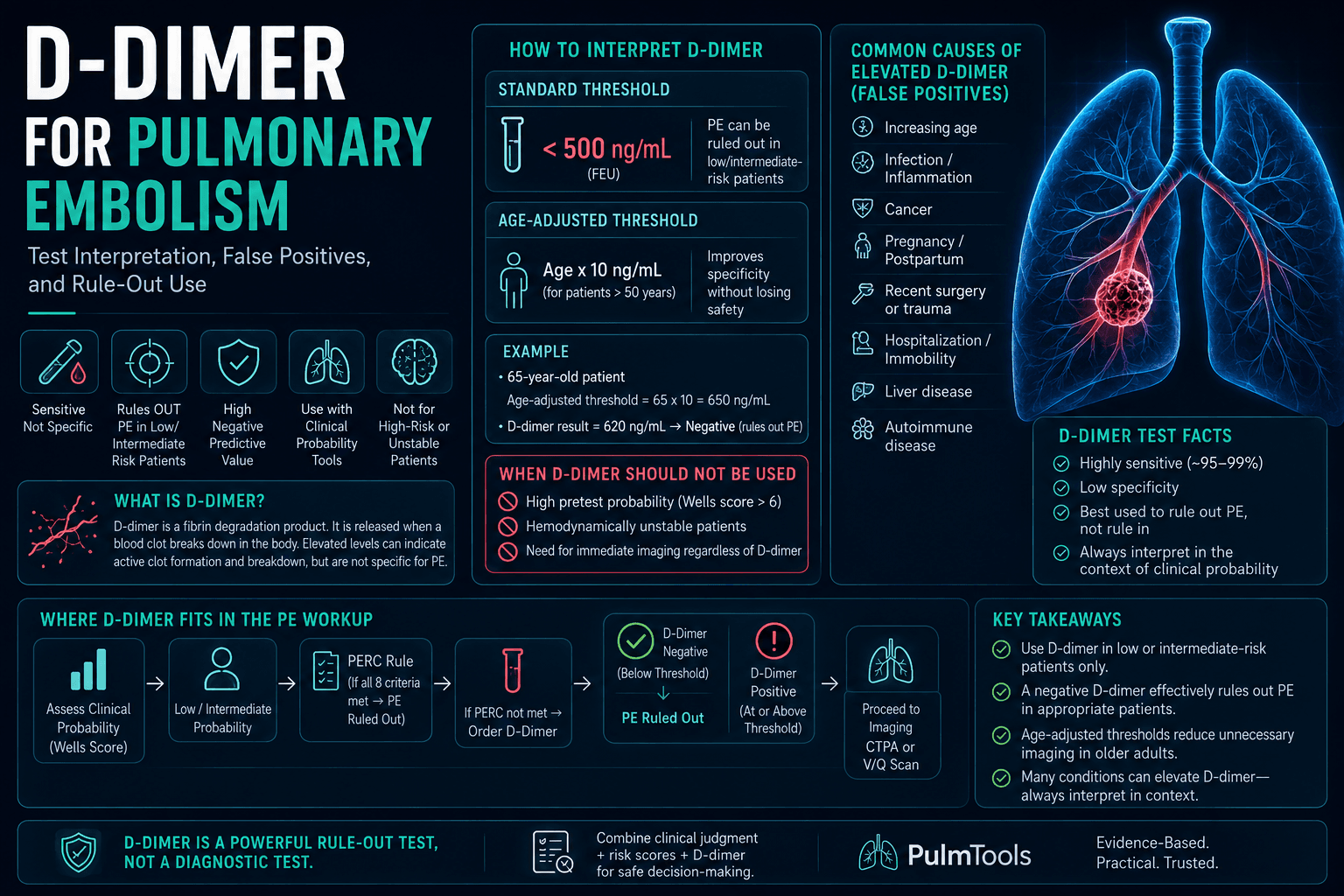
D-dimer is a fibrin degradation product—a small protein fragment present in the blood after a blood clot is degraded by fibrinolysis. When the body forms a clot, fibrin strands create a mesh to stabilize it. As the clot is broken down, D-dimer is released into the bloodstream.
The D-dimer test measures the amount of this fragment in the blood. Because D-dimer is produced whenever there is active clot formation and breakdown, it is highly sensitive for detecting ongoing or recent thrombosis.
However, while a negative D-dimer test is very helpful in excluding pulmonary embolism (PE) in the right context, a positive D-dimer is not specific and cannot confirm PE. For a deeper breakdown of non-PE causes, see the PulmTools guide to D-dimer false positives.
Why D-Dimer Is Sensitive but Not Specific
- High Sensitivity: Nearly all patients with an acute PE will have an elevated D-dimer, especially if using a sensitive assay.
- Poor Specificity: Many conditions besides PE elevate D-dimer (see below).
- A negative D-dimer is powerful for ruling out PE in patients with a low or intermediate pretest probability.
- A positive D-dimer does not diagnose PE—it simply indicates that there is some degree of clot formation and breakdown occurring.
The value of D-dimer is in its negative predictive value—a normal result can help you safely exclude PE in appropriate patients, but an elevated result is nonspecific and requires further evaluation.
When D-Dimer Helps Most
D-dimer is most useful in patients with low or intermediate pretest probability for PE. Its role is to safely avoid unnecessary imaging in those unlikely to have PE, especially inside a structured low-risk PE rule-out pathway.
- Low-risk patients: If the patient is low risk by the Wells Score and negative by the PERC Rule, no D-dimer or imaging is needed.
- Intermediate-risk patients: If the patient is not low risk, a negative D-dimer can rule out PE, avoiding CT imaging.
When D-Dimer Should Not Be the Main Rule-Out Strategy
- High pretest probability: If the patient is high risk for PE or PE likely by the two-tier Wells model, a negative D-dimer is not sufficient to rule out PE. Imaging is usually required.
- Unstable patients: In patients who are hemodynamically unstable or have high clinical suspicion, do not rely on D-dimer. Proceed directly to imaging or empiric treatment.
Bottom line: D-dimer should only be used to rule out PE in low- or intermediate-risk, stable patients.
Common Causes of False Positive D-Dimer
Many conditions can elevate D-dimer, leading to false positives:
- Age (especially >50)
- Infection
- Inflammation
- Cancer
- Pregnancy
- Recent surgery
- Trauma
- Hospitalization
- Liver disease
- Autoimmune disease
These factors can make interpretation challenging, especially in hospitalized or older patients. For a dedicated cause-by-cause breakdown, read D-Dimer False Positives: Causes and Clinical Interpretation.
Age-Adjusted D-Dimer
In patients over 50, using a higher D-dimer threshold improves specificity while maintaining sensitivity. The age-adjusted D-dimer formula is:
Examples:
- Age 60: 600 ng/mL FEU
- Age 75: 750 ng/mL FEU
- Age 82: 820 ng/mL FEU
Practical PE Workflow
The following workflow is evidence-based and widely used to efficiently and safely rule out PE:
- 1. Assess pretest probability (Wells Score)
- 2. If low risk, apply PERC Rule
- 3. If not PERC negative, check D-dimer
- 4. If D-dimer positive, choose imaging when needed (CTPA or V/Q scan)
D-Dimer and Imaging
If D-dimer is positive or the patient is high risk, imaging is required:
- CT Pulmonary Angiography (CTPA): The gold standard for diagnosing PE. Rapid and highly sensitive, but requires IV contrast and radiation.
- Ventilation/Perfusion (V/Q) Scan: Useful in patients with contraindications to contrast or renal dysfunction. Interpretation can be indeterminate in some cases.
Clinical Pearls
- D-dimer is most valuable for ruling out PE, not diagnosing it.
- Use D-dimer only in low or intermediate pretest probability patients.
- Always use age-adjusted cutoffs for patients over 50.
- Do not use D-dimer in unstable or high-risk patients—proceed to imaging.
- Many conditions elevate D-dimer—interpret results in clinical context.
- A negative D-dimer can spare unnecessary CT scans and radiation exposure.
- Always document your pretest probability assessment and rationale for testing.
Rule Out PE with Confidence
Use the PulmTools PE Rule-Out Toolkit to apply Wells Score, PERC Rule, D-dimer logic, and age-adjusted D-dimer at the bedside. Start with PE symptoms and clinical clues when the presentation is unclear.
Launch PE Rule-Out ToolkitRelated PE Resources
PE Rule-Out Toolkit
Apply Wells, PERC, D-dimer, age-adjusted D-dimer, and PE rule-out logic in one workflow.
Pulmonary Embolism Diagnostic Algorithm
See how D-dimer fits into the complete PE workup from symptoms to imaging.
D-Dimer False Positives
Review infection, inflammation, age, cancer, pregnancy, trauma, and other causes of elevated D-dimer.
Age-Adjusted D-Dimer
Use age-adjusted thresholds to reduce unnecessary imaging in selected older adults.
YEARS Algorithm for Pulmonary Embolism
Compare fixed, age-adjusted, and YEARS-based D-dimer threshold strategies.
CTPA vs V/Q Scan
Understand imaging choices when PE cannot be excluded by D-dimer or clinical pathway.
Frequently Asked Questions
- What is a D-dimer test?
- A D-dimer test measures the amount of D-dimer, a fibrin degradation product, in the blood. It is used to help rule out conditions like pulmonary embolism (PE) and deep vein thrombosis (DVT).
- Can a positive D-dimer diagnose PE?
- No. A positive D-dimer is not specific for PE and can be caused by many other conditions. It cannot confirm the diagnosis of PE.
- Can a negative D-dimer rule out PE?
- A negative D-dimer can help rule out PE in low- or intermediate-risk patients, but not in those with high pretest probability.
- What causes a false positive D-dimer?
- False positives can be caused by age, infection, inflammation, cancer, pregnancy, recent surgery, trauma, hospitalization, liver disease, and autoimmune disease.
- What is an age-adjusted D-dimer?
- For patients over 50, the D-dimer threshold can be adjusted to age × 10 ng/mL FEU to improve specificity without sacrificing sensitivity.