Key Clinical Point
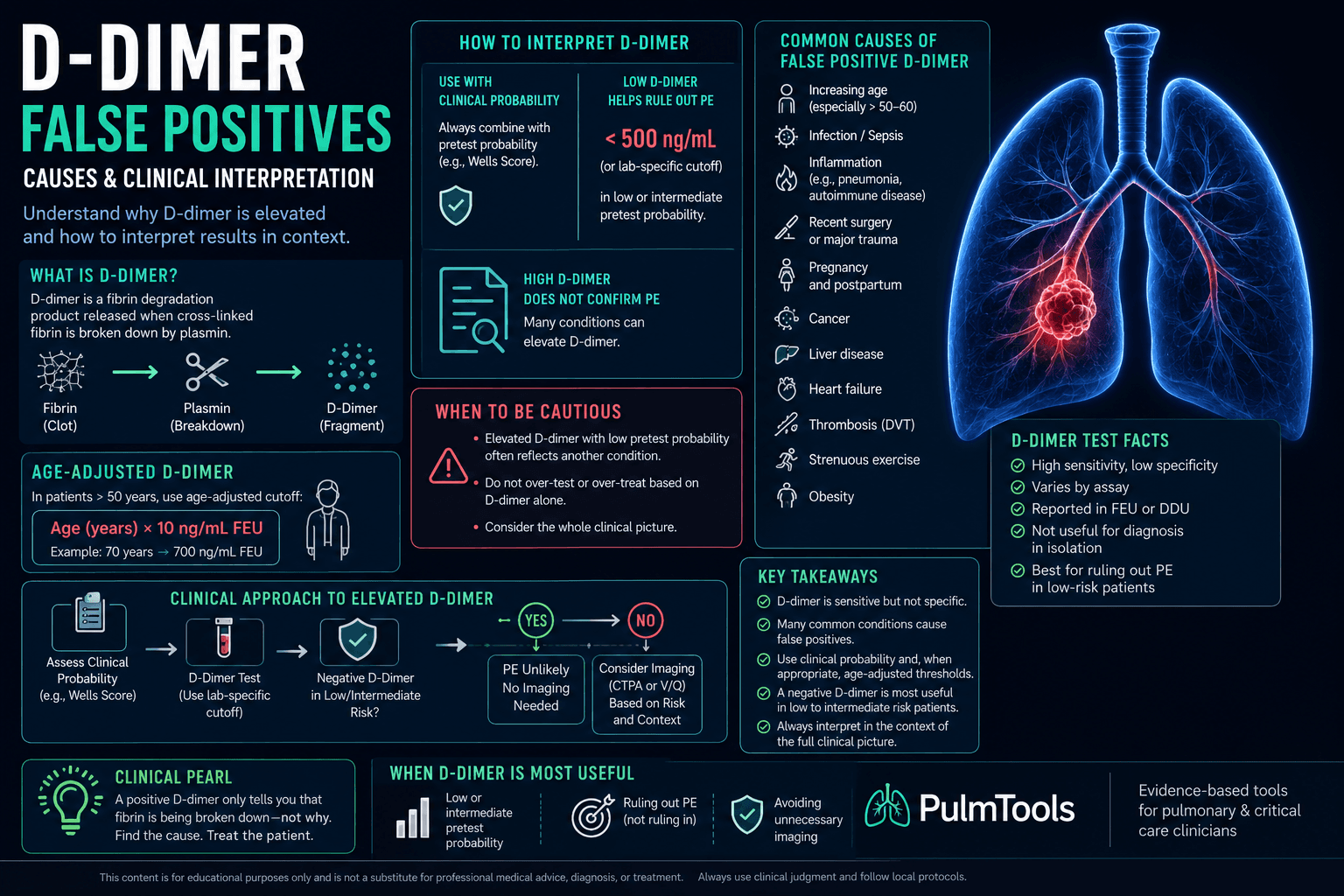
A positive D-dimer does not diagnose pulmonary embolism. D-dimer is highly sensitive but poorly specific.
Why D-dimer becomes elevated
D-dimer is a breakdown product of cross-linked fibrin. Whenever the body forms and degrades clot material, D-dimer levels may rise.
Pulmonary embolism is one cause, but it is far from the only cause. This is why D-dimer is useful as a rule-out test rather than a rule-in test. The value of the result depends on clinical probability, not the number alone.
Infection
Sepsis, pneumonia, viral illness, and systemic infection.
Inflammation
Autoimmune disease and inflammatory states.
Cancer
Malignancy often increases baseline D-dimer levels.
Trauma / Surgery
Tissue injury activates coagulation pathways.
Most common causes of false positive D-dimer
- Advanced age
- Pregnancy
- Recent surgery
- Trauma
- Hospitalization
- Infection
- Inflammation
- Cancer
- Liver disease
- Critical illness
Why D-dimer works well for rule-out
Despite poor specificity, D-dimer has excellent sensitivity in appropriately selected patients. A negative result can help exclude PE when combined with proper clinical probability assessment, especially inside a structured low-risk PE rule-out pathway.
This is why D-dimer is commonly paired with the Wells Score, PE likely vs PE unlikely Wells interpretation, PERC Rule, and YEARS Algorithm.
Age-adjusted D-dimer
Older adults frequently have elevated baseline D-dimer levels. Using age-adjusted D-dimer thresholds improves specificity and reduces unnecessary imaging in appropriately selected patients.
What should happen after a positive D-dimer?
A positive D-dimer does not automatically mean CT imaging, and it does not diagnose PE. Clinicians should consider pretest probability, patient factors, local protocol, and whether imaging is needed. If imaging is required, the next choice is often CTPA versus V/Q scanning depending on contrast risk, pregnancy, chest X-ray findings, renal function, and availability.
For a complete workflow, see the Pulmonary Embolism Diagnostic Algorithm.
Use the PulmTools PE Toolkit
Apply Wells Score, PERC, D-dimer logic, age-adjusted D-dimer, and pulmonary embolism decision support in a single workflow. For symptom-driven evaluation, start with PE symptoms and clinical clues, then move into formal risk stratification.
Open ToolkitEducational content only. Clinical decision-making should always incorporate patient presentation, pretest probability, local protocols, and clinician judgment.