PERC Rule for Pulmonary Embolism:Complete Clinical Guide
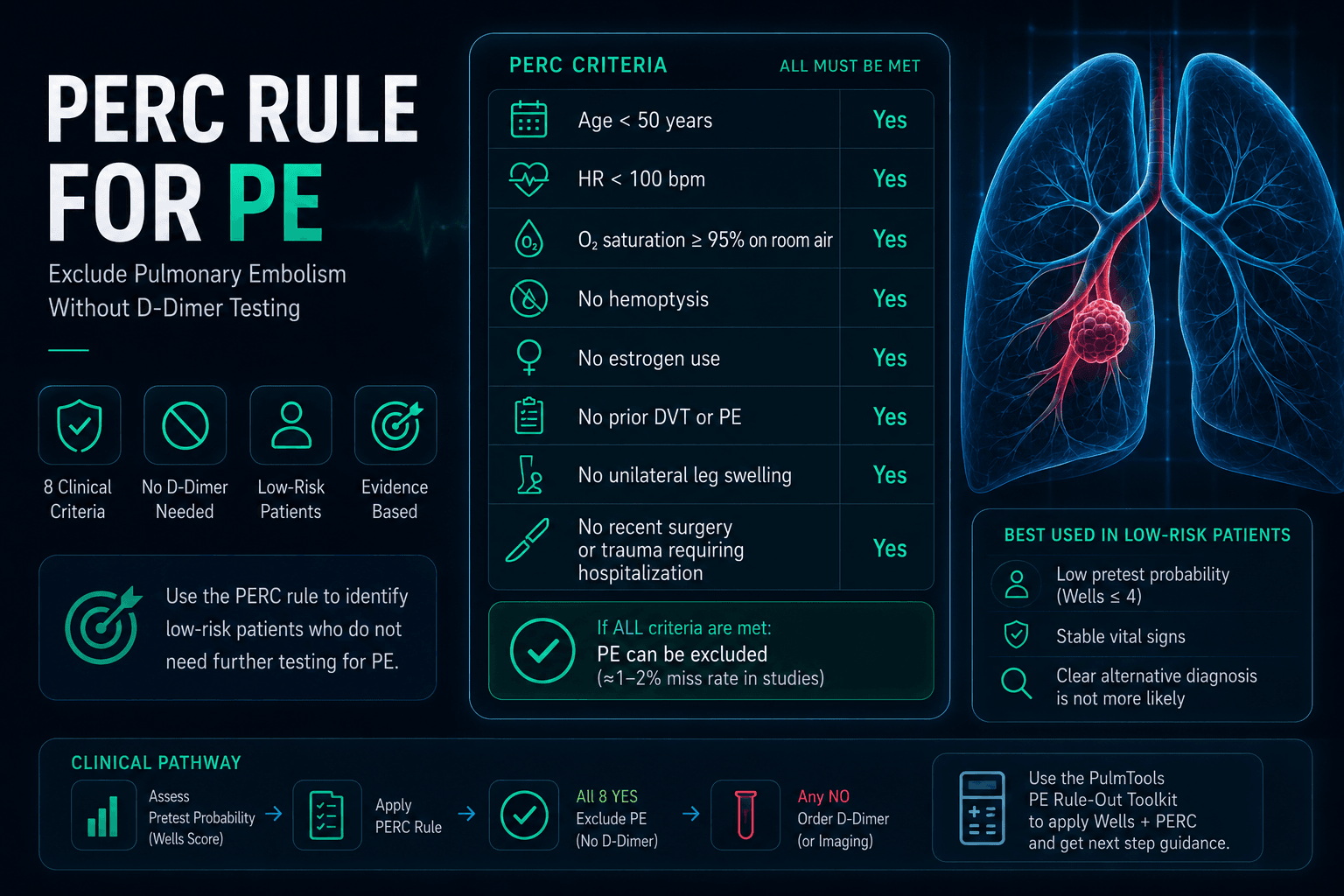
The Pulmonary Embolism Rule-out Criteria (PERC) helps clinicians identify low-risk patients who may not require D-dimer testing or imaging during evaluation for pulmonary embolism. When applied to the correct patient population, the PERC rule can reduce unnecessary testing while maintaining patient safety.
Calculate PERC and Wells Score Instantly
Use the PulmTools PE Rule-Out Toolkit to calculate Wells Score, apply PERC criteria, interpret D-dimer strategy, and receive evidence-based diagnostic pathway guidance.
Open Wells + PERC CalculatorWhat Is the PERC Rule?
The PERC Rule (Pulmonary Embolism Rule-out Criteria) is a clinical decision rule designed to identify patients with such a low probability of pulmonary embolism that additional testing may not be required.
Unlike Wells Score, which estimates pretest probability, PERC is intended to help rule out PE in patients who are already considered low risk by clinician gestalt. This makes it a key step in the low-risk PE rule-out pathway.
Bottom line:
PERC is not a general PE screening tool. It is a rule-out tool for carefully selected patients whose pretest probability is already low before the criteria are applied.
The 8 PERC Criteria
| Criterion | Must Be |
|---|---|
| Age | < 50 years |
| Heart rate | < 100 bpm |
| SpO₂ | ≥ 95% |
| Hemoptysis | Absent |
| Estrogen use | Absent |
| Previous DVT or PE | Absent |
| Unilateral leg swelling | Absent |
| Recent surgery or trauma | Absent |
Every criterion must be satisfied for the patient to be considered PERC negative. If even one criterion is not satisfied, the patient is PERC positive and PE cannot be excluded by PERC alone.
When Should You Use PERC?
Appropriate Use
PERC should only be used when the clinician already believes the patient is low risk for pulmonary embolism. Symptoms and risk factors still matter, so start with PE symptoms and clinical clues before applying the shortcut.
Common Mistake
PERC should not be used to rescue a patient with intermediate or high pretest probability. If Wells Score suggests moderate or high risk, or if the patient is PE likely by the two-tier Wells model, move to a D-dimer or imaging pathway instead.
PERC vs Wells Score
Wells Score and PERC are complementary tools, not competing tools. Wells estimates probability. PERC is only applied after the patient is already judged low risk.
Wells Score
Estimates pretest probability of pulmonary embolism.
PERC Rule
Helps rule out PE without D-dimer testing in carefully selected low-risk patients.
Clinical Workflow
Estimate risk with Wells → If low risk, consider PERC → If PERC positive, obtain D-dimer → If D-dimer positive, proceed to definitive imaging such as CTPA or V/Q scanning.
What Happens If PERC Is Positive?
Failing even one PERC criterion makes the patient PERC positive. This does not diagnose pulmonary embolism—it simply means PE cannot be excluded using the PERC rule alone.
Depending on overall clinical probability, D-dimer testing is often the next step. Positive D-dimer results do not diagnose PE, but they may require definitive imaging. For false-positive context, see the PulmTools guide to D-dimer false positives.
Practical interpretation
PERC positive means the shortcut is no longer available. The next step should be based on the full clinical picture, Wells Score, local D-dimer strategy, age-adjusted D-dimer, imaging availability, renal function, contrast risk, pregnancy status, and hemodynamic stability.
See the Complete PE Diagnostic Pathway
PERC is one branch of a larger diagnostic sequence. The full pathway includes pretest probability, PERC, D-dimer, age-adjusted D-dimer, YEARS-style strategies, and imaging selection.
Read Full PE AlgorithmRelated PE Resources
PE Rule-Out Toolkit
Apply Wells, PERC, D-dimer, age-adjusted D-dimer, and PE rule-out logic in one workflow.
Low-Risk PE Rule-Out Pathway
Review the practical bedside sequence: low gestalt, PERC, D-dimer, then imaging only if needed.
Pulmonary Embolism Diagnostic Algorithm
See how PERC fits into the complete PE workup from symptoms to imaging.
Wells Score for Pulmonary Embolism
Estimate pretest probability before deciding whether PERC or D-dimer is appropriate.
D-Dimer for Pulmonary Embolism
Understand when D-dimer helps after PERC is positive and why positive results are nonspecific.
PE Likely vs PE Unlikely
Understand when two-tier Wells interpretation points toward D-dimer versus imaging.
Age-Adjusted D-Dimer
Use age-adjusted thresholds in selected older adults when D-dimer testing is appropriate.
CTPA vs V/Q Scan
Compare imaging options when PE cannot be excluded by clinical pathway or D-dimer.