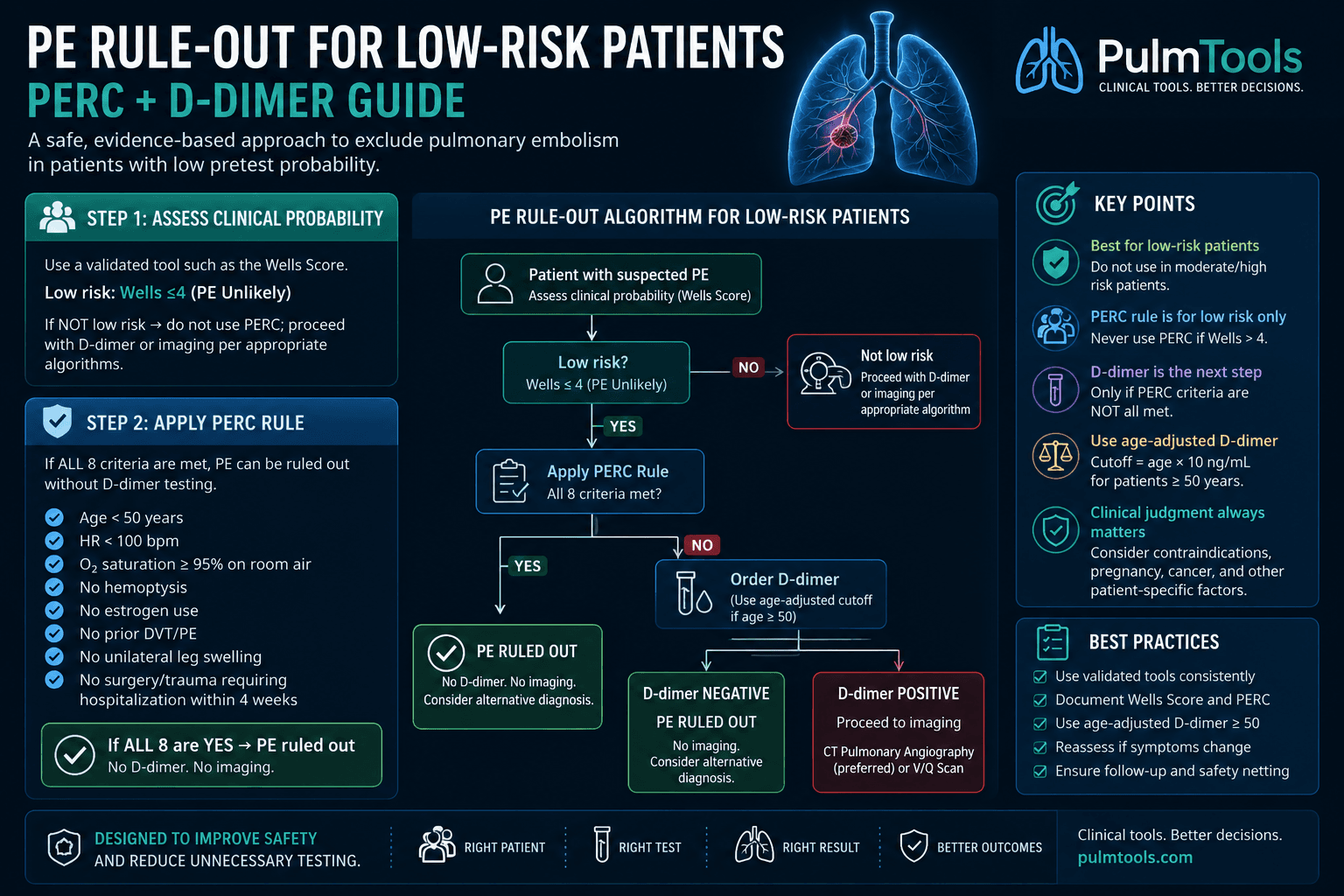
The low-risk pulmonary embolism pathway
Modern PE evaluation follows a stepwise approach. Rather than immediately ordering CT imaging, clinicians first estimate pretest probability and determine whether PE can be excluded using validated decision rules. For the broader pathway, review the PulmTools pulmonary embolism diagnostic algorithm.
Practical PE Rule-Out Workflow
Step 1: Estimate clinical probability
Before applying PERC or D-dimer, clinicians should determine whether PE is reasonably suspected. This may involve clinical gestalt, the Wells Score, or another validated assessment method.
If the patient appears moderate- or high-risk, PERC should not be used as the primary exclusion strategy. If the patient is PE likely by two-tier Wells, imaging is usually considered instead of relying on D-dimer alone.
Step 2: Apply the PERC rule
The Pulmonary Embolism Rule-Out Criteria (PERC) is designed for very-low-risk patients.
- PERC negative → PE may be excluded in an appropriately selected very-low-risk patient.
- PERC positive → proceed to D-dimer testing.
Step 3: D-dimer testing
Patients who are not PERC negative often move to D-dimer testing.
A negative D-dimer can help exclude PE in appropriately selected low-risk patients. Older adults may benefit from age-adjusted D-dimer thresholds, while positive results should be interpreted with awareness of D-dimer false positives.
Step 4: Imaging when PE remains possible
If D-dimer is positive or clinical concern remains elevated, imaging may be required. The next decision is often CTPA versus V/Q scan, depending on contrast risk, renal function, pregnancy considerations, chest X-ray findings, and local availability.
Imaging options include:
- CT Pulmonary Angiography (CTPA)
- Ventilation-Perfusion (V/Q) Scan
Learn more: CTPA vs V/Q Scan
Where YEARS fits
The YEARS algorithm modifies D-dimer thresholds based on three clinical criteria and can reduce unnecessary imaging in selected patients. It is another structured alternative to a simple Wells → PERC → D-dimer workflow.
Common mistakes
- Using PERC in moderate- or high-risk patients.
- Ordering D-dimer in clearly high-risk patients.
- Ignoring age-adjusted D-dimer thresholds.
- Proceeding directly to CT in every low-risk patient.
- Ignoring symptoms, risk factors, or clinical deterioration that should override a low-risk pathway.
PulmTools PE Rule-Out Toolkit
Apply Wells Score, PERC, D-dimer logic, age-adjusted D-dimer thresholds, and pulmonary embolism decision support in one workflow. Start with PE symptoms and clinical clues when the presentation is unclear.
Open ToolkitRelated PE Resources
PE Rule-Out Toolkit
Apply Wells, PERC, D-dimer, age-adjusted D-dimer, and PE rule-out logic in one workflow.
Pulmonary Embolism Diagnostic Algorithm
See how low-risk PE rule-out fits into the full pathway from symptoms to imaging.
PERC Rule for Pulmonary Embolism
Review the eight PERC criteria and when they should only be applied to very-low-risk patients.
D-Dimer for Pulmonary Embolism
Understand when D-dimer helps rule out PE and why positive results are nonspecific.
Age-Adjusted D-Dimer
Use age-adjusted thresholds in selected older adults when D-dimer testing is appropriate.
PE Likely vs PE Unlikely
Understand when two-tier Wells interpretation points toward D-dimer versus imaging.
Educational content only. Clinical decision rules support—but do not replace—clinical judgment, local protocols, and patient-specific assessment.