PulmTools Student ABG Workflow
ABG Interpretation Step-by-Step for Students
This page is built for students and early learners who want a faster, cleaner way to work through arterial blood gases without getting lost in too much detail. Think of it as a practice workflow: a simple sequence to memorize, common mistakes to avoid, and example cases to help you build speed before moving to more advanced bedside interpretation.
If you want the more complete clinician-facing reference, use our ABG Interpretation pillar guide. If you want to practice actively, jump into ABGenius. If you already have values and want bedside speed, use the ABG Analyzer.
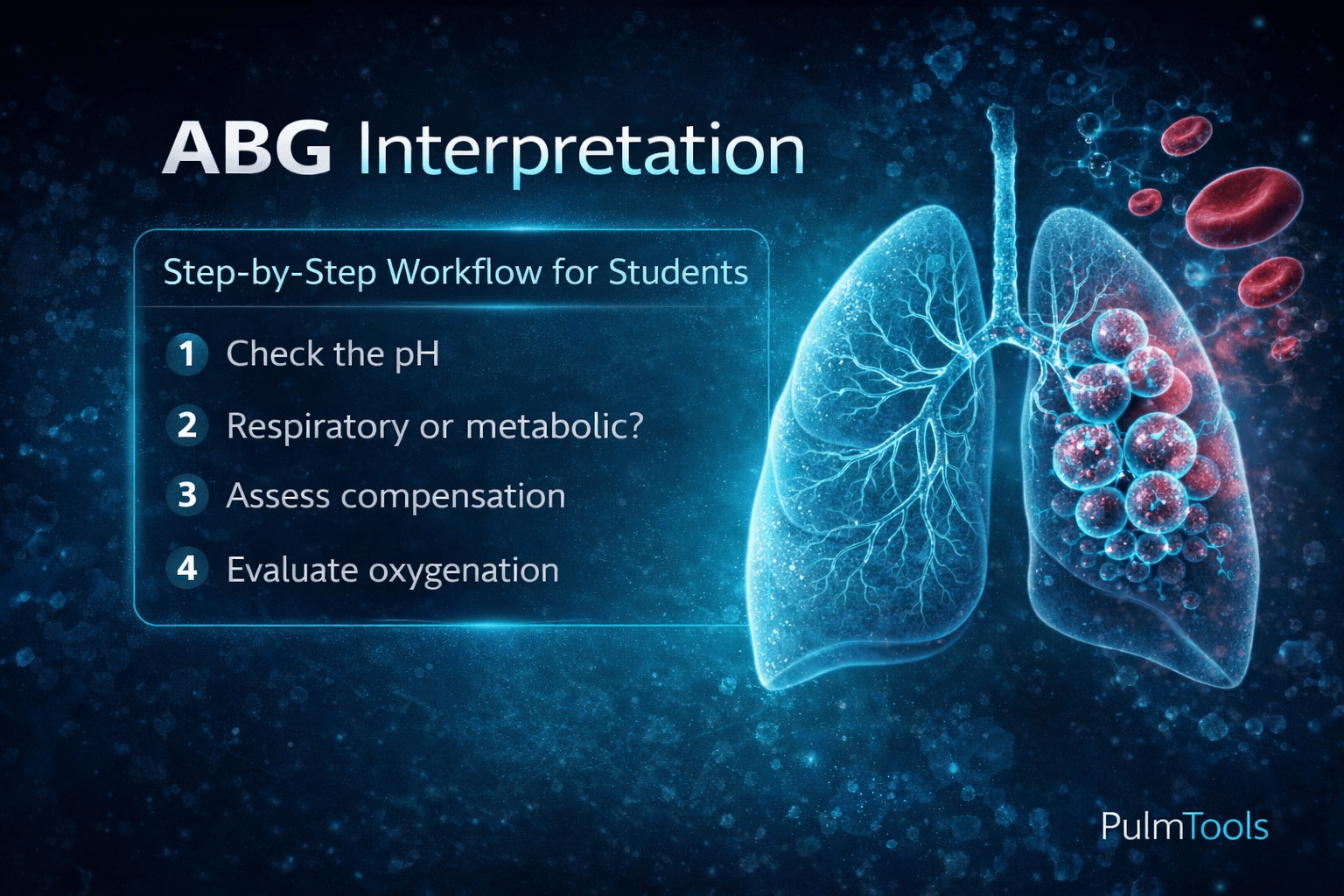
Memorize this 4-step ABG workflow
This is the version to memorize for tests, practice questions, and quick repetition. Keep it simple first, then add nuance later.
- Check the pH.
- Decide whether the main problem is respiratory or metabolic.
- Check whether compensation makes sense.
- Look at oxygenation last.
Which PulmTools ABG resource should you use?
This student workflow page
Best if you want the fastest, simplest path to understanding the ABG sequence and avoiding beginner mistakes.
ABG Analyzer
Best for bedside use when you already have a blood gas and want a fast interpretation with less mental math.
ABGenius
Best for building speed and retention with repeated case exposure, instant feedback, and realistic ABG pattern recognition.
Step-by-Step ABG Interpretation Workflow
1. Look at pH first
Decide whether the patient is acidemic (< 7.35) or alkalemic (> 7.45). This is your anchor. Do not skip this.
2. Check PaCO₂
PaCO₂ tells you about the respiratory side. High PaCO₂ pushes toward respiratory acidosis. Low PaCO₂ pushes toward respiratory alkalosis.
3. Evaluate HCO₃⁻
HCO₃⁻ tells you about the metabolic side. Low bicarbonate points toward metabolic acidosis. High bicarbonate points toward metabolic alkalosis.
4. Ask if compensation fits
Compensation should move in the expected direction. If it does not fit, start thinking about a mixed disorder. For metabolic acidosis, use Winter’s Formula.
5. Assess oxygenation last
Look at PaO₂ after the acid-base portion. If oxygenation needs deeper analysis, use the P/F ratio or A–a gradient.
Common mistakes students make with ABGs
These are some of the biggest reasons learners miss ABG questions:
- Starting with PaCO₂ instead of pH
- Mixing up the respiratory and metabolic components
- Calling compensation “normal” instead of understanding that the primary disorder is still present
- Forgetting to assess oxygenation after the acid-base interpretation
- Assuming compensation always makes the pH normal
Normal ABG values to memorize
- pH: 7.35 – 7.45
- PaCO₂: 35 – 45 mmHg
- HCO₃⁻: 22 – 26 mEq/L
- PaO₂: 80 – 100 mmHg
Mini self-check examples
Example 1
7.25 / 60 / 26 / 55
pH is low, PaCO₂ is high, and bicarbonate is still near normal. This fits acute respiratory acidosis with moderate hypoxemia.
Example 2
7.30 / 20 / 10 / 92
pH is low, bicarbonate is low, and PaCO₂ is also low in the compensatory direction. This fits partially compensated metabolic acidosis with normal oxygenation.
Example 3
7.48 / 32 / 24 / 88
pH is high and PaCO₂ is low, pointing toward respiratory alkalosis. This is a common ABG pattern to see in anxiety, pain, or early hypoxemic states.
What should you do next?
Want practice?
Use ABGenius if you want repeated cases, active recall, and faster pattern recognition.
Practice with ABGeniusNeed bedside speed?
Use the ABG Analyzer if you already have values and want a fast interpretation for real-world use.
Open ABG AnalyzerWant the full reference guide?
Read the broader ABG Interpretation pillar if you want a more complete clinician-facing reference page.
Open Full ABG GuideInternal links that help you go deeper
Once this student workflow feels natural, use these next pages to strengthen compensation logic, oxygenation interpretation, and mixed-disorder reasoning.