Advanced ABG Interpretation
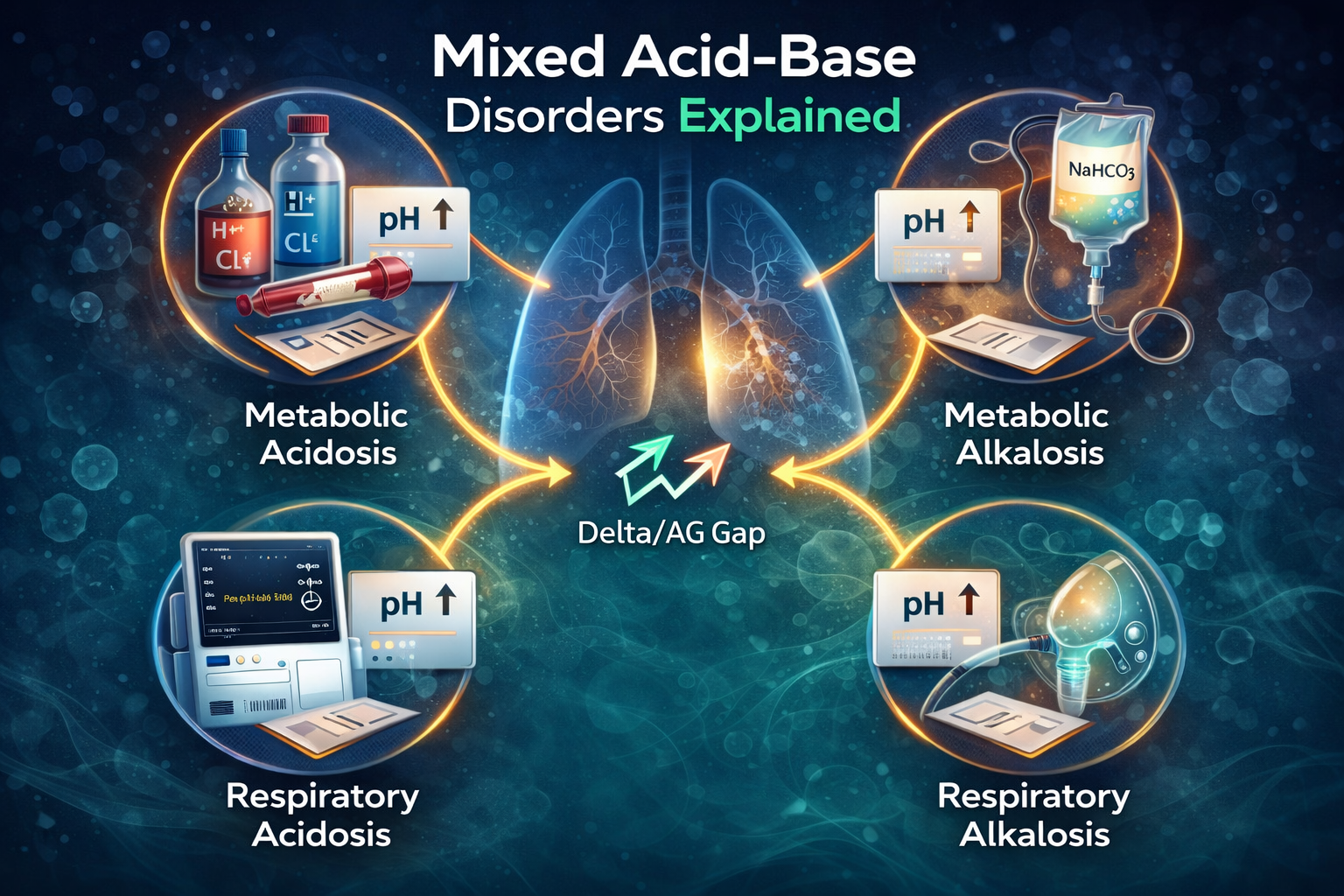
Mixed Acid-Base Disorders Explained
Mixed acid-base disorders happen when a patient has more than one acid-base problem at the same time. This is one of the highest-yield topics in ABG interpretation for respiratory therapy students, ICU learners, exam prep, and bedside clinical reasoning. The key idea is simple: if the numbers do not fit the expected compensation pattern, there may be a second disorder hiding in the blood gas.
Before tackling mixed disorders, make sure you are solid on the ABG Interpretation Guide, the Respiratory vs Metabolic Acidosis guide, our VBG vs ABG guide, and the Normal VBG Values page. Mixed disorder logic becomes much easier once the basics are automatic.
What Is a Mixed Acid-Base Disorder?
A mixed disorder means the patient has two or more primary acid-base problems at the same time. This is different from normal compensation. Compensation is the body responding predictably to a primary disorder. A mixed disorder means the blood gas values go beyond what normal compensation should produce.
High-yield rule: if the PaCO₂ or HCO₃⁻ does not match the expected compensation for the primary process, think mixed disorder.
Why Mixed Disorders Matter
Mixed disorders are common in critically ill patients. Missing them can lead to incorrect diagnoses, delayed treatment, or poor ventilator decisions. Many board-style ABG questions are built specifically to test whether you can tell the difference between normal compensation and a second acid-base problem.
- Sepsis can create metabolic acidosis plus respiratory alkalosis
- COPD plus vomiting can create respiratory acidosis plus metabolic alkalosis
- DKA plus drug overdose can create metabolic acidosis plus respiratory acidosis
Students often miss mixed disorders because they stop after identifying the first abnormality. Start with the ABG interpretation sequence, then ask whether the compensation actually fits.
How to Spot a Mixed Disorder
- Identify whether the blood is acidotic, alkalotic, or near normal.
- Determine the primary disorder using PaCO₂ and HCO₃⁻.
- Check whether compensation is appropriate.
- If the compensation is too much or too little, suspect a second process.
If you need the full step-by-step foundation first, review the ABG Interpretation Guide. If you are still learning the core distinction between primary processes, review Respiratory vs Metabolic Acidosis.
Common Mixed Patterns
Metabolic Acidosis + Respiratory Acidosis
Seen in DKA with fatigue, overdose, severe COPD + shock, or any situation where the patient cannot ventilate enough to compensate.
Metabolic Acidosis + Respiratory Alkalosis
Seen in sepsis, salicylate toxicity, liver failure, and some critically ill patients who are both acidotic and hyperventilating.
Respiratory Acidosis + Metabolic Alkalosis
Seen in chronic CO₂ retainers who are also vomiting, taking diuretics, or have volume contraction alkalosis.
Respiratory Alkalosis + Metabolic Alkalosis
Less common, but can occur with hyperventilation plus vomiting or aggressive diuresis.
Compensation Clues That Suggest a Mixed Disorder
- If metabolic acidosis is present, PaCO₂ should roughly follow expected compensation using Winter's Formula.
- If the measured PaCO₂ is higher than expected, there may be a concurrent respiratory acidosis.
- If the measured PaCO₂ is lower than expected, there may be a concurrent respiratory alkalosis.
- If a chronic respiratory acidosis has a bicarbonate that is much higher or lower than expected, think additional metabolic alkalosis or metabolic acidosis.
For a separate deep dive, your next high-value content page should be Winter's Formula and a future post on respiratory compensation. But even now, this page pairs tightly with your acid-base fundamentals.
Delta Gap Basics
In an anion gap metabolic acidosis, a delta gap helps you check for an additional metabolic disorder. You compare the rise in anion gap to the fall in bicarbonate.
- If bicarbonate falls more than expected, there may also be a non-anion gap metabolic acidosis.
- If bicarbonate falls less than expected, there may also be a metabolic alkalosis.
Delta gap is an advanced concept, but it is one of the best ways to detect a hidden second metabolic disorder on an exam or at the bedside.
Even if you are not using delta gap yet, you should still know the core difference between respiratory vs metabolic acidosis before trying to identify multiple overlapping disorders.
Worked ABG Examples
Example 1
pH 7.20 / PaCO₂ 55 / HCO₃⁻ 18
The bicarbonate is low, so metabolic acidosis is present. But the PaCO₂ is high instead of low, which means the lungs are not compensating correctly. This is a mixed metabolic acidosis + respiratory acidosis.
Example 2
pH 7.46 / PaCO₂ 28 / HCO₃⁻ 19
The patient is alkalemic, and PaCO₂ is low, suggesting respiratory alkalosis. But the bicarbonate is also low, which suggests a concurrent metabolic acidosis. This pattern can appear in sepsis or salicylate toxicity.
Example 3
pH 7.37 / PaCO₂ 60 / HCO₃⁻ 34
The near-normal pH can fool beginners. But PaCO₂ is clearly high and HCO₃⁻ is clearly elevated. This may represent chronic respiratory acidosis with compensation, but if the bicarbonate is higher than expected, think additional metabolic alkalosis.
Practice & Related Tools
Related Guides
FAQ
What is a mixed acid-base disorder?
A mixed acid-base disorder means a patient has more than one primary acid-base abnormality at the same time, not just normal compensation for one process.
How do you know if an ABG has a mixed disorder?
If the measured PaCO₂ or HCO₃⁻ does not match the expected compensation for the primary disorder, a second disorder may be present.
Can the pH be normal in a mixed disorder?
Yes. Some mixed disorders can push pH in opposite directions, making the pH look near normal even though multiple serious abnormalities are present.