PulmTools Blog
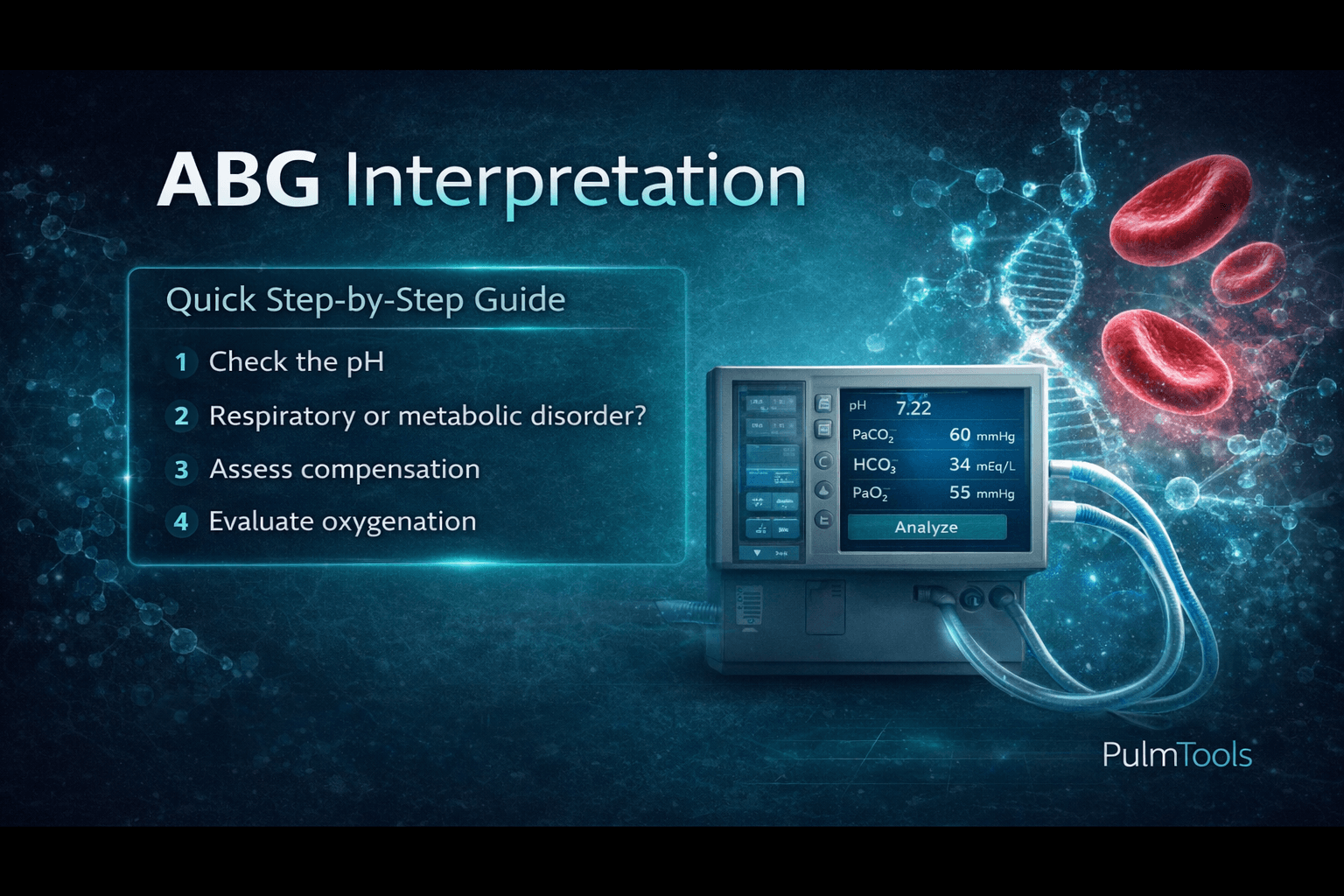
ABG Interpretation Step-by-StepSimple Guide for Clinicians
ABG interpretation is one of the most important bedside skills in respiratory care, critical care, emergency medicine, and hospital practice. This guide walks through a simple, repeatable method for interpreting arterial blood gases (ABGs) so you can quickly decide whether a patient has acidosis, alkalosis, a respiratory disorder, a metabolic disorder, compensation, and oxygenation problems. For related guides, see our VBG Interpretation Guide, VBG vs ABG comparison, and the ABG Analysis guide.
Use these alongside this guide
The quick ABG interpretation sequence
- Check the pH first.
- Decide whether the primary disorder is respiratory or metabolic.
- Assess whether compensation is present.
- Evaluate oxygenation with PaO₂.
If you want a faster bedside workflow after learning the logic, try the PulmTools ABG Calculator.
Step 1: Check the pH
Start with pH because it tells you whether the blood is overall acidic or alkalotic.
- Normal pH: 7.35–7.45
- Acidosis: pH below 7.35
- Alkalosis: pH above 7.45
Always anchor yourself here first. If the pH is low, think acidosis. If the pH is high, think alkalosis. Everything else should be interpreted in light of that first decision.
Step 2: Decide respiratory vs metabolic
Next, compare the pH direction to PaCO₂ and HCO₃⁻.
Respiratory component
PaCO₂ reflects the respiratory side of the ABG. A high PaCO₂ tends to make the pH go down, while a low PaCO₂ tends to make the pH go up.
Metabolic component
HCO₃⁻ reflects the metabolic side. A low bicarbonate pushes toward acidosis, while a high bicarbonate pushes toward alkalosis.
Simple pattern recognition
- Low pH + high PaCO₂ → respiratory acidosis
- High pH + low PaCO₂ → respiratory alkalosis
- Low pH + low HCO₃⁻ → metabolic acidosis
- High pH + high HCO₃⁻ → metabolic alkalosis
This helps you decide if the primary disorder is respiratory or metabolic.
Step 3: Assess compensation
Compensation means the body is trying to bring the pH back toward normal. It does not mean the primary disorder is gone — it means the body is responding.
Respiratory disorders
The kidneys compensate by changing bicarbonate over time. So in respiratory acidosis or alkalosis, look for HCO₃⁻ movement.
Metabolic disorders
The lungs compensate by changing ventilation. So in metabolic acidosis or alkalosis, look for PaCO₂ moving in the expected direction.
For metabolic acidosis, many clinicians use Winter’s Formula to estimate the expected PaCO₂:
You can also use our Winter’s Formula Calculator if you want the compensation math done automatically.
Step 4: Evaluate oxygenation
After the acid-base interpretation, check oxygenation using PaO₂. On room air, a typical normal PaO₂ is about 80–100 mmHg.
- Mild hypoxemia: PaO₂ 60–79 mmHg
- Moderate hypoxemia: PaO₂ 40–59 mmHg
- Severe hypoxemia: PaO₂ below 40 mmHg
Remember to interpret oxygenation in clinical context — especially FiO₂, altitude, and ventilator settings. For a deeper dive into oxygenation assessment, see our P/F Ratio guide.
ABG interpretation examples
Example 1
7.25 / 60 / 26 / 55
- pH low → acidosis
- PaCO₂ high → respiratory cause
- HCO₃⁻ normal → little or no metabolic compensation
- PaO₂ 55 → moderate hypoxemia
Interpretation: Uncompensated respiratory acidosis with moderate hypoxemia.
Example 2
7.30 / 20 / 10 / 92
- pH low → acidosis
- HCO₃⁻ low → metabolic cause
- PaCO₂ low → respiratory compensation
- PaO₂ 92 → normal oxygenation
Interpretation: Partially compensated metabolic acidosis with normal oxygenation.
Common ABG questions
How do you interpret an ABG step by step?
A simple ABG method is: check the pH first, decide whether the primary disorder is respiratory or metabolic, assess compensation, and then evaluate oxygenation with PaO₂.
What is a normal ABG?
Typical normal ABG values on room air are pH 7.35–7.45, PaCO₂ 35–45 mmHg, HCO₃⁻ 22–26 mEq/L, and PaO₂ 80–100 mmHg.
How do you tell if an ABG is respiratory or metabolic?
PaCO₂ reflects the respiratory component, while HCO₃⁻ reflects the metabolic component. Compare the direction of pH with PaCO₂ and HCO₃⁻ to identify the primary disturbance.
What is compensation in ABG interpretation?
Compensation is the body’s attempt to move pH back toward normal. Respiratory disorders are compensated metabolically by the kidneys, while metabolic disorders are compensated respiratorily by changes in ventilation.
Use the ABG calculator
Once you understand the step-by-step method, a calculator can speed things up at the bedside. Use the PulmTools ABG calculator to interpret pH, PaCO₂, HCO₃⁻, and PaO₂ in seconds.