Oxygenation and ARDS
P/F Ratio: Formula, Normal Range and ARDS Interpretation
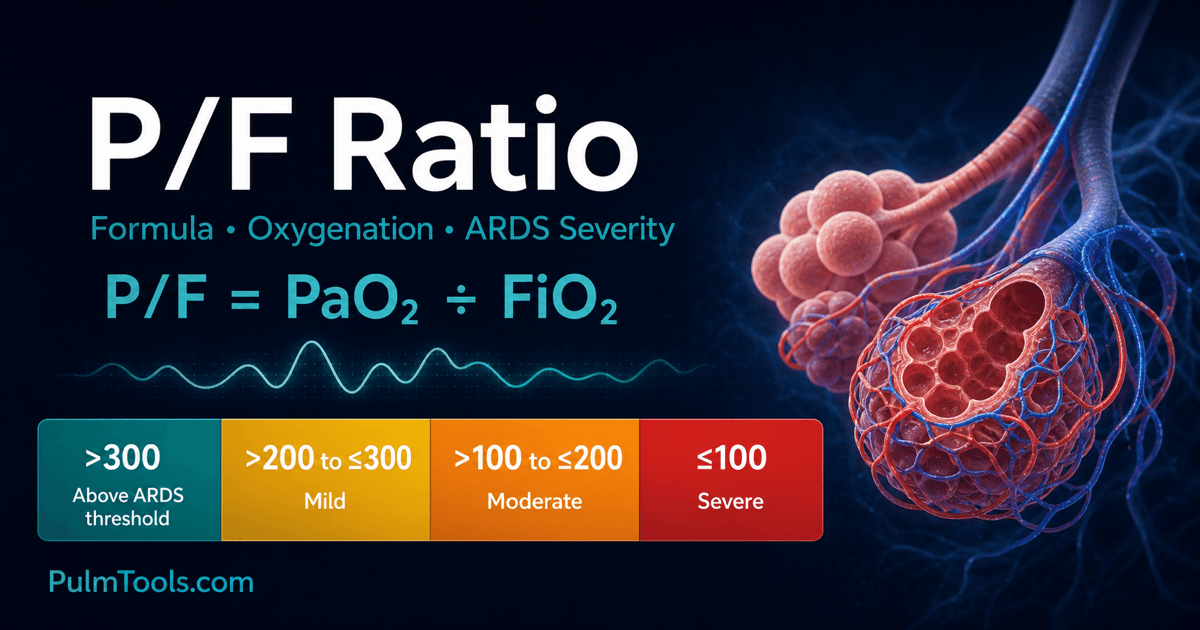
The P/F ratio compares arterial oxygen tension PaO₂ with the fraction of inspired oxygen FiO₂. It is a quick measure of oxygenation impairment and one component of ARDS severity assessment.
Quick answer
P/F ratio = PaO₂ ÷ FiO₂
Enter FiO₂ as a decimal. For example, PaO₂ 80 mmHg on 40% oxygen is calculated as 80 ÷ 0.40 = 200.
What is the P/F ratio?
The P/F ratio, also called the PaO₂/FiO₂ ratio, compares the oxygen pressure measured in arterial blood with the concentration of oxygen being delivered. Lower values generally indicate greater oxygenation impairment.
The ratio describes oxygenation; it does not identify the cause of hypoxemia and cannot diagnose ARDS by itself. Interpretation also depends on the accuracy of the FiO₂ estimate, applied pressure, altitude, timing, imaging, and the overall clinical picture.
For a broader evaluation, pair the ratio with the A–a gradient and a structured ABG interpretation.
How to calculate the P/F ratio
Step 1
Find the PaO₂
Use the arterial oxygen tension reported on the ABG in mmHg.
Step 2
Convert FiO₂ to a decimal
Convert 40% to 0.40, 60% to 0.60, or room air to approximately 0.21.
Step 3
Divide PaO₂ by FiO₂
Divide the PaO₂ value by the decimal FiO₂ value to obtain the P/F ratio.
What is a normal P/F ratio?
There is no single P/F ratio that proves oxygenation is normal in every patient. A value above 300 is above the Berlin ARDS oxygenation threshold, but it must still be interpreted alongside the patient's age, altitude, FiO₂, respiratory support, and clinical condition.
A declining value can be clinically meaningful even when it remains above an ARDS threshold. Trends should be interpreted with the rest of the respiratory assessment rather than as an isolated number.
P/F ratio chart for Berlin ARDS severity
The Berlin definition uses mutually exclusive P/F ratio ranges to grade oxygenation impairment after the other diagnostic criteria for ARDS have been evaluated.
| P/F ratio | Interpretation | Qualification |
|---|---|---|
| >300 | Above the Berlin ARDS oxygenation threshold | This does not necessarily prove normal oxygenation; interpret the value in clinical context. |
| >200 to ≤300 | Mild ARDS oxygenation range | Only when the remaining diagnostic criteria for ARDS are also satisfied. |
| >100 to ≤200 | Moderate ARDS oxygenation range | Only when the remaining diagnostic criteria for ARDS are also satisfied. |
| ≤100 | Severe ARDS oxygenation range | Only when the remaining diagnostic criteria for ARDS are also satisfied. |
Worked P/F ratio examples
Example 1: P/F ratio of 300
PaO₂ 90 mmHg and FiO₂ 0.30
90 ÷ 0.30 = 300
A P/F ratio of 300 falls within the mild ARDS oxygenation range under the Berlin definition, but ARDS cannot be diagnosed from the ratio alone.
Example 2: P/F ratio of 200
PaO₂ 80 mmHg and FiO₂ 0.40
80 ÷ 0.40 = 200
A P/F ratio of 200 falls within the moderate ARDS oxygenation range when the remaining ARDS criteria are satisfied.
Example 3: P/F ratio below 100
PaO₂ 55 mmHg and FiO₂ 0.80
55 ÷ 0.80 = 68.75
A P/F ratio of 68.75 falls within the severe ARDS oxygenation range when the remaining diagnostic criteria are satisfied.
Clinical uses of the P/F ratio
- Describe the degree of oxygenation impairment.
- Contribute to ARDS severity classification when all criteria are satisfied.
- Follow oxygenation trends after changes in respiratory support.
- Provide one data point within a broader respiratory assessment.
The ratio should not be used as the sole basis for treatment or escalation decisions. Pair it with the patient's trajectory, work of breathing, gas exchange, imaging, ventilator settings, and hemodynamic status.
Limitations of the P/F ratio
- The value changes with FiO₂, PEEP, recruitment, positioning, and other respiratory interventions.
- FiO₂ may be estimated rather than precisely known with some oxygen-delivery devices.
- The ratio identifies impaired oxygenation but does not explain its cause.
- Altitude and barometric pressure can affect interpretation.
- A single measurement may be less useful than a clinically consistent trend.
To investigate mechanisms of hypoxemia, review the A–a gradient guide. For acid-base and oxygenation assessment together, use the ABG analyzer.
Calculate the P/F ratio
Enter PaO₂ and FiO₂ in the PulmTools oxygenation calculator to calculate the ratio and review the result alongside oxygenation and ARDS guidance.
Frequently asked questions
How do you calculate the P/F ratio?
Divide the arterial oxygen tension, PaO₂, by the fraction of inspired oxygen, FiO₂, expressed as a decimal. For example, a PaO₂ of 80 mmHg on an FiO₂ of 0.40 produces a P/F ratio of 200.
What is considered a normal P/F ratio?
There is no single universal normal cutoff. A P/F ratio above 300 is above the Berlin ARDS oxygenation threshold, but the result still depends on factors such as FiO₂ accuracy, PEEP, altitude, age, and the overall clinical situation.
What are the P/F ratio ranges for ARDS?
Under the Berlin definition, a P/F ratio greater than 200 through 300 is in the mild range, greater than 100 through 200 is in the moderate range, and 100 or less is in the severe range. The remaining ARDS criteria must also be satisfied.
Does a low P/F ratio automatically mean ARDS?
No. A low P/F ratio identifies impaired oxygenation but does not diagnose ARDS by itself. ARDS assessment also considers timing, chest imaging, the origin of pulmonary edema, and the applicable positive-pressure requirement.
References
- ARDS Definition Task Force. Acute respiratory distress syndrome: the Berlin Definition. JAMA. 2012;307(23):2526–2533. View the Berlin definition.
- Matthay MA, Arabi Y, Arroliga AC, et al. A new global definition of acute respiratory distress syndrome. American Journal of Respiratory and Critical Care Medicine. 2024. View the global definition.