Winter’s Formula (Metabolic Acidosis)
Expected PaCO₂ = 1.5 × HCO₃⁻ + 8 ± 2
Use Winter’s formula in metabolic acidosis to determine whether respiratory compensation is appropriate or whether a mixed disorder is present.
Learn the key compensation formulas for ABG interpretation, including Winter’s formula, metabolic alkalosis compensation, and acute vs chronic respiratory compensation rules. This step-by-step cheat sheet helps students identify whether compensation is appropriate or whether a mixed acid-base disorder is present.
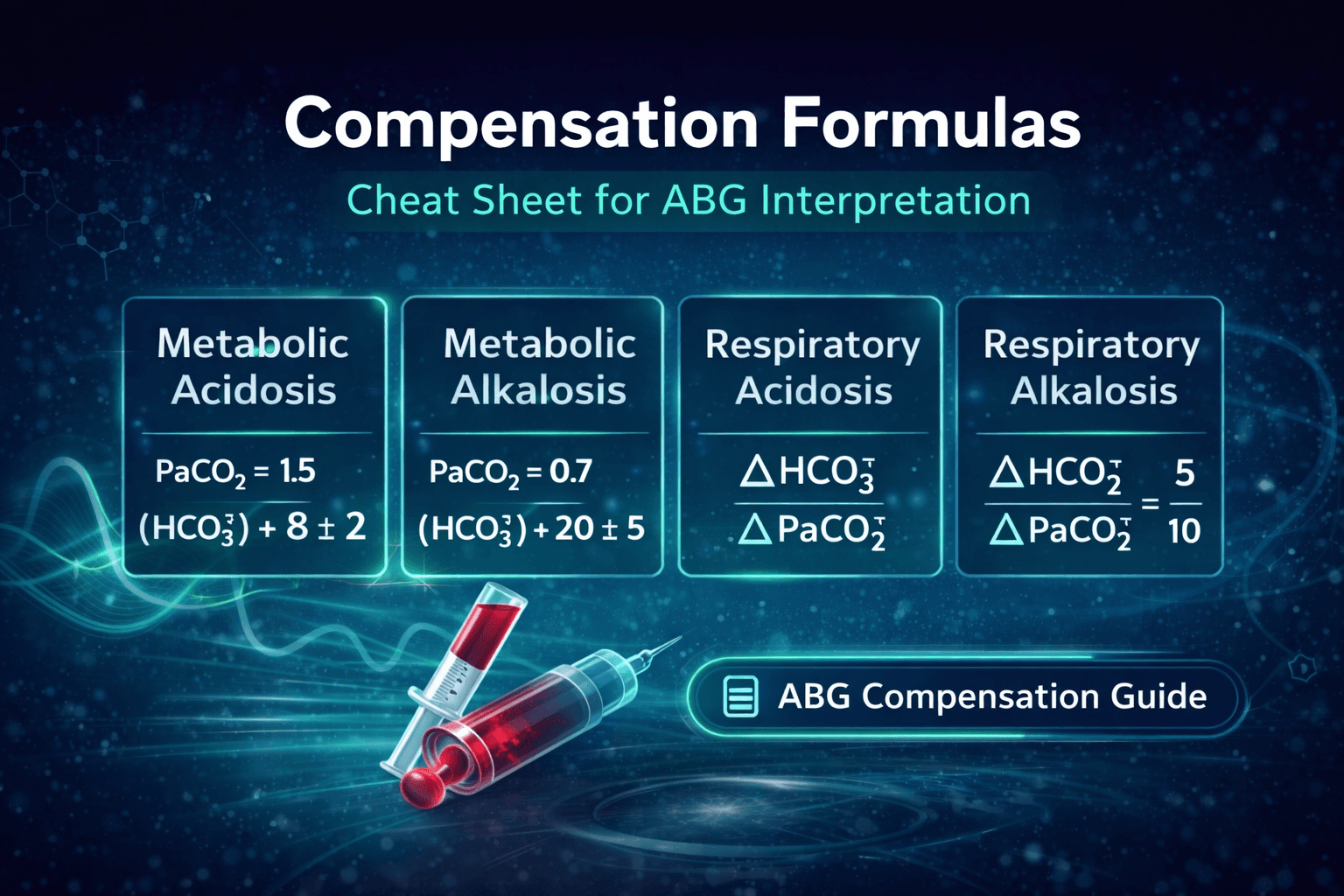
Compensation formulas are essential in acid-base interpretation because they help you decide whether the body is responding appropriately to a primary disturbance.
If the measured value is far from the expected compensatory range, the patient may have a mixed acid-base disorder rather than a single simple disorder.
Expected PaCO₂ = 1.5 × HCO₃⁻ + 8 ± 2
Use Winter’s formula in metabolic acidosis to determine whether respiratory compensation is appropriate or whether a mixed disorder is present.
Expected PaCO₂ ≈ 0.7 × (HCO₃⁻ − 24) + 40 ± 5
In metabolic alkalosis, PaCO₂ rises as the lungs retain carbon dioxide. Compare the actual PaCO₂ to the expected range to look for a second respiratory disorder.
HCO₃⁻ increases by ~1 mEq/L for every 10 mmHg rise in PaCO₂ above 40
Acute respiratory acidosis has limited renal compensation because the kidneys have not had time to retain much bicarbonate.
HCO₃⁻ increases by ~3.5–4 mEq/L for every 10 mmHg rise in PaCO₂ above 40
Chronic respiratory acidosis shows stronger renal compensation because the kidneys have had time to retain bicarbonate over days.
HCO₃⁻ decreases by ~2 mEq/L for every 10 mmHg drop in PaCO₂ below 40
In acute respiratory alkalosis, bicarbonate falls slightly as an early compensatory response.
HCO₃⁻ decreases by ~4–5 mEq/L for every 10 mmHg drop in PaCO₂ below 40
Chronic respiratory alkalosis produces a greater fall in bicarbonate because the kidneys have more time to excrete it.
Start by determining whether the main problem is metabolic or respiratory and whether it is acidosis or alkalosis.
Use the compensation rule that matches the primary disorder. Winter’s formula is used for metabolic acidosis, while separate rules apply for metabolic alkalosis and respiratory disorders.
Compute the expected PaCO₂ or HCO₃⁻ change and compare it to the patient’s measured value.
If the actual value is outside the expected range, consider an additional acid-base disturbance.
Use the PulmTools ABG calculator to check acid-base status, compensation, oxygenation, and apply these formulas to real clinical examples.