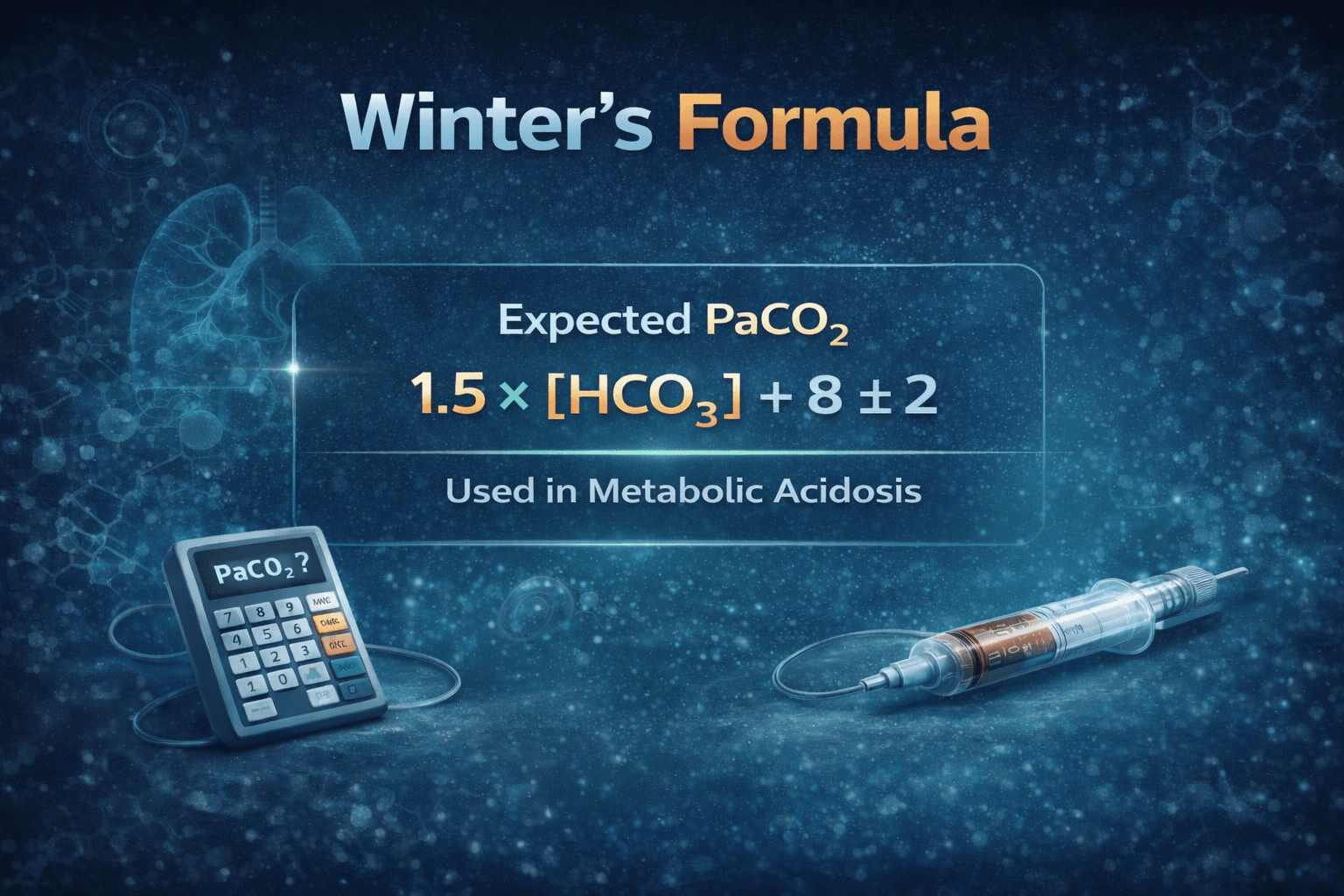
Winter's Formula Explained Step by Step

Learn how to use Winter's formula to calculate the expected PaCO₂ in metabolic acidosis, recognize appropriate respiratory compensation, and identify possible mixed acid-base disorders.

Winter's formula expected PaCO2 calculation for metabolic acidosis compensation using ABG values

What Is Winter's Formula?

Winter's formula is used in metabolic acidosis to estimate what the patient's PaCO₂ should be if the lungs are compensating appropriately.

It helps you answer a critical question: is the respiratory response appropriate, or is there a second acid-base problem?

Winter's Formula

Expected PaCO₂ = 1.5 × HCO₃⁻ + 8 ± 2

When Do You Use Winter's Formula?

Use it in metabolic acidosis

Start when the pH is low and the bicarbonate is low, suggesting a primary metabolic acidosis.

Check expected compensation

Calculate the expected PaCO₂ range and compare it to the actual measured PaCO₂ on the ABG.

Detect mixed disorders

If the PaCO₂ is too high or too low for the expected range, think mixed acid-base disorder.

How to Use Winter's Formula Step by Step

1. Confirm metabolic acidosis

Look for a low pH and a low HCO₃⁻. This tells you the primary disorder is metabolic acidosis.

2. Plug HCO₃⁻ into the equation

Multiply the bicarbonate by 1.5 and add 8.

3. Apply the ± 2 range

This gives you the expected PaCO₂ range rather than a single exact number.

4. Compare with the measured PaCO₂

If the actual PaCO₂ is within range, compensation is appropriate. If it is above or below that range, consider an additional respiratory disorder.

How to Interpret the Result

If measured PaCO₂ is within the expected range: respiratory compensation is appropriate.

If measured PaCO₂ is higher than expected: think metabolic acidosis plus respiratory acidosis.

If measured PaCO₂ is lower than expected: think metabolic acidosis plus respiratory alkalosis.

Worked Winter's Formula Examples

Example 1: Appropriate Respiratory Compensation

pH 7.28 / PaCO₂ 28 / HCO₃⁻ 12 / PaO₂ 90

Calculation: 1.5 × 12 + 8 = 26. Expected range: 24–28 mmHg.

Interpretation: The measured PaCO₂ is 28, which falls within the expected range. This means respiratory compensation is appropriate for the metabolic acidosis.

Example 2: Additional Respiratory Acidosis

pH 7.21 / PaCO₂ 36 / HCO₃⁻ 14 / PaO₂ 84

Calculation: 1.5 × 14 + 8 = 29. Expected range: 27–31 mmHg.

Interpretation: The measured PaCO₂ is higher than expected. That suggests the patient has metabolic acidosis plus a superimposed respiratory acidosis.

Example 3: Additional Respiratory Alkalosis

pH 7.32 / PaCO₂ 20 / HCO₃⁻ 11 / PaO₂ 96

Calculation: 1.5 × 11 + 8 = 24.5. Expected range: 22.5–26.5 mmHg.

Interpretation: The measured PaCO₂ is lower than expected. That suggests metabolic acidosis plus a superimposed respiratory alkalosis.

Common Mistakes Students Make

Use the ABG Calculator

After calculating Winter's formula by hand, use the PulmTools ABG calculator to check acid-base status, compensation, and oxygenation.

Open ABG Calculator

Related Guides