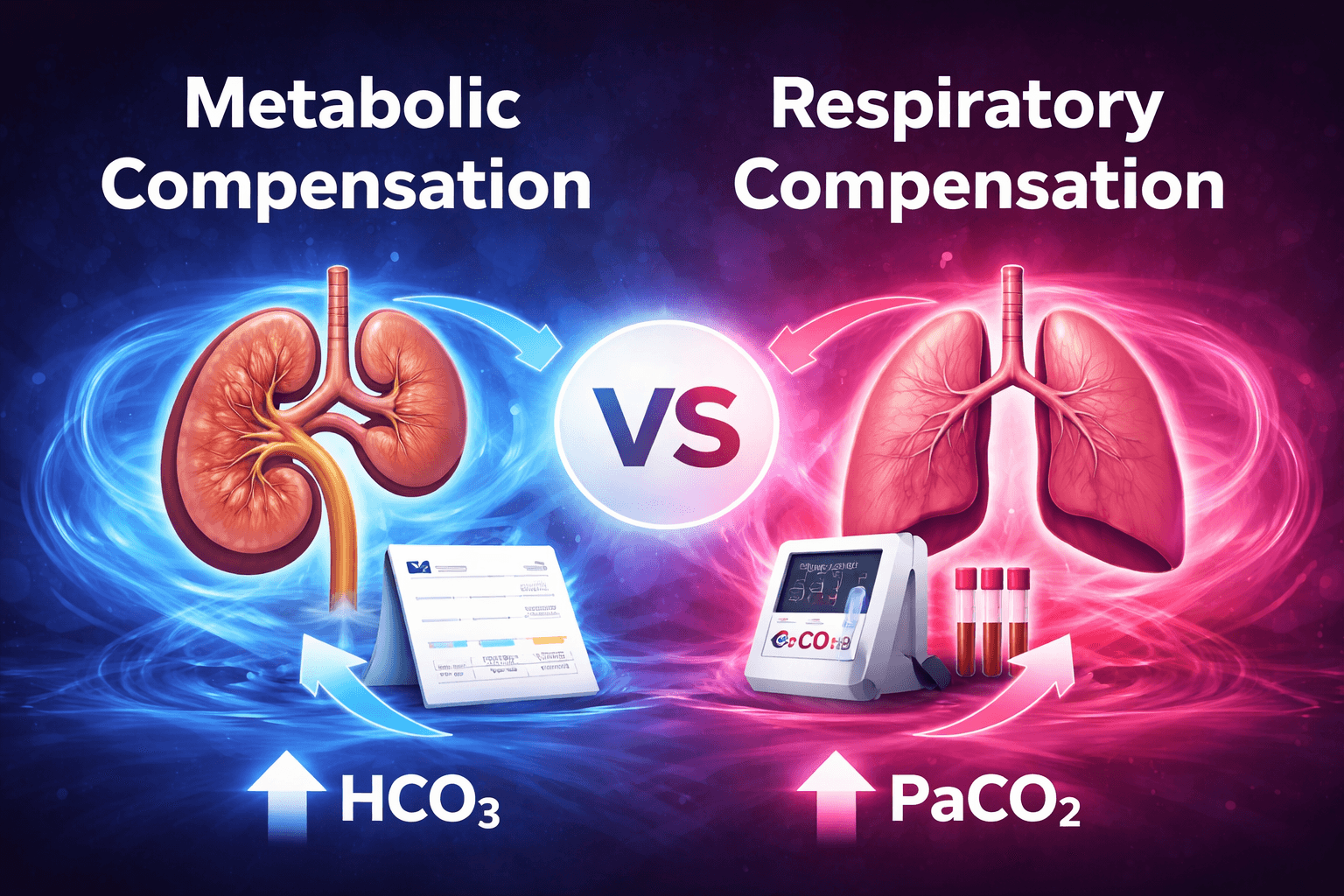
Metabolic vs Respiratory Compensation in ABG Interpretation

Learn the difference between metabolic and respiratory compensation in ABG interpretation, including how the lungs and kidneys respond, when compensation occurs, and how to recognize the expected pattern on arterial blood gases.

Metabolic vs respiratory compensation in ABG interpretation with acid-base calculation guide

What Is Compensation in ABG Interpretation?

Compensation is the body's attempt to reduce the pH disturbance caused by a primary acid-base disorder. In ABG interpretation, compensation does not fix the underlying problem. It simply helps move the pH closer to normal.

The key idea is simple: the lungs compensate for metabolic disorders, and the kidneys compensate for respiratory disorders.

Metabolic vs Respiratory Compensation: Quick Comparison

Feature
Metabolic Compensation
Respiratory Compensation
What changes?
The kidneys change bicarbonate (HCO₃⁻) to compensate for a primary respiratory disorder.
The lungs change PaCO₂ through ventilation to compensate for a primary metabolic disorder.
How fast does it happen?
Slower. Renal compensation takes hours to days.
Faster. Ventilatory compensation begins within minutes.
When do you see it?
In respiratory acidosis and respiratory alkalosis.
In metabolic acidosis and metabolic alkalosis.
Key lab to watch
HCO₃⁻ is the main compensatory variable.
PaCO₂ is the main compensatory variable.

Metabolic Compensation

Metabolic compensation happens when the kidneys adjust bicarbonate levels to respond to a primary respiratory disorder.

This is seen in respiratory acidosis and respiratory alkalosis. Because the kidneys work more slowly, metabolic compensation takes time.

Respiratory Compensation

Respiratory compensation happens when the lungs change ventilation to adjust PaCO₂ in response to a primary metabolic disorder.

This is seen in metabolic acidosis and metabolic alkalosis. Because breathing changes quickly, respiratory compensation happens much faster.

How to Differentiate Metabolic vs Respiratory Compensation Step by Step

1. Look at the pH

Decide whether the patient is acidotic or alkalotic first.

2. Find the primary disorder

Determine whether PaCO₂ or HCO₃⁻ best explains the pH change.

3. Identify the compensating system

If the primary problem is metabolic, the lungs compensate. If the primary problem is respiratory, the kidneys compensate.

4. Use the correct formula or rule

Use compensation formulas to see whether the response is appropriate or if a mixed disorder is likely.

Clinical Examples

Metabolic Acidosis with Respiratory Compensation

pH 7.28 / PaCO₂ 28 / HCO₃⁻ 12

This is a primary metabolic acidosis because the pH is low and HCO₃⁻ is low. The PaCO₂ is also low because the lungs are compensating by blowing off carbon dioxide.

See Winter’s Formula →

Respiratory Acidosis with Metabolic Compensation

pH 7.33 / PaCO₂ 60 / HCO₃⁻ 31

This is a primary respiratory acidosis because the PaCO₂ is high and the pH is acidotic. The bicarbonate is elevated because the kidneys are compensating.

See Compensation Formulas →

Common Mistakes

Use the ABG Calculator

Use the PulmTools ABG calculator to identify the primary disorder, evaluate compensation, and recognize possible mixed acid-base patterns.

Open ABG Calculator

Related Guides