ABG Compensation & Acid-Base
Winter's Formula Explained
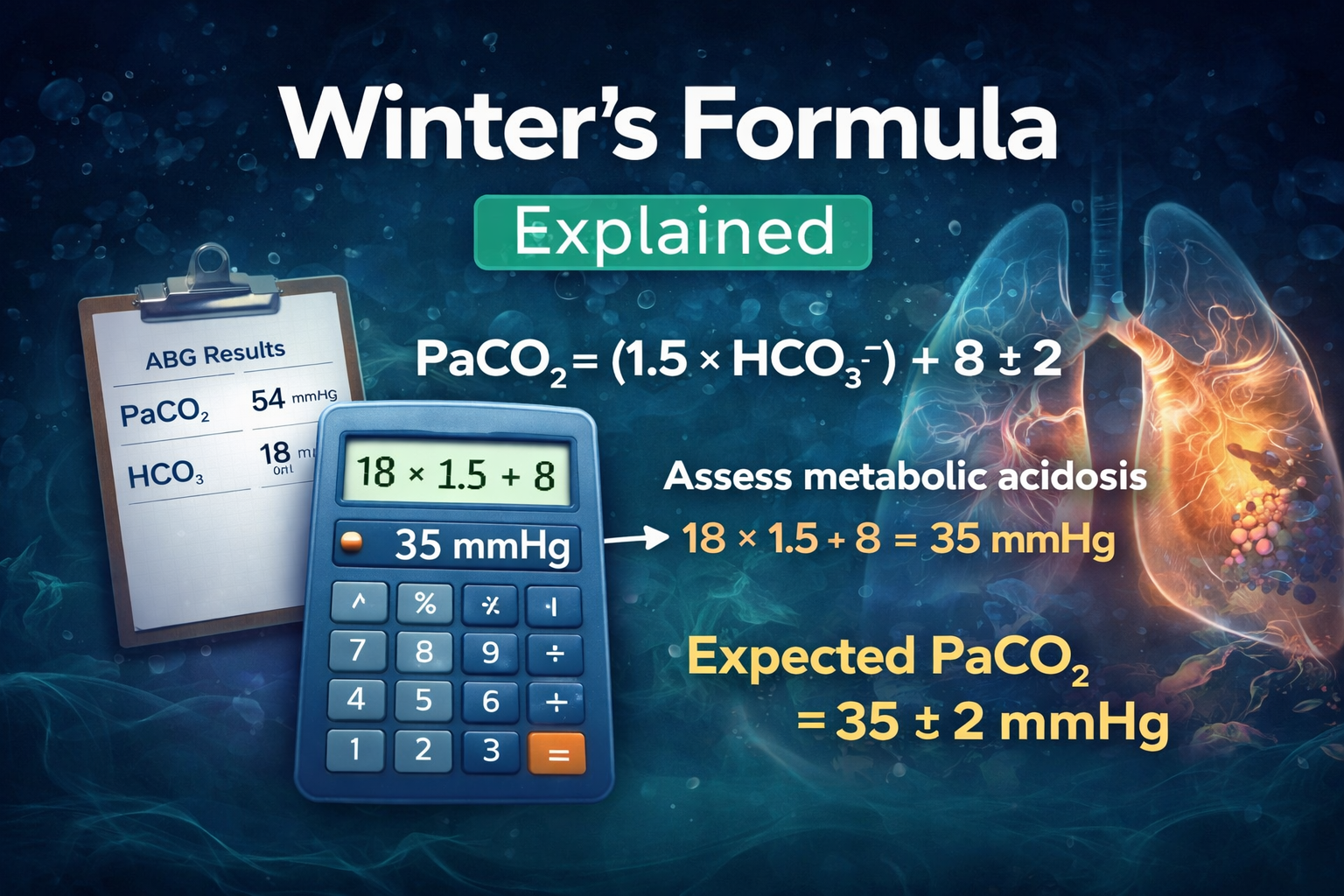
Winter's Formula is one of the most important ABG formulas for students, respiratory therapists, ICU clinicians, and anyone learning acid-base interpretation. It tells you the expected PaCO₂ in metabolic acidosis. In other words, it helps you decide whether the lungs are compensating appropriately — or whether a second respiratory disorder is present.
This page pairs directly with the ABG Interpretation Guide, our Respiratory vs Metabolic Acidosis guide, the Mixed Acid-Base Disorders guide, the VBG vs ABG guide, and our VBG Interpretation Guide, the ABG Calculator Guide, the ABG Practice Questions Guide. If you want to dominate ABG interpretation as a student, you need all of these concepts connected.
What Is Winter's Formula?
Winter's Formula estimates the expected respiratory compensation for a patient with metabolic acidosis. If the measured PaCO₂ matches the expected range, the lungs are compensating appropriately. If the measured PaCO₂ is too high or too low, there may be a mixed acid-base disorder.
This is one of the clearest ways to separate a simple metabolic acidosis from a mixed disorder involving the lungs.
It is most often used after you have already decided the patient has metabolic acidosis on a blood gas. That is why it fits naturally into a full ABG interpretation workflow.
The Formula
The bicarbonate value comes from the ABG or chemistry data, and the result gives you the expected PaCO₂ range if compensation is appropriate.
If you want the calculator version, use the Winter's Formula calculator. If you are still learning the broader clinical context, review Mixed Acid-Base Disorders.
Why It Matters
Metabolic acidosis should trigger compensatory hyperventilation. The lungs try to blow off CO₂ to push the pH back toward normal. Winter's Formula tells you whether that compensation is happening as expected.
- If PaCO₂ is in range → appropriate respiratory compensation
- If PaCO₂ is too high → concurrent respiratory acidosis
- If PaCO₂ is too low → concurrent respiratory alkalosis
This logic connects directly to the Mixed Acid-Base Disorders page and is a major exam favorite.
This compensation logic is one of the cleanest bridges between basic ABG interpretation and advanced mixed-disorder recognition. Students should know it alongside respiratory vs metabolic acidosis, ABG calculator interpretation, and ABG practice questions.
How to Use It Step by Step
- Confirm the patient has metabolic acidosis (low HCO₃⁻ driving the pH down).
- Plug the bicarbonate into Winter's Formula.
- Calculate the expected PaCO₂ range.
- Compare the expected PaCO₂ to the measured PaCO₂ on the ABG.
- Decide whether compensation is appropriate or whether a mixed disorder is present.
If you are still shaky on how to identify metabolic acidosis in the first place, review Respiratory vs Metabolic Acidosis and the ABG Interpretation Guide.
How to Interpret the Result
Measured PaCO₂ matches expected range
This suggests a simple metabolic acidosis with appropriate respiratory compensation.
Measured PaCO₂ is higher than expected
Think concurrent respiratory acidosis. The lungs are not blowing off enough CO₂.
Measured PaCO₂ is lower than expected
Think concurrent respiratory alkalosis. The patient is hyperventilating more than expected.
Worked Examples
Example 1: Appropriate Compensation
ABG: pH 7.28 / PaCO₂ 28 / HCO₃⁻ 13
Winter's Formula: (1.5 × 13) + 8 = 27.5 ± 2 → expected range about 25.5 to 29.5. The measured PaCO₂ of 28 is in range, so this is metabolic acidosis with appropriate respiratory compensation.
Example 2: Concurrent Respiratory Acidosis
ABG: pH 7.20 / PaCO₂ 40 / HCO₃⁻ 14
Winter's Formula: (1.5 × 14) + 8 = 29 ± 2 → expected range about 27 to 31. The actual PaCO₂ is 40, which is too high, suggesting metabolic acidosis + respiratory acidosis.
Example 3: Concurrent Respiratory Alkalosis
ABG: pH 7.32 / PaCO₂ 20 / HCO₃⁻ 12
Winter's Formula: (1.5 × 12) + 8 = 26 ± 2 → expected range about 24 to 28. The actual PaCO₂ is 20, which is lower than expected, suggesting metabolic acidosis + respiratory alkalosis.
These are the exact kinds of patterns that show up in exam questions and ICU practice. After you work through them here, reinforce the same logic in ABGenius and compare them to the deeper pattern recognition in Mixed Acid-Base Disorders.
Common Student Mistakes
- Using Winter's Formula when the primary disorder is not metabolic acidosis
- Forgetting the ± 2 range
- Stopping after finding metabolic acidosis without checking compensation
- Confusing compensation with a second primary disorder
This is exactly why Winter's Formula belongs in the same study cluster as mixed disorders, respiratory vs metabolic acidosis, and step-by-step ABG interpretation.
Practice & Related Tools
Related Guides
Build the Complete ABG Interpretation Framework
Winter's Formula is only one piece of ABG interpretation. To master acid-base analysis, learn how to identify the primary disorder, evaluate compensation, recognize mixed disorders, and apply oxygenation concepts together.
FAQ
What is Winter's Formula used for?
Winter's Formula is used to estimate the expected PaCO₂ in metabolic acidosis so you can determine whether respiratory compensation is appropriate.
What does it mean if PaCO₂ is higher than Winter's Formula predicts?
A higher PaCO₂ than expected suggests a concurrent respiratory acidosis in addition to the metabolic acidosis.
What does it mean if PaCO₂ is lower than Winter's Formula predicts?
A lower PaCO₂ than expected suggests a concurrent respiratory alkalosis in addition to the metabolic acidosis.