1
Patient effort rises
Pain, anxiety, acidosis, hypoxemia, fever, dyssynchrony, or obstructive physiology increases inspiratory drive.
PulmTools Resource
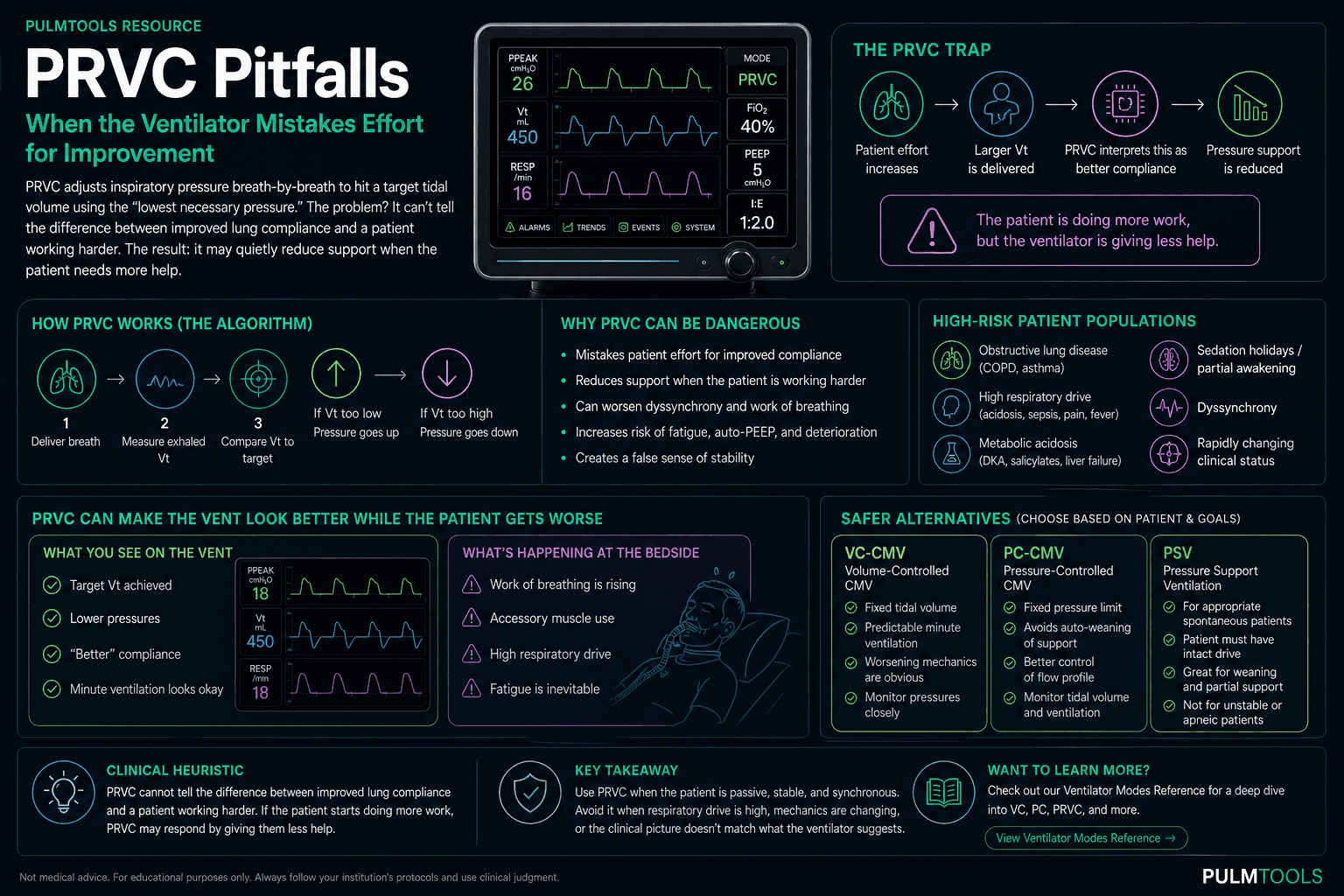
PRVC is a hybrid adaptive ventilator mode that automatically adjusts inspiratory pressure to achieve a target tidal volume. In the wrong patient, it can mistake rising patient effort for improved compliance and quietly reduce support when the patient needs more help.
What clinicians often miss
PRVC blends pressure-targeted breath delivery with a volume target. It is not the same as fixed pressure control or classic fixed volume control.
The ventilator measures delivered tidal volume and changes inspiratory pressure on later breaths to keep VT near the set target.
Because the algorithm seeks the lowest pressure needed to hit target VT, PRVC can function like automated pressure reduction when target volume is achieved.
Key point: Many clinicians do not realize PRVC is a hybrid adaptive mode built to automatically reduce support when target volume is achieved. That design becomes risky when target volume is achieved because the patient is working harder, not because the lungs are improving.
The PRVC trap
Pain, anxiety, acidosis, hypoxemia, fever, dyssynchrony, or obstructive physiology increases inspiratory drive.
The patient pulls harder, so exhaled tidal volume meets or exceeds the target even though the patient is doing more work.
The adaptive algorithm interprets the achieved volume as less pressure being needed on the next breath.
PIP may fall toward PEEP or MAP, sometimes triggering minimum-pressure alarms while work of breathing rises.
Minute ventilation can look acceptable until fatigue develops, then ETCO₂/PaCO₂ may rise late.
Bedside recognition
Lower pressure does not always mean improvement. In PRVC, it can mean the ventilator is shifting work onto the patient.
When pressure above baseline becomes minimal, the patient may be generating most of the breath themselves.
Some ventilators alarm when PRVC has reduced inspiratory pressure to its lower safety floor — essentially giving little support while target VT is still achieved by patient effort.
This can be falsely reassuring if the patient is maintaining those numbers through high effort rather than true mechanical improvement.
Believe the patient, not just the vent. Rising work of breathing with falling pressure is a PRVC red flag.
CO₂ rise can be a late sign after compensation fails. Waiting for hypercapnia may mean waiting until fatigue has already started.
Mode labels can mislead
For this reason, PulmTools uses non-company-specific terms such as VC-CMV, PC-CMV, and PSV when discussing alternatives. The label on the ventilator matters less than whether the mode is volume-controlled, pressure-controlled, pressure-supported, or adaptively targeting volume by changing pressure.
Safer alternatives
The safer choice depends on the patient and clinical goal. The point is not that PRVC is always wrong — it is that hidden auto-weaning behavior should not be allowed to mask distress.
VC-CMV
Useful when
You need predictable mandatory tidal volume and do not want an adaptive algorithm quietly reducing pressure because the patient pulled harder.
Watch closely
Monitor peak pressure, plateau pressure, driving pressure, expiratory time, flow, and lung-protective tidal volume targets.
PC-CMV
Useful when
You want fixed clinician-set inspiratory pressure and clearer pressure limitation without breath-to-breath adaptive auto-weaning.
Watch closely
Tidal volume is not guaranteed. Follow delivered VT, minute ventilation, CO₂, synchrony, and changing compliance/resistance.
PSV
Useful when
The patient is an appropriate spontaneous breather with intact drive, adequate strength, and a clear partial-support or weaning goal.
Watch closely
Not for unstable, apneic, severely fatigued, poorly compensating, or high-risk patients who need reliable mandatory support.
Pair this PRVC pitfalls guide with ventilator modes, troubleshooting, ARDSNet support, desired ventilation calculations, and dead space tools.