PulmTools Resource

RSI Intubation Checklist

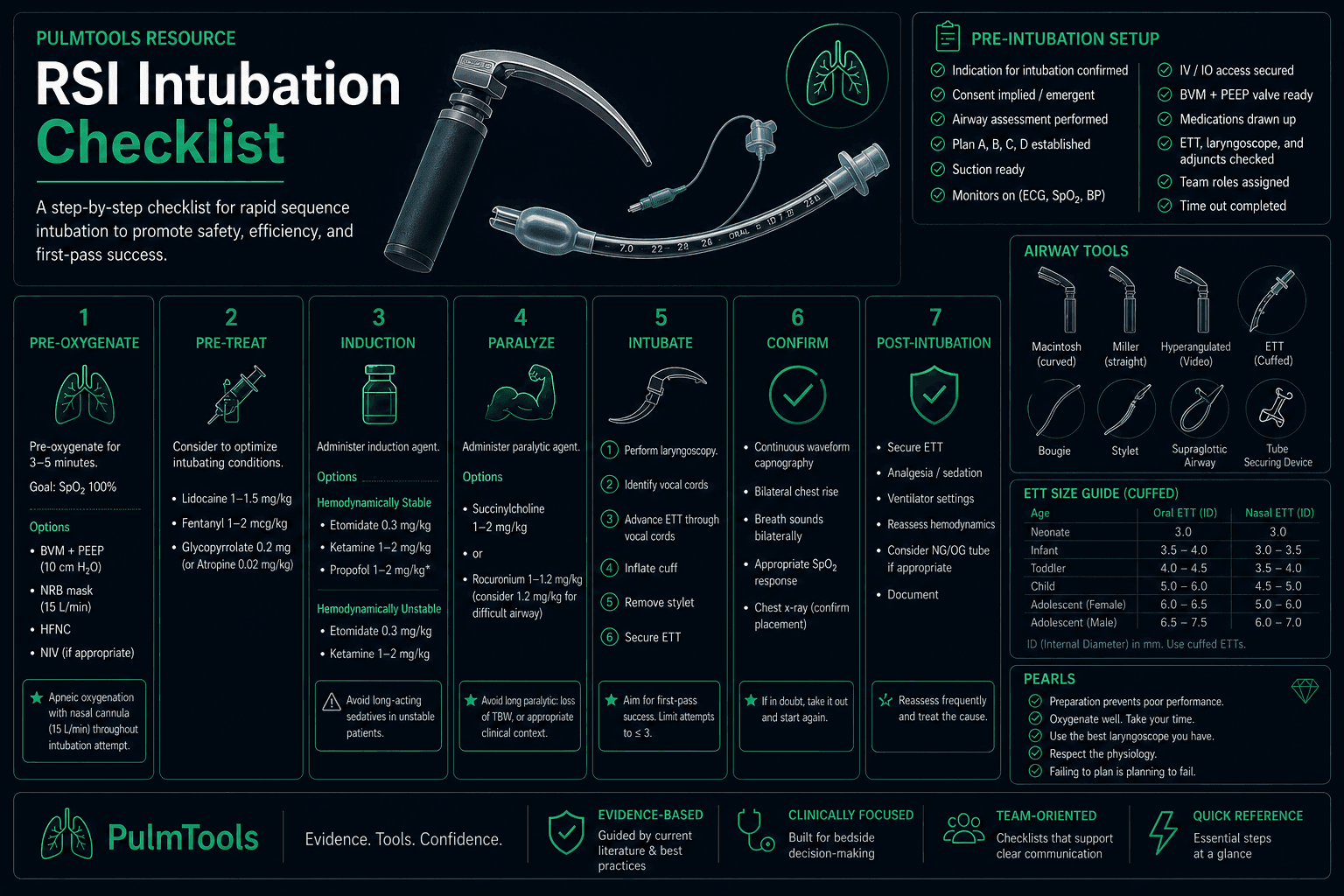
A premium rapid sequence intubation checklist for airway preparation, preoxygenation, induction, paralytic selection, first-pass optimization, ETT confirmation, ventilator transition, and post-intubation safety.

PreoxygenationAirway setupInductionParalyticsETT confirmationPost-intubation care
Safety note: RSI medication dosing, indications, contraindications, difficult airway management, and airway team roles are protocol-dependent. This page is an educational checklist and should not replace local airway policy, physician direction, or hands-on training.
PulmTools RSI intubation checklist for preoxygenation, induction, paralytics, ETT placement, confirmation, and post-intubation care

Prepare before drugs

RSI risk increases when medications are given before oxygenation, suction, backup airway, vasopressor, and post-intubation plans are ready.

Oxygenation is the priority

A fast intubation attempt should never distract from the core goal: maintain oxygen delivery and avoid preventable desaturation.

Confirm immediately

Endotracheal tube placement should be confirmed with CO₂ detection, clinical assessment, securement, and reassessment after ventilator connection.

Before the attempt

Pre-intubation setup checklist

Indication for intubation confirmed
Airway assessment completed
Team roles assigned and plan verbalized
Plan A / B / C / D established
IV / IO access secured
Suction ready and functional
BVM with PEEP valve ready
ETT, laryngoscope, bougie, stylet, and backup airway checked
Monitors on: ECG, SpO₂, BP, waveform capnography if available
Post-intubation sedation and ventilator plan prepared

Airway cart

Equipment to have ready

Bag-valve-mask with oxygen source
PEEP valve and appropriate mask size
Working suction with Yankauer and flexible catheter
Laryngoscope handle and backup handle
Macintosh / Miller / video laryngoscope blades
Endotracheal tubes: planned size plus one size smaller/larger
Stylet and bougie
Supraglottic airway rescue device
ETCO₂ detector or waveform capnography
Tube securing device and syringe for cuff inflation

Stepwise RSI workflow

Rapid sequence intubation checklist

1

Prepare and brief

Confirm indication, assign roles, verbalize the airway plan, prepare backup devices, and ensure post-intubation support is ready before medications are given.

  • Call for help early when airway difficulty is possible.
  • Plan for failed first attempt before the first attempt begins.
  • Prepare suction, BVM, airway adjuncts, rescue SGA, and surgical airway pathway when appropriate.
2

Preoxygenate

Maximize oxygen reserve before apnea. Use the best-tolerated method based on oxygenation, work of breathing, mental status, and aspiration risk.

  • Use tight-seal BVM + PEEP, NRB, HFNC, or NIV when clinically appropriate.
  • Aim for the highest safe SpO₂ before laryngoscopy while avoiding unnecessary hyperoxia in sensitive neonatal contexts.
  • Consider apneic oxygenation during laryngoscopy when feasible.
3

Optimize physiology

Resuscitate before intubating when possible. Hypotension, hypoxemia, severe acidosis, and shock increase peri-intubation arrest risk.

  • Treat hypotension and prepare push-dose or infusion vasopressors when indicated.
  • Correct equipment and positioning issues before escalating attempts.
  • Anticipate rapid desaturation in infants, pregnancy, obesity, severe pneumonia, and shock.
4

Induction

Choose an induction agent based on hemodynamics, neurologic status, bronchospasm, and local protocol.

  • Ketamine is often favored when hypotension or bronchospasm is a concern.
  • Etomidate is commonly used for hemodynamic neutrality where available.
  • Propofol can worsen hypotension and is often avoided in unstable patients.
5

Paralyze

Administer the paralytic after induction unless using a specific alternate pathway. Confirm ability to rescue oxygenation if the first attempt fails.

  • Rocuronium is common for RSI and has a longer duration.
  • Succinylcholine has faster offset but important contraindications.
  • Know local policy for neonatal, pediatric, emergency, and difficult airway scenarios.
6

Intubate

Position, suction, perform laryngoscopy, identify landmarks, pass the ETT through the cords, remove stylet, inflate cuff when used, and secure the tube.

  • Limit repeated attempts; optimize between attempts rather than repeating the same approach.
  • Use bougie or video laryngoscopy early when predicted difficulty or poor view occurs.
  • If oxygenation fails, return to oxygenation and backup airway plan immediately.
7

Confirm and stabilize

Confirm tube placement immediately and transition to post-intubation sedation, ventilation, and reassessment.

  • Use continuous waveform capnography when available; colorimetric ETCO₂ is better than no CO₂ confirmation.
  • Assess chest rise, bilateral breath sounds, SpO₂ response, tube depth, and hemodynamics.
  • Order CXR for depth confirmation after stabilization; do not delay immediate correction of suspected esophageal or mainstem placement.

Medication framing

Induction and paralytic notes

Induction agents

Common RSI induction choices include ketamine, etomidate, and propofol. Selection depends heavily on hemodynamics, bronchospasm, neurologic concern, age, and local protocol.

Paralytics

Common paralytics include rocuronium and succinylcholine. Contraindications, duration, airway risk, and rescue strategy should be considered before administration.

Pretreatment

Pretreatment practices vary. Routine pretreatment is not universal; use should be tied to local protocol and patient-specific physiology.

After the tube

Post-intubation analgesia and sedation are not optional after paralytic RSI. Prepare them before the attempt so the patient is not awake and paralyzed.

Tube confirmation

ETT confirmation checklist

  • Continuous waveform capnography or colorimetric ETCO₂ confirms tracheal placement
  • Bilateral chest rise observed
  • Bilateral breath sounds present with absent epigastric sounds
  • SpO₂ improves or remains appropriate for clinical context
  • ETT depth documented at teeth/lip or gum depending on age and local practice
  • Cuff pressure checked when cuffed ETT is used
  • Tube secured and ventilator/BVM connected
  • Chest radiograph obtained after stabilization to confirm depth

After the tube

Post-intubation checklist

  • Analgesia and sedation started promptly after tube placement
  • Ventilator settings selected for age, size, disease, and lung-protective goals
  • Blood pressure reassessed after induction, paralysis, and positive pressure ventilation
  • OG/NG tube considered when appropriate
  • ABG/VBG or ETCO₂ trend used to reassess ventilation
  • Tube depth, cuff pressure, restraints/securement, and skin protection documented

Related PulmTools resources and calculators

Pair this RSI checklist with airway, oxygenation, and ventilation references before moving into post-intubation blood gas interpretation and ventilator decision support.