PulmTools Resource
Neonatal & Pediatric Mechanical Ventilation Reference
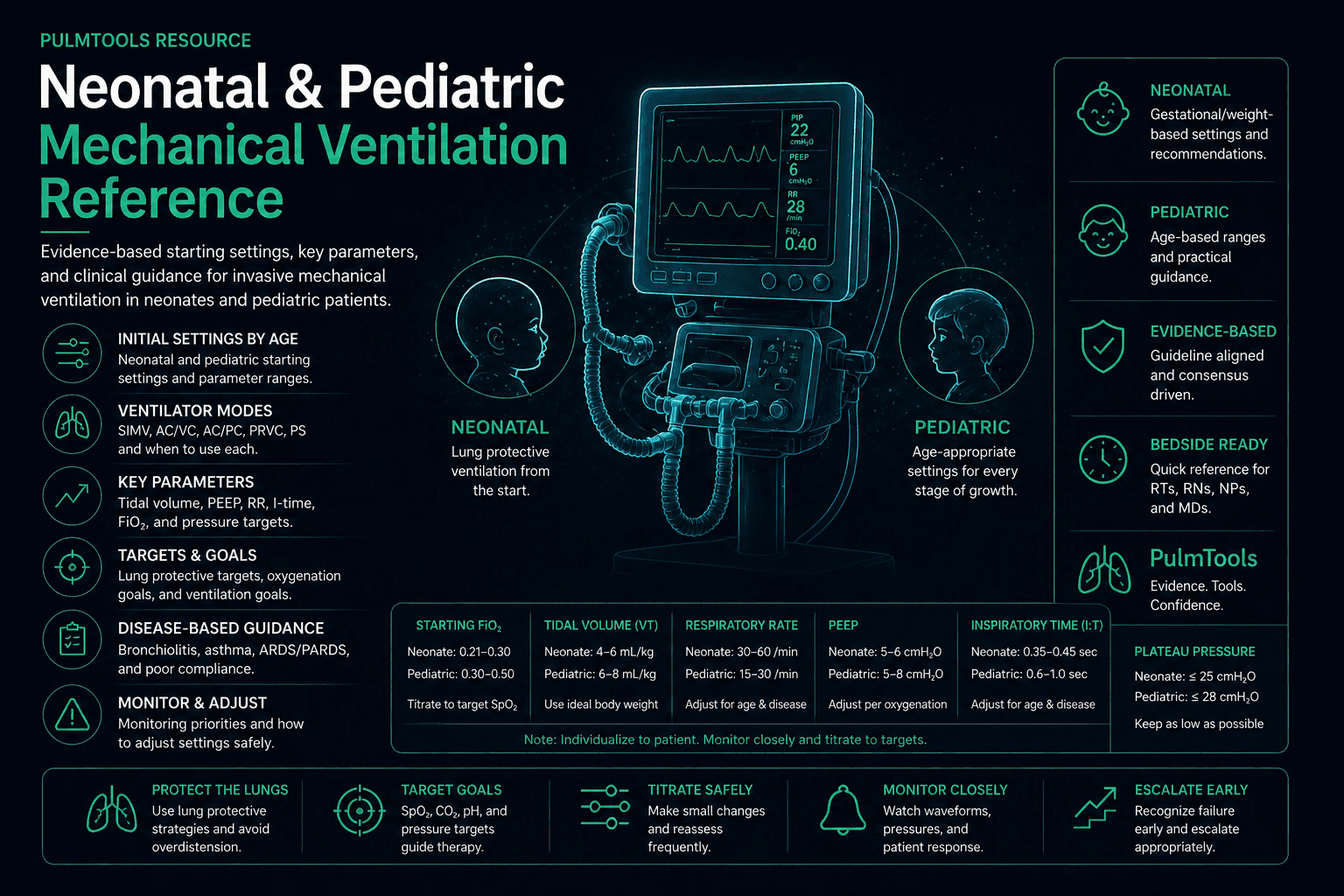
Evidence-informed bedside reference for neonatal and pediatric ventilator settings, SIMV / AC / PRVC modes, tidal volume targets, PEEP, respiratory rate, inspiratory time, oxygenation goals, and lung-protective ventilation. Built for RTs, RNs, NPs, PAs, physicians, and students who need practical starting points with clear safety context.
How to use this reference
Start with physiology, then set the ventilator
Use this page to frame initial settings and safety checks, not to override NICU, PICU, transport, anesthesia, or institutional protocols. Neonatal ventilation depends heavily on gestational age and lung disease. Pediatric ventilation depends on size, mechanics, oxygenation, ventilation, synchrony, and whether PARDS or obstructive physiology is present.
What this page covers
Practical starting ranges for invasive ventilation in neonates, infants, children, and adolescents with clear separation between neonatal and pediatric logic.
Lung-protective focus
Emphasizes low tidal volume, pressure awareness, oxygen titration, permissive hypercapnia when appropriate, and avoiding preventable ventilator-induced lung injury.
Not one-size-fits-all
Neonatal and pediatric ventilator settings vary by disease, anatomy, compliance, resistance, and local ICU/NICU practice.
Neonatal ventilation
Neonatal initial ventilator settings
Neonatal ventilation is highly dependent on gestational age, lung compliance, surfactant status, air leak risk, and unit practice. Use these values as common starting ranges while trending chest movement, blood gases, oxygen requirement, pressure needs, and hemodynamics.
| Population | Common mode | Rate | Vt / PIP | PEEP | I-time | Practical note |
|---|---|---|---|---|---|---|
| Extremely preterm (<28 weeks) | Pressure-limited SIMV / AC or volume-targeted ventilation | 40–50/min | Vt 4–6 mL/kg if volume-targeted; PIP often 18–22 cm H₂O | 3–7 cm H₂O | 0.30–0.40 sec | Use gentle ventilation, avoid volutrauma and hypocapnia, and titrate to blood gas, chest movement, and lung disease severity. |
| Preterm 28–37 weeks | Pressure control or volume-targeted ventilation | 30–40/min | Vt 4–6 mL/kg; PIP often 18–20 cm H₂O | 3–6 cm H₂O | 0.30–0.40 sec | Wean FiO₂ and pressure as compliance improves. Monitor closely for air leak and overventilation. |
| Term neonate | Pressure or volume control depending on disease and unit practice | 20–30/min | Vt 4–6 mL/kg; PIP often 16–18 cm H₂O, higher if poor compliance | 3–5 cm H₂O | 0.50–0.60 sec | May require higher pressures in meconium aspiration, pneumonia, PPHN, or severe compliance problems. Individualize rapidly. |
Pediatric ventilation
Pediatric initial ventilator settings
Pediatric starting settings should be adjusted to ideal body weight, disease mechanics, and gas exchange goals. Avoid treating infants, children, and adolescents as the same population—dead space, airway resistance, compliance, and respiratory reserve differ substantially.
| Population | Tidal volume | Rate | PEEP | FiO₂ | Notes |
|---|---|---|---|---|---|
| Infants | 6–8 mL/kg ideal body weight; lower in lung injury | 20–30/min | 5–8 cm H₂O | Start 0.40–0.60 in many critical illness scenarios, then titrate quickly | Measure delivered tidal volume near the patient when possible, especially in small children. |
| Children | 6–8 mL/kg; 4–6 mL/kg in severe PARDS | 15–20/min | 5–8 cm H₂O; higher in moderate/severe PARDS | Titrate to SpO₂ target and avoid unnecessary hyperoxia | Adjust rate and I-time based on disease mechanics, synchrony, and gas exchange. |
| Adolescents | 6–8 mL/kg ideal body weight; ARDS-style lower Vt when indicated | 12–16/min | 5–8 cm H₂O initial; escalate per oxygenation and hemodynamics | Use the lowest FiO₂ that achieves goal saturation | Treat more like adult lung-protective ventilation when body size and disease pattern fit, but keep pediatric physiology in mind. |
Core targets
High-yield ventilator parameters
These targets are meant to support lung-protective thinking. The right setting depends on whether the dominant issue is oxygenation, ventilation, compliance, airway resistance, synchrony, or hemodynamic tolerance.
Tidal volume
4–8 mL/kg
Use ideal body weight. Target 4–6 mL/kg for severe PARDS and 6–8 mL/kg for mild/moderate disease when tolerated.
PEEP
5–8 cm H₂O
Common pediatric starting range. Higher PEEP may be needed in moderate/severe PARDS but must be balanced against hemodynamics.
Plateau pressure
≤28–30 cm H₂O
Keep as low as feasible. Consider lower tidal volume or pressure changes when plateau pressure is high.
Driving pressure
Aim low
Driving pressure is plateau pressure minus PEEP. Lower driving pressure is generally preferred when achievable.
Oxygenation
Avoid hyperoxia
Use disease-specific SpO₂ targets. PARDS guidance accepts lower saturation targets in severe disease than in mild disease.
Permissive hypercapnia
pH ≥7.20 often accepted
May be appropriate in PARDS or lung-protective strategies unless contraindicated, such as severe pulmonary hypertension or elevated ICP concerns.
Ventilator modes
Common modes and practical use
| Mode | Common use | Practical note |
|---|---|---|
| SIMV + pressure support | Common pediatric and neonatal starting mode | Allows mandatory breaths plus supported spontaneous breaths; adjust PS carefully to avoid excessive tidal volume. |
| Assist-control / AC | Full support when patient effort is unreliable or high work of breathing persists | Can improve support but may overventilate if sensitivity, rate, or patient triggering are poorly matched. |
| PRVC / volume-targeted pressure control | Targets tidal volume while limiting pressure when available | Useful when lung compliance is changing; still requires close review of pressure, Vt, and synchrony. |
| Pressure control | Neonatal ventilation and poor compliance patterns | Delivered Vt changes as compliance changes. Watch tidal volume and blood gases closely. |
| Volume control | Predictable Vt delivery in larger pediatric patients | Monitor peak/plateau pressures and adjust for lung-protective targets. |
Disease-based adjustments
Ventilator strategy changes by disease
PARDS / ARDS
Use lung-protective ventilation, lower tidal volumes, pressure limits, individualized PEEP, and oxygenation targets based on severity.
Asthma / obstructive disease
Avoid air trapping. Use lower rate, longer expiratory time, permissive hypercapnia, and monitor auto-PEEP closely.
Bronchiolitis
Ventilation failure is often mixed obstruction, fatigue, and secretion burden. Suctioning, synchrony, and avoiding dynamic hyperinflation matter.
Poor compliance / stiff lungs
May require higher pressures or PEEP, but protect against volutrauma, barotrauma, and hemodynamic compromise.
Source hierarchy
Evidence base used
This page was built from PulmTools neonatal and pediatric respiratory evidence synthesis using pediatric critical care consensus guidance, PARDS guidance, neonatal ventilation literature, and protocol-derived starting ranges where society guidance is variable.
- PALICC / PALICC-2 pediatric acute respiratory distress guidance
- Paediatric Mechanical Ventilation Consensus Conference recommendations
- AHA / AAP neonatal resuscitation and transition guidance
- NICU ventilation reviews and neonatal lung-protective ventilation guidance
- Academic pediatric and neonatal ventilation protocols where society guidance is variable
- PulmTools neonatal and pediatric respiratory evidence dossier
FAQ
Neonatal and pediatric ventilator questions
What tidal volume is commonly used in pediatric ventilation?
Many pediatric patients start around 6–8 mL/kg ideal body weight, with lower targets such as 4–6 mL/kg often used in severe PARDS or lung-protective strategies.
What makes neonatal ventilation different?
Neonatal ventilation depends heavily on gestational age, surfactant status, compliance, air leak risk, and very small delivered tidal volumes. Small changes in pressure or volume can have major effects.
When is permissive hypercapnia considered?
Permissive hypercapnia may be considered when normalizing PaCO₂ would require unsafe pressure, volume, or rate changes. It must be balanced against pH tolerance, hemodynamics, neurologic risk, and local protocol.
What should be checked before escalating ventilator settings?
Check tube position, leak, obstruction, pneumothorax, circuit problems, synchrony, blood gas trend, oxygenation, hemodynamics, and whether the problem is oxygenation, ventilation, or both.