PulmTools Resource
Neonatal & Pediatric HFNC / CPAP Reference
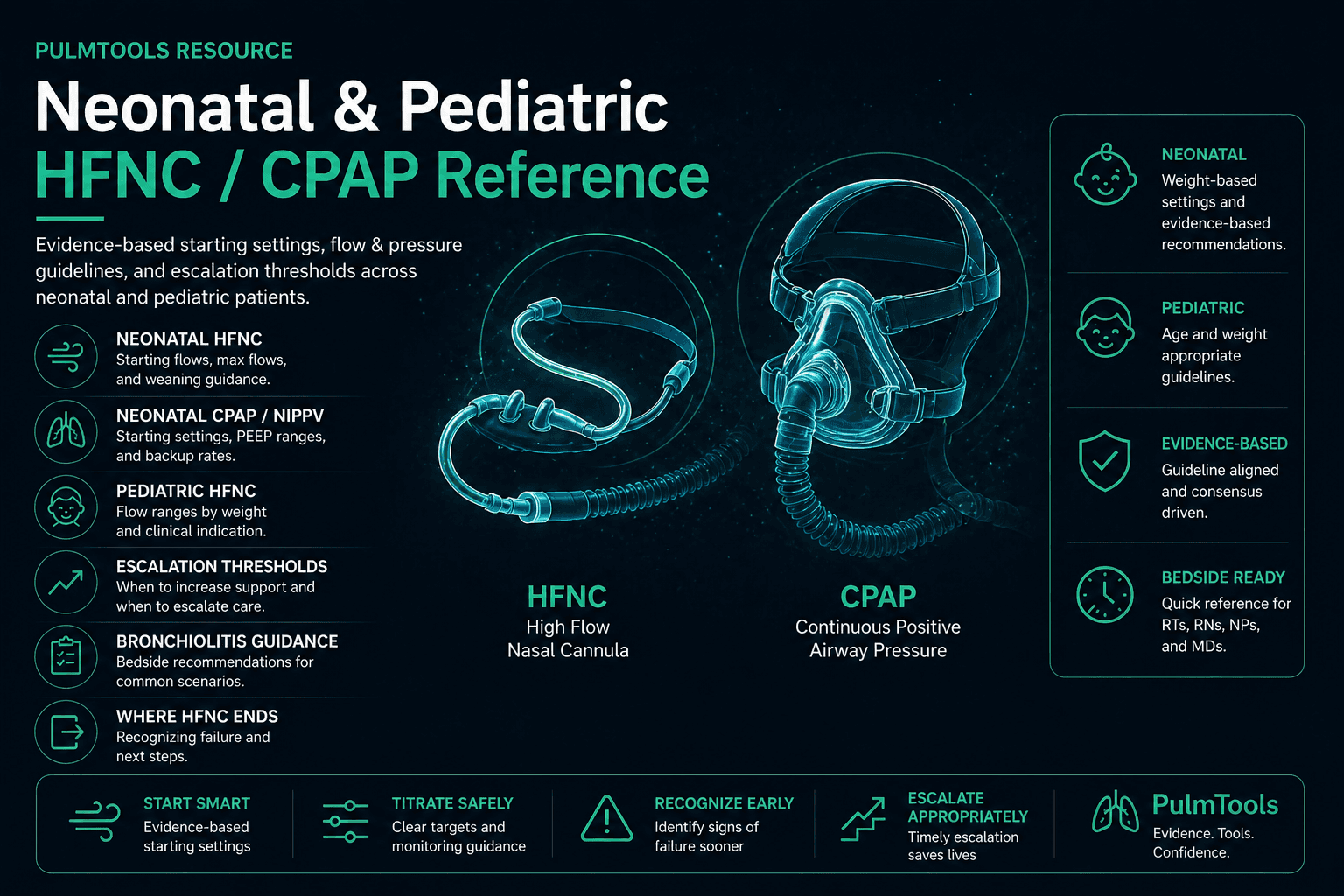
Evidence-informed bedside reference for neonatal and pediatric HFNC, CPAP, and NIPPV starting settings, escalation thresholds, bronchiolitis support, and when high-flow is no longer enough. Built for RTs, RNs, NPs, PAs, physicians, and students who need fast respiratory support guidance without losing the clinical safety context.
How to use this reference
Start with the patient, then match the support
Use this page to frame common starting points and escalation signals, not to override local NICU, PICU, ED, transport, or floor pathways. In neonates, CPAP remains the better-supported first-line noninvasive strategy in many respiratory distress scenarios. In pediatrics, HFNC is most established in bronchiolitis, but failure recognition matters more than simply increasing flow.
What this page covers
Quick-reference starting points for neonatal and pediatric non-invasive respiratory support with emphasis on practical bedside escalation.
Evidence framing
Neonatal CPAP is more guideline-supported than neonatal HFNC. Pediatric HFNC has stronger bronchiolitis support than many other diagnoses.
Escalate early
The biggest clinical mistake is allowing prolonged high-flow support to delay escalation in a tiring or worsening patient.
Neonatal high-flow
Neonatal HFNC starting points
Neonatal HFNC is commonly used after extubation, during CPAP weaning, or in selected respiratory support pathways. For many preterm infants with respiratory distress, CPAP has stronger first-line support than HFNC, so escalation should be considered early if work of breathing or oxygen requirement rises.
| Population | Starting flow | Upper range | FiO₂ guidance | Practical note |
|---|---|---|---|---|
| Neonates (< 4 kg) | 2 L/kg/min (typically 4–8 L/min) | Do not exceed ~2 L/kg/min or ~8 L/min | Titrate to target SpO₂ for gestational age; wean FiO₂ before flow | HFNC is most commonly used post-extubation or during CPAP weaning. Evidence for primary neonatal support remains weaker than CPAP. |
| Preterm infants | 4 L/min common starting point | Up to 8 L/min when tolerated and clinically indicated | Adjust FiO₂ to maintain target saturations | Ensure heated humidification and secure cannula fit. Monitor for abdominal distension and nasal trauma. |
Neonatal CPAP / NIPPV
Neonatal CPAP and NIPPV reference
CPAP supports functional residual capacity and is often preferred over HFNC for initial support in spontaneously breathing preterm infants with respiratory distress. NIPPV can add backup breaths, but exact settings are usually institution-specific.
| Scenario | Support | FiO₂ | Escalation | Notes |
|---|---|---|---|---|
| Spontaneously breathing preterm infant | CPAP 5–6 cm H₂O | 21% if ≥32 weeks; 21–30% if <32 weeks | Increase toward 8–10 cm H₂O if WOB or O₂ needs rise | Preferred first-line support over HFNC in most preterm infants with respiratory distress. |
| NRP-era PPV / support | PEEP 5–6 cm H₂O with PIP adjusted clinically | 21% term; 21–30% preterm depending on gestation | Persistent apnea, rising FiO₂, or poor ventilation → intubation / surfactant consideration | Use age and gestation-specific oxygen targets. Escalate early if bradycardia or persistent ineffective ventilation. |
| NIPPV (when used) | CPAP-level baseline with backup breaths per local NICU protocol | Titrate to saturation goals | Escalate to invasive support if apnea burden, CO₂ retention, or fatigue worsens | NIPPV settings are highly protocol-dependent and should remain clearly labeled as institution-specific. |
Pediatric high-flow
Pediatric HFNC by age and weight
Pediatric HFNC is most commonly used for moderate to severe bronchiolitis and other hypoxemic respiratory support pathways. Flow targets, floor limits, and transfer thresholds vary widely by institution, so the trend after initiation is often more important than the starting number.
| Age / group | Starting flow | Upper range | FiO₂ / escalation | Notes |
|---|---|---|---|---|
| 0–24 months | 2 L/kg/min | Up to 15 L/min common floor limit | Aim FiO₂ ≤60%; escalate if no improvement within 60 min | Strongest evidence in bronchiolitis. Reassess work of breathing, HR, RR, and SpO₂ frequently. |
| 2–10 years | 1 L/kg/min | Up to 20 L/min (institution dependent) | Escalate if persistent tachypnea, retractions, or rising O₂ need | Institutional pathways vary. Some cap flows earlier on acute care floors. |
| >10 years / larger children | 1 L/kg/min | Up to 30 L/min in many pathways | Escalate if max flow + FiO₂ >50–60% with persistent distress | Monitor closely for fatigue, worsening ventilation, and delayed escalation. |
Escalation triggers
When HFNC is no longer enough
- !Persistent or worsening retractions despite increasing support
- !Rising FiO₂ requirement (especially >50–60%)
- !No improvement in heart rate, respiratory rate, or work of breathing within 30–60 minutes
- !Increasing fatigue, apnea, mental status change, or poor air movement
- !Hypercapnia, worsening acidosis, or clinical signs of impending respiratory failure
- !Need for support beyond floor pathway thresholds or institutional flow limits
Bronchiolitis bedside notes
High-yield practical reminders
- ✓HFNC has the strongest pediatric ward evidence in moderate to severe bronchiolitis.
- ✓Suction first. HFNC is not a substitute for secretion management.
- ✓Failure to improve after suction + HFNC should trigger escalation planning early.
- ✓Do not let prolonged HFNC delay CPAP, BiPAP, or intubation in a tiring child.
Source hierarchy
Evidence base used
This page was built from PulmTools neonatal and pediatric respiratory support evidence synthesis using society guidance first, then consensus statements and institutional pathways when evidence was variable.
- AARC oxygen guideline for pediatric acute care and bronchiolitis
- European neonatal resuscitation and CPAP guidance
- AHA / AAP neonatal resuscitation recommendations
- Children’s Minnesota and Stanford pediatric HFNC pathways
- Western Australia neonatal humidified high-flow guidance
- NICU / pediatric consensus pathways for CPAP and escalation
Related PulmTools resources
FAQ
Neonatal and pediatric HFNC / CPAP questions
Is HFNC first-line for neonatal respiratory distress?
Not usually for many preterm respiratory distress scenarios. CPAP has stronger first-line support in many neonatal pathways, while HFNC is often used after extubation, during CPAP weaning, or when local protocols support it.
When should pediatric HFNC be escalated?
Escalate when work of breathing, oxygen requirement, fatigue, apnea, mental status, hypercapnia, or acidosis worsens despite appropriate flow and FiO₂. Lack of improvement within 30–60 minutes should prompt reassessment.
What is the strongest pediatric use case for HFNC?
The strongest common pediatric ward use case is moderate to severe bronchiolitis, especially when suction, oxygen, and supportive care are not enough but the child is not yet requiring CPAP, BiPAP, or intubation.
Does high-flow replace CPAP or BiPAP?
No. HFNC can reduce work of breathing and improve oxygen delivery, but it does not provide the same controlled distending pressure or ventilatory support as CPAP, NIPPV, or BiPAP. Worsening patients should be escalated early.