PulmTools Resource
Neonatal & Pediatric Airway Reference
Evidence-informed bedside quick reference for neonatal and pediatric ETT sizing, intubation depth, cuffed vs uncuffed tube selection, LMA / SGA sizing, and airway confirmation. Built for RTs, RNs, NPs, PAs, physicians, transport teams, and students who need fast airway sizing guidance with clear safety context.
How to use this reference
Pick the starting size, then confirm clinically
Use this page to choose reasonable starting sizes and depth estimates, not as a substitute for direct airway assessment. Neonatal and pediatric airway management depends on weight, age, anatomy, leak, cuff pressure, ventilation, capnography, and local airway protocol. Always prepare adjacent ETT sizes before intubation.
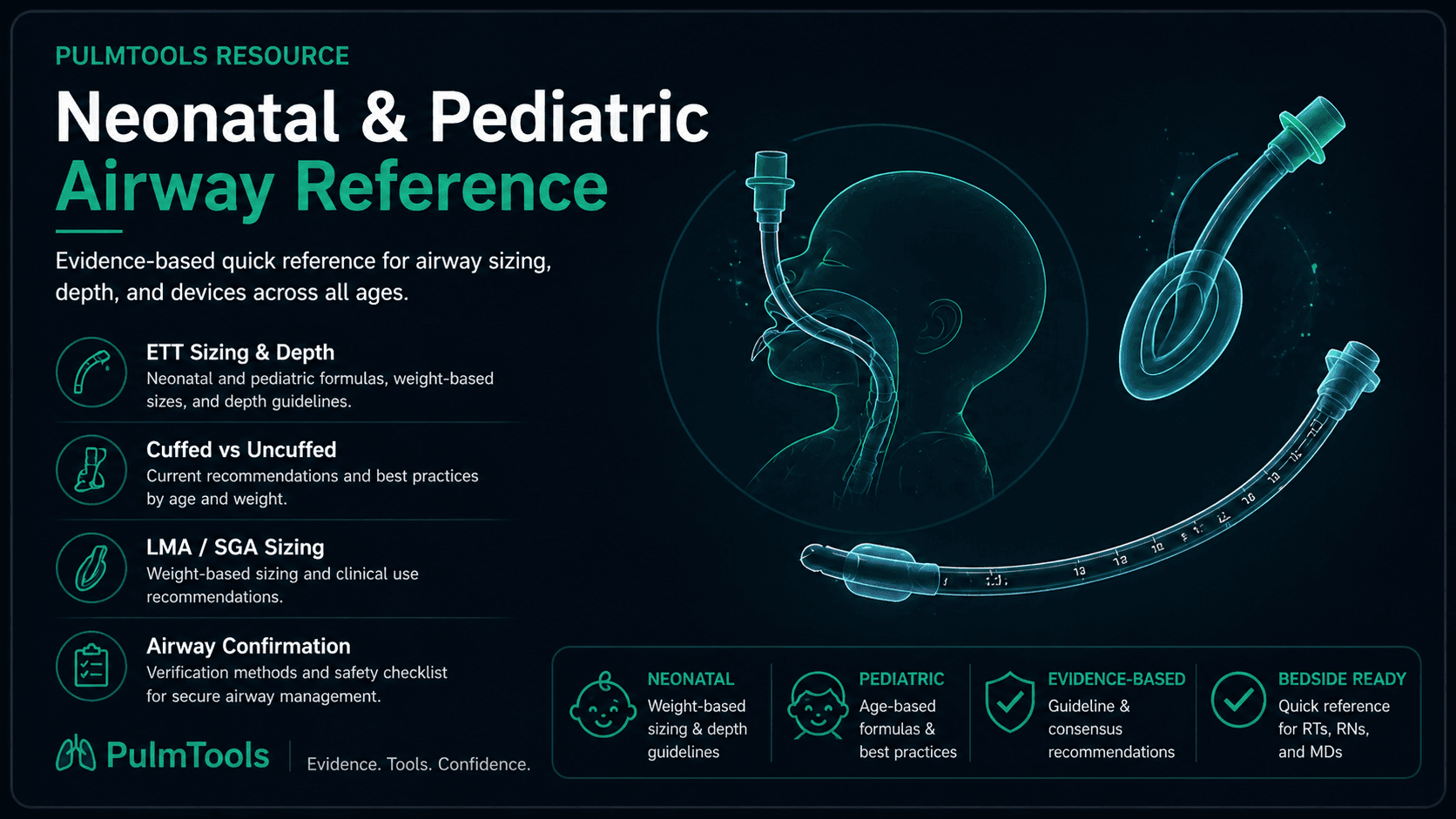
What this page covers
A fast reference for respiratory therapists, nurses, physicians, APPs, students, and transport teams who need airway sizing and confirmation values quickly.
Evidence framing
Values are separated into guideline-supported, consensus-supported, and protocol-derived guidance where source strength varies.
Use cautiously
ETT formulas and LMA sizing are starting points. Final selection depends on anatomy, leak, ventilation, capnography, and local policy.
Neonatal airway
Neonatal ETT size and depth
Neonatal airway sizing is primarily weight-based. Depth estimates such as weight + 6 cm are starting points only; final position must be confirmed with CO₂ detection, chest movement, bilateral breath sounds, clinical response, and radiograph when appropriate.
| Weight / group | Recommended ETT | Depth guide | Evidence | Practical note |
|---|---|---|---|---|
| < 1 kg | 2.5 mm uncuffed ETT | Approx. weight (kg) + 6 cm at lip; confirm clinically and radiographically | Guideline / protocol-supported | Very low birth-weight infants usually require uncuffed tubes; maintain an audible leak around 15–20 cm H₂O when possible. |
| 1–2 kg | 3.0 mm uncuffed ETT | Approx. weight (kg) + 6 cm at lip | Guideline / protocol-supported | Have one size smaller and larger available. Reassess if there is no leak or the tube passes tightly. |
| 2–3 kg | 3.5 mm uncuffed ETT | Approx. weight (kg) + 6 cm at lip | Guideline / protocol-supported | Confirm position with CO₂ detection, bilateral breath sounds, chest rise, and CXR after stabilization. |
| > 3 kg / term | 3.5–4.0 mm ETT; cuffed may be considered when appropriate | Weight + 6 cm or NRP-style tip-to-gum approach when available | Guideline / consensus-supported | If cuffed, monitor cuff pressure and avoid overinflation. Many neonatal settings still favor uncuffed tubes depending on size and protocol. |
Pediatric airway
Pediatric ETT formulas and cuffed tube guidance
Modern pediatric resuscitation guidance supports cuffed ETT use in many infants and children when cuff pressure is monitored. Formulas remain estimates and should not replace bedside reassessment.
| Age / group | Cuffed ETT estimate | Uncuffed ETT estimate | Depth estimate | Notes |
|---|---|---|---|---|
| Infants < 6 months | Usually table / weight-based selection | Usually table / weight-based selection | Confirm clinically; formulas are less reliable in small infants | Use clinical judgment, patient size, and local airway carts. Always prepare adjacent sizes. |
| Children > 1 year | (Age / 4) + 3.5 mm ID | (Age / 4) + 4 mm ID | 3 × ETT size or (Age / 2) + 12 cm | These are starting estimates, not guarantees. Confirm position and cuff pressure after placement. |
| Most pediatric patients | Reasonable/preferred in many modern pediatric resuscitation settings | May still be used by local protocol or patient-specific need | Adjust to clinical exam, capnography, and radiograph | Contemporary AHA/PALS-era guidance supports cuffed ETTs in infants and children when cuff pressure is monitored. |
LMA / SGA sizing
Supraglottic airway quick reference
LMA and supraglottic airway sizing is usually weight-based. In neonatal and pediatric emergencies, SGAs are most useful as rescue airways when mask ventilation or intubation is difficult or unsuccessful.
| LMA size | Weight | Population | Notes |
|---|---|---|---|
| 1 | < 5 kg | Neonate / small infant | Used as rescue SGA in term or near-term neonates when mask ventilation or intubation fails. |
| 1.5 | 5–10 kg | Infant | Weight-based manufacturer sizing; confirm seal and ventilation. |
| 2 | 10–20 kg | Toddler / small child | Avoid undersizing, which can cause leaks and poor ventilation. |
| 2.5 | 20–30 kg | School-age child | Transitional pediatric size. |
| 3 | 30–50 kg | Older child | Confirm placement by chest rise and capnography. |
| 4 | 50–70 kg | Adolescent / small adult | Monitor cuff pressure and airway seal. |
| 5 | > 70 kg | Large adolescent / adult | Adult-sized SGA. |
Practice variation
Where recommendations vary
Cuffed vs uncuffed pediatric ETTs
Older teaching favored uncuffed tubes in young children. Current pediatric resuscitation and airway literature supports cuffed tubes in many children when cuff pressure is monitored and correct sizing is used.
Neonatal cuffed ETT use
Small neonates generally remain uncuffed. Cuffed tubes may be considered in larger term neonates depending on equipment, clinician experience, and local NICU / transport protocol.
ETT depth formulas
Weight + 6 and age-based formulas are quick estimates. Final position requires clinical confirmation and radiographic confirmation when appropriate.
SGA role in neonates
Supraglottic airways are most established as rescue devices for term or near-term infants when mask ventilation or intubation is unsuccessful.
Source hierarchy
Evidence base used
This page was built from a PulmTools neonatal / pediatric respiratory reference dossier using society guidance first, then consensus statements, peer-reviewed reviews, and hospital protocols only when higher-level guidance was limited.
- AHA / AAP neonatal resuscitation guidance and NRP updates
- AHA Pediatric Advanced Life Support guidance on cuffed ETT use
- ANZCOR / NeoResus supraglottic airway recommendations
- West of Scotland and Queensland neonatal intubation guidance
- Peer-reviewed pediatric airway reviews on cuffed tube sizing formulas
- Manufacturer weight-based LMA / SGA sizing standards
FAQ
Neonatal and pediatric airway questions
What ETT size is used for a neonate under 1 kg?
A common starting size for a neonate under 1 kg is a 2.5 mm uncuffed ETT, with adjacent sizes available and final selection confirmed by leak, ventilation, CO₂ detection, and clinical response.
What is the pediatric cuffed ETT formula?
A common cuffed ETT estimate for children older than 1 year is age divided by 4 plus 3.5. This is only a starting estimate and cuff pressure should be monitored.
How do you confirm neonatal or pediatric ETT placement?
Use CO₂ detection when available, visible chest rise, bilateral breath sounds, improving heart rate and oxygenation, securement depth documentation, and radiograph after stabilization when appropriate.
When is an LMA or SGA used in neonates?
SGAs are most commonly used as rescue airways in term or near-term neonates when mask ventilation or intubation is unsuccessful, depending on device availability, size, and local protocol.