PulmTools Resource
Neonatal & Pediatric Oxygenation Reference
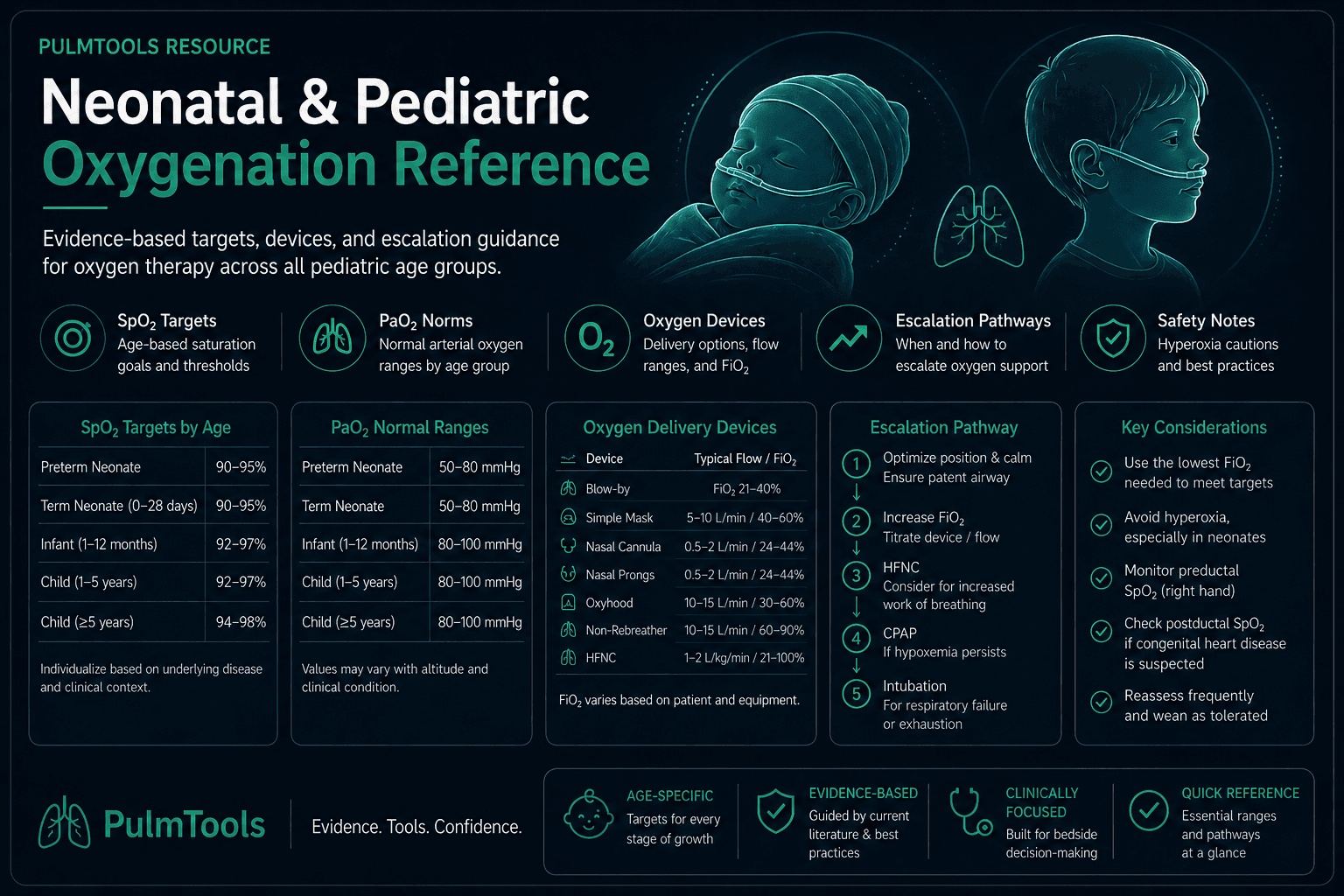
Evidence-informed bedside guide for SpO₂ targets, PaO₂ ranges, FiO₂ escalation, oxygen delivery devices, neonatal preductal and postductal monitoring, bronchiolitis oxygen thresholds, and escalation to HFNC, CPAP, or intubation.
Targets are context-dependent
SpO₂ and PaO₂ targets should be individualized for gestational age, disease state, altitude, shunt physiology, and institutional policy.
Device choice matters
Low-flow cannula, mask oxygen, oxyhood, HFNC, CPAP, and NIPPV deliver very different levels of support even when the SpO₂ looks similar.
Escalate by trajectory
Rising FiO₂ need, worsening distress, fatigue, apnea, acidosis, or altered mental status should prompt escalation before collapse.
Oxygen saturation
SpO₂ targets by age group
| Population | Common target range | Practical note |
|---|---|---|
| Preterm neonate | Use the NICU's gestational-age and diagnosis-specific target | There is no single range for every preterm infant. Avoid both hypoxemia and hyperoxia and follow the current unit protocol. |
| Term neonate (0–28 days) | Use the care-setting and diagnosis-specific target | Use the 2025 preductal table during transition/resuscitation. Ongoing neonatal targets depend on diagnosis and setting. |
| Hospitalized bronchiolitis | ≥90% | AARC supports an oxygenation target of 90% or greater for hospitalized pediatric patients with bronchiolitis. |
| Other pediatric respiratory disease | No universal numeric target recommended by AARC | Establish a patient- and disease-specific target on admission; individualize for chronic lung disease, congenital heart disease, pulmonary hypertension, and institutional policy. |
Neonatal transition
Preductal SpO₂ after birth
During neonatal resuscitation and transition, use preductal SpO₂ monitoring from the right hand or wrist. The 2025 AHA/AAP table begins at 2 minutes; expected saturations rise gradually after birth and should not be forced immediately to older child targets.
2 minutes
65–70%
3 minutes
70–75%
4 minutes
75–80%
5 minutes
80–85%
10 minutes
85–95%
Arterial oxygen
PaO₂ reference ranges
| Population | PaO₂ range | Notes |
|---|---|---|
| Preterm neonate | Often ~50–80 mmHg | Higher PaO₂ exposure may increase oxidative risk; trends and saturation targeting matter more than a single value. |
| Term neonate | Often ~50–80 mmHg early, then rises with transition | Interpret in context of age in hours, preductal/postductal difference, FiO₂, and cardiopulmonary transition. |
| Infant / child | ~80–100 mmHg commonly referenced at sea level | PaO₂ varies with altitude, FiO₂, ventilation/perfusion matching, hemoglobin saturation curve, and disease state. |
| Critically ill child | Target depends on diagnosis and severity | PARDS guidance may accept lower oxygenation targets in severe disease to reduce oxygen toxicity and ventilator injury. |
Oxygen delivery
Oxygen devices, flow ranges, and practical cautions
| Device | Typical flow | Approximate FiO₂ | Best use | Caution |
|---|---|---|---|---|
| Blow-by oxygen | Variable | Highly variable | Brief support when child will not tolerate a device | Poorly controlled FiO₂; do not rely on it for significant distress. |
| Low-flow nasal cannula | ~0.25–2 L/min in infants/children; lower neonatal flows per policy | Variable, often ~24–44% depending on size and minute ventilation | Mild hypoxemia with low work of breathing | FiO₂ is not fixed; mouth breathing and inspiratory flow change delivery. |
| Simple mask | 5–10 L/min | ~35–60% | Short-term moderate oxygen need | Avoid flows below minimum due to CO₂ rebreathing risk. |
| Non-rebreather mask | 10–15 L/min | Up to ~60–90%+ when seal and reservoir inflation are adequate | High oxygen need or preoxygenation before escalation | Requires good mask seal and inflated reservoir; not definitive support for fatigue. |
| Oxyhood / oxygen hood | Often 7–15 L/min depending on hood size and unit policy | Can provide controlled oxygen in neonates | Neonatal oxygen delivery without nasal interface trauma | Monitor temperature, CO₂ clearance, and access to the infant. |
| HFNC | Neonate often up to ~2 L/kg/min; pediatrics commonly weight-based | 21–100% blended oxygen | Hypoxemia plus increased work of breathing after low-flow support is inadequate | Failure should be recognized early; do not delay CPAP/BiPAP/intubation when worsening. |
| CPAP / NIPPV | Pressure-based support | 21–100% blended oxygen | Persistent hypoxemia, atelectasis, pulmonary edema, apnea, or increased work of breathing | Escalate if oxygenation, ventilation, mental status, or fatigue worsens. |
Escalation pathway
When oxygen is not enough
Optimize basics
Position airway, suction when appropriate, calm the child, verify probe quality, and reassess work of breathing.
Increase oxygen delivery
Titrate FiO₂ and match the device to severity. Avoid staying on an inadequate low-flow device when distress is increasing.
Move to HFNC when appropriate
Consider HFNC for persistent hypoxemia with increased work of breathing, especially when low-flow oxygen is insufficient.
Escalate to CPAP / NIPPV
If oxygenation or work of breathing remains poor, consider positive pressure support where clinically appropriate.
Prepare for intubation
Escalate urgently for respiratory failure, exhaustion, worsening mental status, shock, apnea, or inability to maintain oxygenation.
Source hierarchy
Evidence base used
This page uses a source-first bedside synthesis from neonatal resuscitation guidance, pediatric oxygen therapy guidance, PARDS oxygenation framing, bronchiolitis recommendations, and institutional oxygen device ranges where society guidance is variable.
- AHA / AAP / NRP neonatal resuscitation oxygen targeting and preductal SpO₂ guidance
- AARC pediatric oxygen therapy guidance and bronchiolitis oxygen target evidence
- PALICC / PALICC-2 pediatric acute respiratory distress and oxygenation target framing
- Academic neonatal and pediatric hospital protocols where device flow ranges vary by institution
- PulmTools neonatal and pediatric respiratory evidence dossier used for source hierarchy and bedside synthesis
Related PulmTools resources and calculators
Pair this oxygenation reference with PulmTools calculators and the neonatal/pediatric respiratory reference suite for faster bedside reasoning.