1
Look at the patient first
Assess mental status, chest rise, work of breathing, color, perfusion, blood pressure, SpO₂ waveform, and immediate distress.
PulmTools Resource
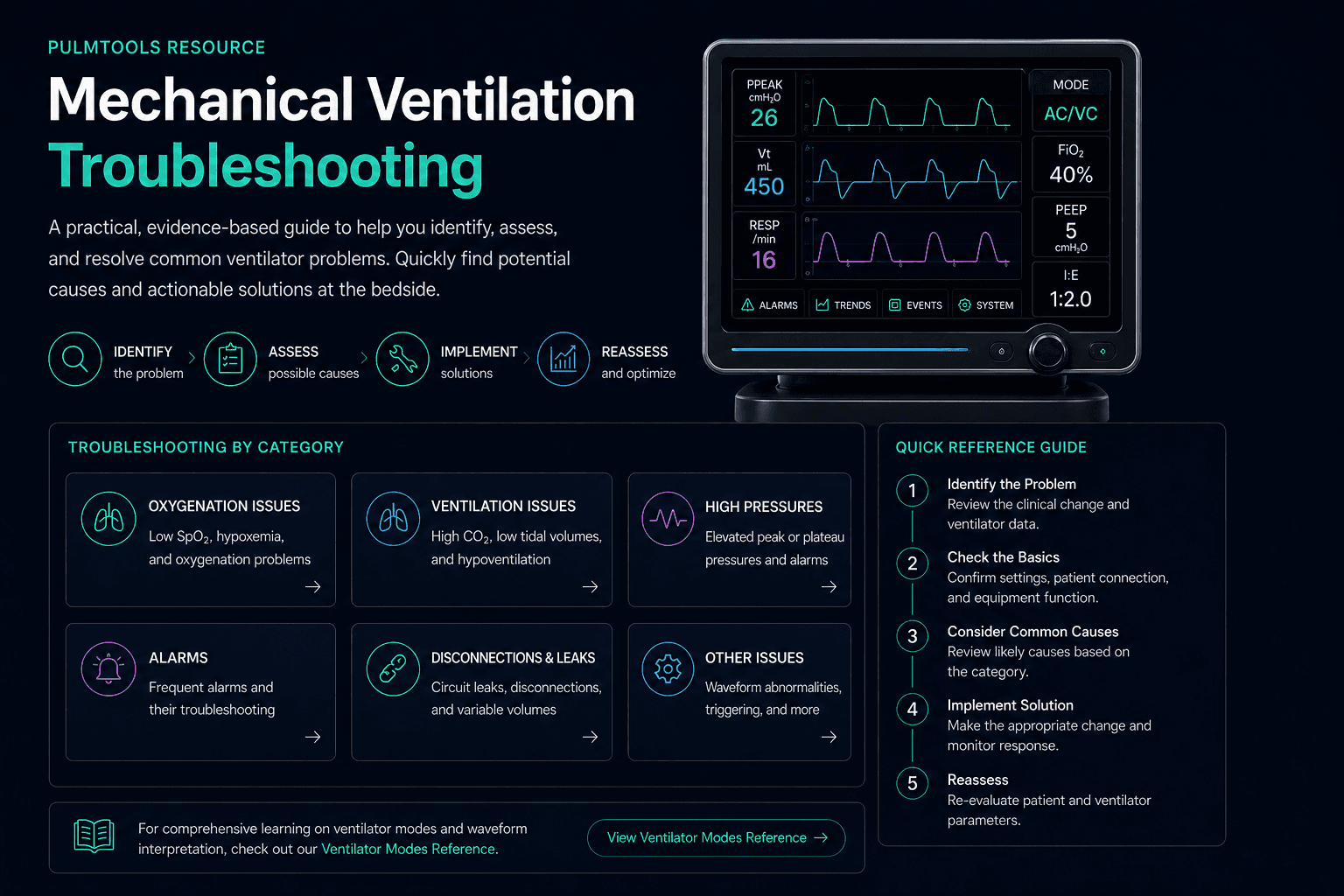
A practical ventilator troubleshooting reference for high peak pressure, high plateau pressure, auto-PEEP, low exhaled tidal volume, leaks, dyssynchrony, ventilator alarms, and sudden desaturation on mechanical ventilation.
Assess mental status, chest rise, work of breathing, color, perfusion, blood pressure, SpO₂ waveform, and immediate distress.
Follow oxygen source, ventilator, circuit, humidifier/filter, patient connection, cuff, tube depth, and suction catheter passage.
Compare set vs delivered VT, exhaled VT, minute ventilation, peak, plateau, PEEP, FiO₂, ETCO₂, and alarm history.
Flow, pressure, and volume waveforms often reveal air trapping, obstruction, leaks, dyssynchrony, or inadequate flow.
After each intervention, reassess the patient, ventilator numbers, waveforms, oxygenation, ventilation, and hemodynamics.
Troubleshooting by problem
Use these patterns to organize bedside thinking. Many ventilator problems overlap, so reassess the patient and waveforms after each intervention.
Signal: Low SpO₂, falling PaO₂, rising FiO₂ need, cyanosis, or worsening work of breathing
Signal: High PaCO₂, rising ETCO₂, low minute ventilation, low tidal volume, or hypoventilation alarms
Signal: Peak inspiratory pressure rises while plateau pressure may be normal or elevated
Signal: Elevated plateau pressure during passive ventilation suggests increased alveolar pressure / reduced compliance
Signal: Expiratory flow fails to return to baseline, air trapping, hypotension, high total PEEP, or difficult triggering
Signal: Low exhaled VT alarm, low minute ventilation, audible leak, poor cuff seal, or inconsistent delivered volume
Signal: Patient fighting the ventilator, double breaths, accessory muscle use, discomfort, or abnormal waveforms
Signal: Abrupt SpO₂ drop, alarm cluster, new hypotension, loss of chest rise, or acute distress
Alarm guide
| Alarm | Likely meaning | Fast check |
|---|---|---|
| High pressure alarm | Resistance, compliance problem, coughing, secretions, kink, bronchospasm, or breath stacking | Patient → tube/circuit → suction/bronchospasm → peak vs plateau → waveform |
| Low pressure alarm | Disconnect, leak, cuff issue, circuit problem, or inadequate patient connection | Connections → cuff pressure → exhaled VT → circuit integrity → patient chest rise |
| Low minute ventilation | Low VT, apnea, leak, fatigue, weak effort, low set rate, or disconnect | Mode/rate → exhaled VT → leak → patient effort → ABG/VBG/ETCO₂ trend |
| High respiratory rate | Pain, anxiety, hypoxemia, acidosis, fever, dyssynchrony, or inadequate support | Patient comfort → oxygenation → acid-base → trigger/support → waveform |
| Apnea alarm | Low drive, oversedation, fatigue, neurologic change, or spontaneous mode mismatch | Patient responsiveness → backup ventilation → sedation/meds → mode safety |
Escalation cues
Pair this troubleshooting guide with ventilator modes, ARDSNet, predicted body weight, oxygenation tools, and post-intubation airway resources.