AC/VC, SIMV-VC, PRVC target VT
Volume-targeted modes
More predictable ventilation, but pressures reveal the cost of delivering that volume.
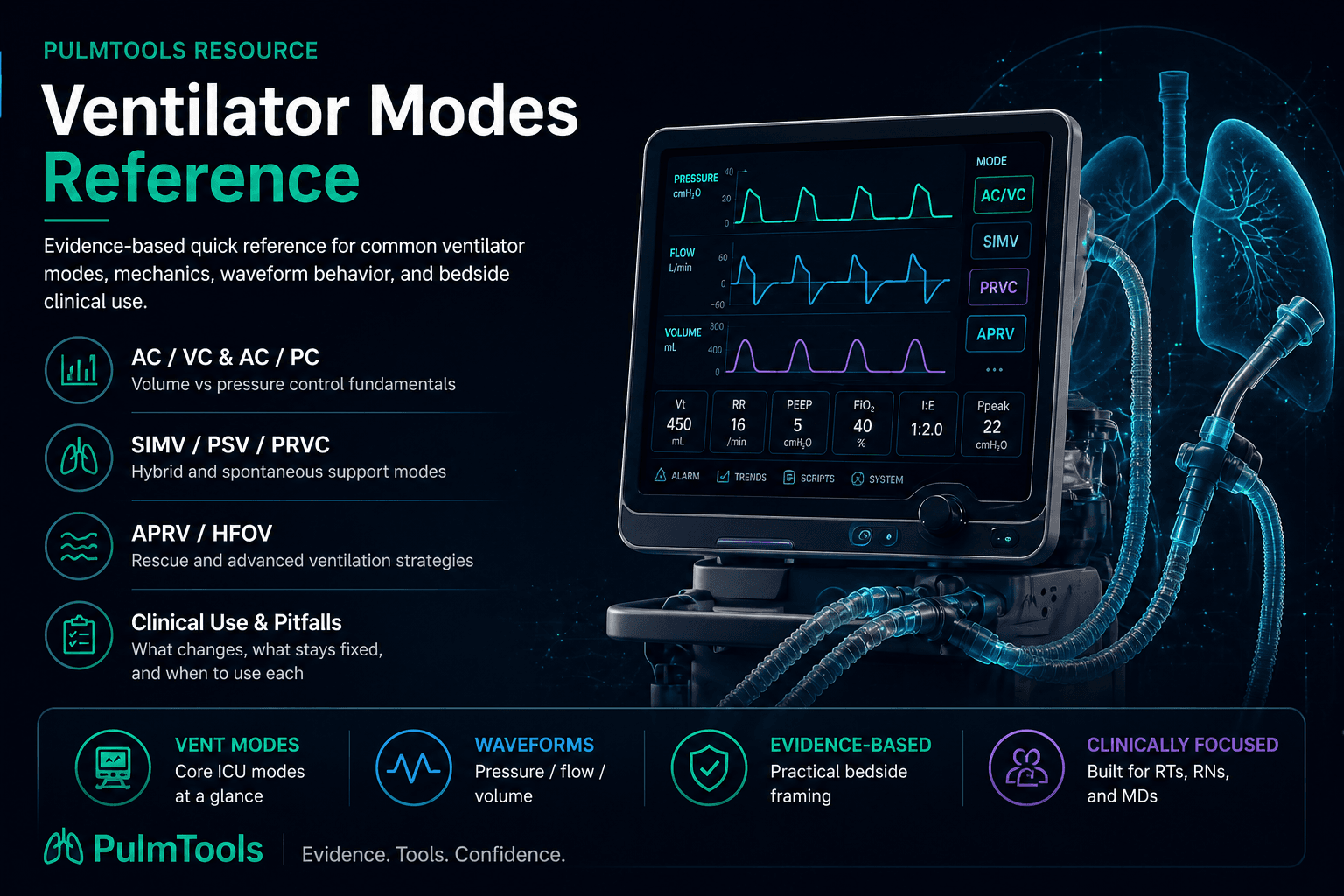
PulmTools Resource
A high-yield mechanical ventilation mode guide for AC/VC, AC/PC, SIMV, PSV, PRVC, APRV, HFOV, pressure-flow-volume waveforms, bedside ventilator mechanics, and practical mode selection.
AC/VC, SIMV-VC, PRVC target VT
More predictable ventilation, but pressures reveal the cost of delivering that volume.
AC/PC, PSV, APRV pressure levels
Pressure is limited, but tidal volume and minute ventilation can vary with changing mechanics.
PSV, SIMV + PS, spontaneous breathing on APRV
Useful for synchrony and weaning, but only when drive, strength, and airway protection are adequate.
APRV, HFOV
Best used with experienced teams, clear monitoring goals, and disease-specific protocols.
Mode comparison
| Mode | What is fixed | What varies | Best use | Common pitfall |
|---|---|---|---|---|
AC/VC Assist-Control / Volume Control | Tidal volume, respiratory rate, flow pattern, PEEP, FiO₂ | Peak pressure varies with resistance, compliance, flow, and patient effort | Predictable minute ventilation, ARDSNet-style low tidal volume ventilation, controlled ventilation | High peak pressure may reflect resistance or flow; plateau pressure better estimates alveolar pressure. |
AC/PC Assist-Control / Pressure Control | Inspiratory pressure, inspiratory time, respiratory rate, PEEP, FiO₂ | Tidal volume varies with compliance, resistance, leak, and effort | Poor compliance, pressure limitation, synchrony issues, severe obstructive or restrictive mechanics | Minute ventilation can fall suddenly if compliance worsens or resistance rises. |
SIMV Synchronized Intermittent Mandatory Ventilation | Mandatory breath settings plus synchronized rate | Spontaneous breath contribution depends on patient effort and pressure support | Gradual transition toward spontaneous breathing in selected patients | Can increase work of breathing if support is inadequate; not automatically a weaning shortcut. |
PSV Pressure Support Ventilation | Pressure support level, PEEP, FiO₂ | Rate, tidal volume, inspiratory time, and minute ventilation depend on patient effort | Spontaneous breathing trials, weaning assessment, supported spontaneous ventilation | Apnea, fatigue, weak drive, or excessive support can make interpretation misleading. |
PRVC Pressure-Regulated Volume Control | Target tidal volume, respiratory rate, PEEP, FiO₂ | Ventilator adjusts inspiratory pressure to target volume within pressure limits | Volume-targeted ventilation with pressure-limited breath delivery | Pressure changes can obscure worsening mechanics; target volume does not guarantee lung protection if set poorly. |
APRV Airway Pressure Release Ventilation | P-high, P-low, T-high, T-low, FiO₂ | Release volumes and spontaneous breathing contribution vary | Selected severe hypoxemia or recruitment strategy under experienced supervision | Requires expertise; inappropriate settings can worsen hyperinflation, hemodynamics, or ventilation. |
HFOV High-Frequency Oscillatory Ventilation | Mean airway pressure, amplitude, frequency, FiO₂ | CO₂ clearance and oxygenation depend on oscillator settings, lung volume, and disease state | Selected neonatal/pediatric rescue scenarios and specialized ICU settings | Specialized mode requiring experienced teams, close monitoring, and institution-specific protocols. |
Waveform interpretation
Suggests: Increased airway resistance, secretions, bronchospasm, biting tube, kinked circuit
Next step: Suction, inspect circuit/ETT, assess bronchospasm, compare peak vs plateau.
Suggests: Reduced compliance, edema, atelectasis, ARDS, pneumothorax, abdominal pressure
Next step: Assess plateau/driving pressure, lung mechanics, CXR, PEEP/VT strategy, hemodynamics.
Suggests: Air trapping / auto-PEEP, obstructive disease, inadequate expiratory time
Next step: Reduce RR, shorten inspiratory time, increase expiratory time, evaluate bronchodilation needs.
Suggests: Obstructive physiology or bronchospasm
Next step: Assess wheeze, resistance, bronchodilators, secretion burden, and expiratory time.
Suggests: Dyssynchrony, high drive, inadequate flow/VT, short inspiratory time, discomfort
Next step: Assess sedation, pain, trigger sensitivity, flow, inspiratory time, support level, and lung demand.
How to think clinically
PaCO₂ is shaped by minute ventilation, alveolar ventilation, dead space, respiratory rate, tidal volume, and patient synchrony.
SpO₂ and PaO₂ are influenced by FiO₂, PEEP, mean airway pressure, shunt, recruitment, perfusion, and disease trajectory.
Lung-protective strategy depends on tidal volume, plateau pressure, driving pressure, mechanical power, and avoiding unnecessary hyperoxia.
Pair this ventilator modes guide with PulmTools calculators and airway references for faster mode selection, post-intubation setup, and ventilator troubleshooting.