ABGenius · Free interactive case simulator
ABG Practice Questions & Interactive Quiz
Interpret realistic blood gases, check your answers, and build confidence with acid-base balance, compensation, and oxygenation.
Arterial blood gas practice
Study smarter with ABGenius.
Practice realistic cases, then focus your study on the concepts that need another pass.
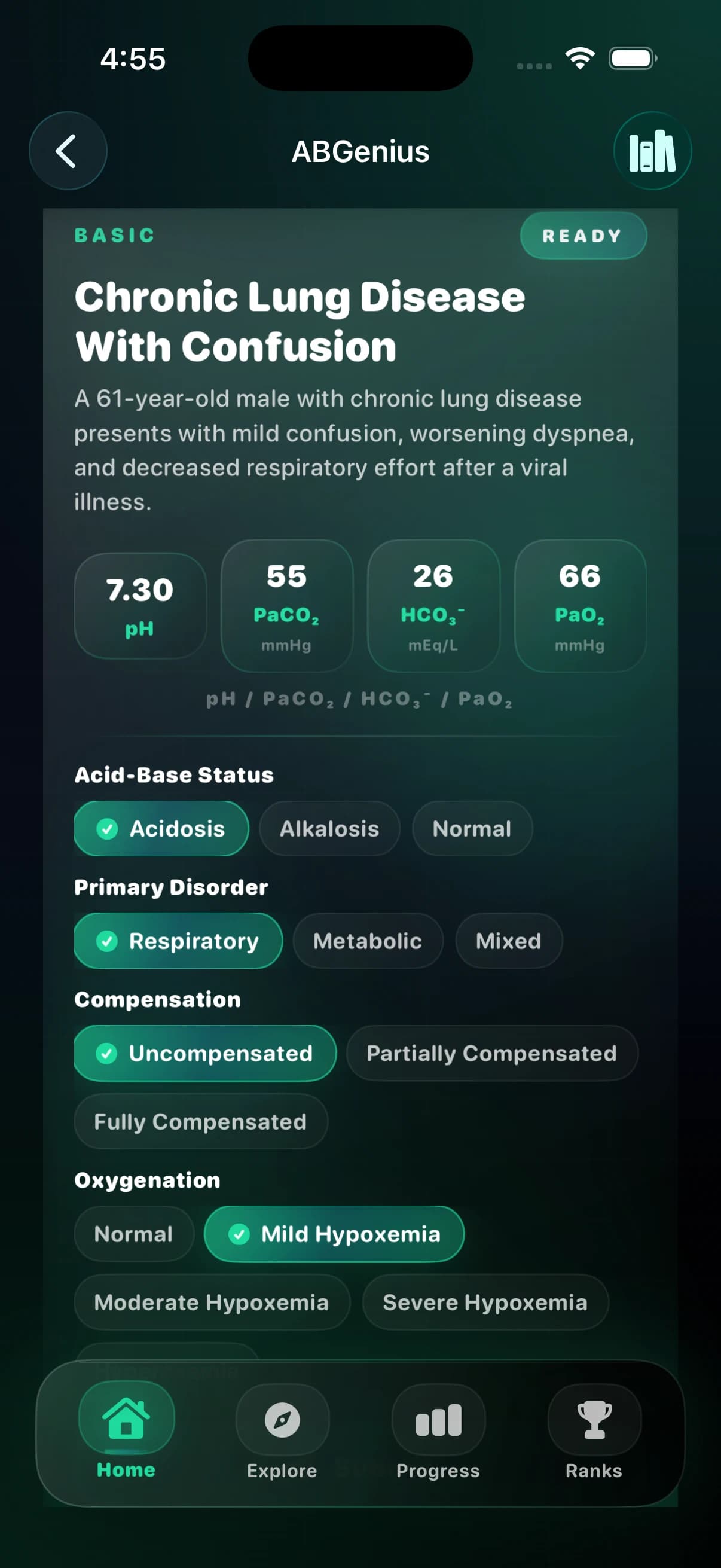
Real ABG cases. Sharper instincts.
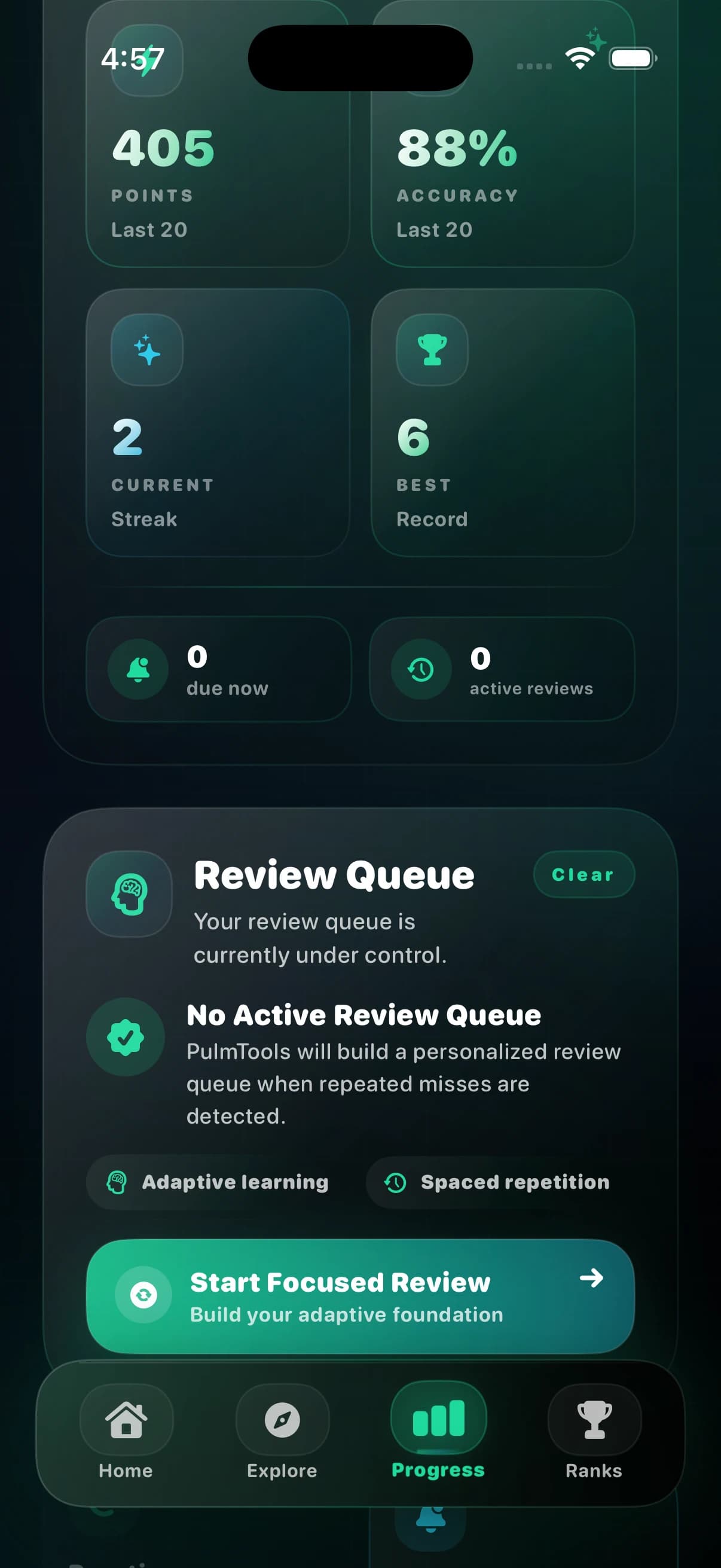
Review that adapts to you.
Free ABG learning hub
ABG practice questions that teach the full interpretation
ABGenius is a free ABG practice quiz, random case generator, and interactive arterial blood gas simulator. Each case asks you to connect pH, PaCO₂, HCO₃⁻, and PaO₂ rather than memorize an isolated rule. Submit your interpretation to receive immediate feedback, review the expected pattern, and move directly into another clinical case.
The simulator covers respiratory acidosis, respiratory alkalosis, metabolic acidosis, metabolic alkalosis, compensation, mixed acid-base disorders, and oxygenation classification. It is built for repeated practice by respiratory therapy students, nurses, medical trainees, and clinicians refreshing a core critical-care skill.
Realistic clinical cases
Interpret ABGs in clinical context instead of solving disconnected number sets.
Immediate explanations
Compare your answer with the primary disorder, compensation, and oxygenation pattern.
Unlimited repetition
Generate another ABG and keep practicing until the sequence becomes automatic.
How to interpret an ABG step by step
- 1. Read the pH. Decide whether the sample shows acidemia, alkalemia, or a pH within the stated reference interval.
- 2. Compare PaCO₂ and HCO₃⁻. Identify which variable changes in the direction that explains the pH.
- 3. Check expected compensation. Use the appropriate acute, chronic, or metabolic compensation rule instead of assuming that any opposite change is adequate.
- 4. Screen for a mixed disorder. A compensation value outside the expected range suggests an additional acid-base process.
- 5. Assess oxygenation separately. Interpret PaO₂ with FiO₂, age, altitude, and the patient's clinical setting.
Reference intervals and oxygenation categories vary by laboratory and clinical context. ABGenius is for education and does not replace bedside assessment or local protocols.
Choose focused ABG practice
Target a difficult pattern or keep the default mixed-case session for broad exam and bedside preparation.
Respiratory acidosis
Practice elevated-PaCO₂ disorders and distinguish acute, chronic, and compensated patterns.
Start focused quiz →Respiratory alkalosis
Practice low-PaCO₂ disorders and recognize acute versus compensated presentations.
Start focused quiz →Metabolic acidosis
Work through low-bicarbonate disorders and decide whether respiratory compensation fits.
Start focused quiz →Metabolic alkalosis
Practice high-bicarbonate disorders and evaluate the expected PaCO₂ response.
Start focused quiz →Mixed acid-base disorders
Challenge yourself with cases where pH, PaCO₂, and HCO₃⁻ do not fit a single-process disorder.
Start focused quiz →ABG oxygenation practice
Classify PaO₂ while keeping oxygenation separate from ventilation and acid-base status.
Start focused quiz →ABG practice questions: frequently asked questions
- What are the best ABG practice questions for learning ABG interpretation?
- The most useful ABG practice questions require you to interpret pH, PaCO₂, HCO₃⁻, compensation, and oxygenation together, then explain why the pattern fits. ABGenius uses realistic clinical cases with immediate feedback so you can repeat that full reasoning process.
- Where can I take a free ABG practice quiz?
- ABGenius is a free interactive ABG quiz and case simulator. It generates arterial blood gas practice cases and provides feedback on acid-base status, the primary disorder, compensation, and oxygenation.
- How should I practice ABG interpretation?
- Use the same sequence for every case: assess pH, identify whether PaCO₂ or HCO₃⁻ best explains the pH direction, test the compensation pattern, look for a mixed disorder, and evaluate PaO₂ in clinical context. Repetition with varied cases builds faster pattern recognition.
- What should I look at first in an ABG?
- Start with pH to identify acidemia, alkalemia, or a value within the laboratory reference interval. Then compare PaCO₂ and HCO₃⁻ with the pH direction before assessing compensation and oxygenation.
- Is ABGenius useful for respiratory therapy and nursing students?
- Yes. ABGenius is designed for respiratory therapy, nursing, medical, physician assistant, and other health-professions learners who need repeated arterial blood gas interpretation practice for class, exams, or clinical training.
- Does ABGenius replace an ABG analyzer or clinical assessment?
- No. ABGenius is an educational practice tool. Use the PulmTools ABG Analyzer for entered values, and always interpret real patient results with the laboratory reference range, oxygen delivery, history, examination, and the complete clinical picture.
ABG guides and clinical references
ABG interpretation guide
Learn a systematic clinical approach before beginning the quiz.
Worked ABG questions and answers
Study written examples with the reasoning shown step by step.
Free ABG cheat sheet
Review normal values, primary disorders, and compensation formulas.
ABG calculator and analyzer
Enter a real set of values when you need analyzer—not quiz—mode.
Clinical background reviewed against:
- American Thoracic Society: Interpretation of Arterial Blood Gases
- NCBI Bookshelf: Arterial Blood Gas Analysis
Educational content updated August 4, 2026.
New to arterial blood gases? Start with the ABG Interpretation Guide or use the Bedside ABG Analyzer.
Continue Building Clinical Reasoning
Explore additional acid-base, oxygenation, and respiratory care resources.