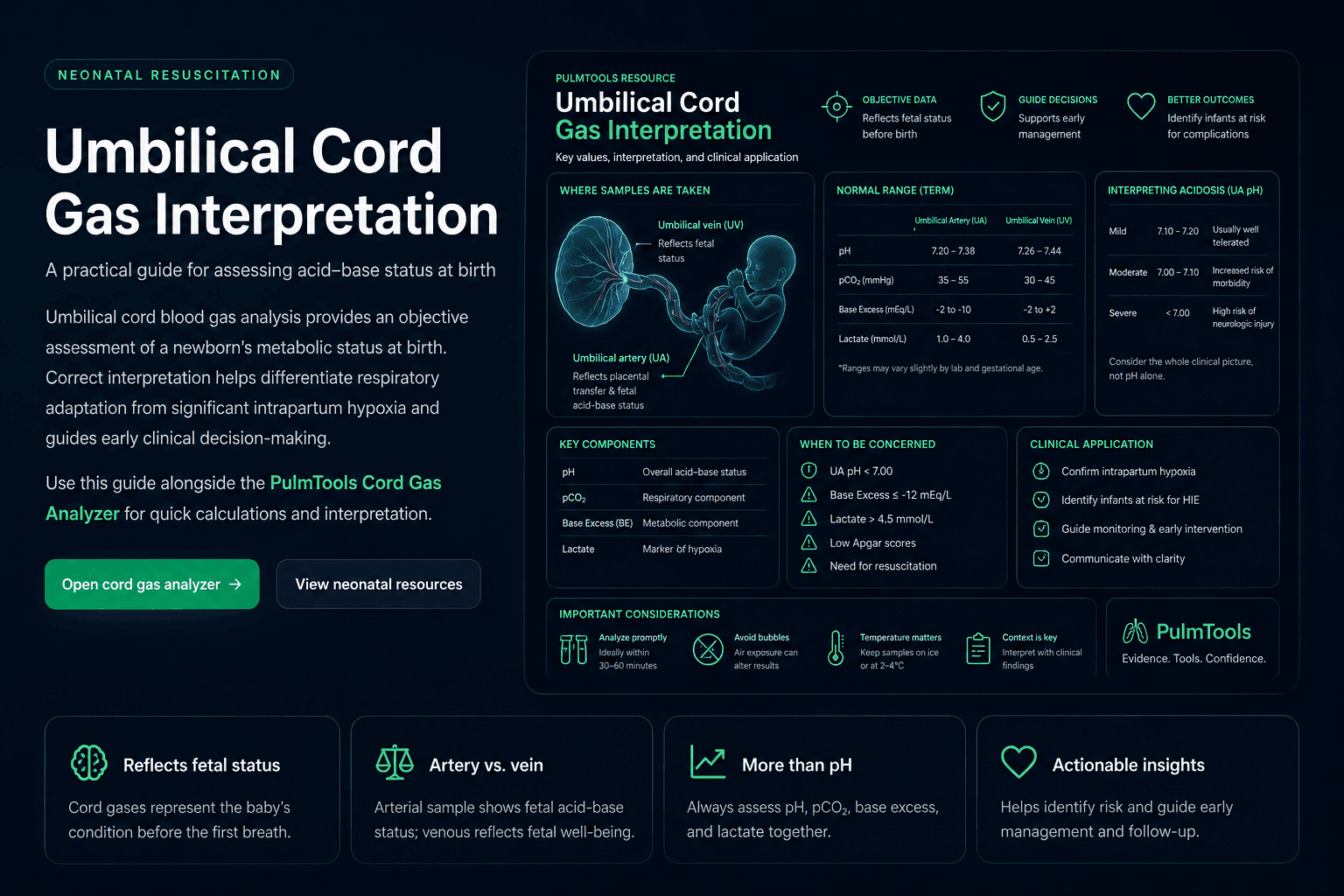
Arterial cord gas
The umbilical arterial sample best reflects fetal acid-base status because it carries blood from the fetus back toward the placenta.
Venous cord gas
The umbilical venous sample reflects placental return and maternal/placental oxygen delivery more than direct fetal metabolic condition.
Base deficit matters
pH alone can miss the bigger picture. Base excess / deficit helps separate acute respiratory changes from sustained metabolic stress.
Clinical concept
What does a cord gas tell you?
Cord gases provide an objective snapshot of acid-base status at birth. The arterial cord gas is usually the most clinically important sample because it reflects fetal metabolism. The venous cord gas helps confirm placental return and can reveal whether paired samples make physiologic sense.
A low pH with a high PaCO₂ and relatively preserved base excess suggests a more acute respiratory process. A low pH with a significant base deficit suggests a sustained metabolic component. Mixed patterns are common, so pH, PaCO₂, bicarbonate, base excess, and the delivery course should be interpreted together.
Reference table
Typical arterial vs venous cord gas ranges
| Sample | pH | PaCO₂ | PaO₂ | HCO₃⁻ | Base excess |
|---|---|---|---|---|---|
| Arterial cord | ~7.20–7.35 | 35–70 mmHg | ~10–25 mmHg | 17–27 mmol/L | ~−9 to +2 |
| Venous cord | ~7.25–7.45 | 30–55 mmHg | ~20–35 mmHg | 16–25 mmol/L | ~−10 to 0 |
Expected paired pattern
- Arterial pH is usually lower than venous pH.
- Arterial PaCO₂ is usually higher than venous PaCO₂.
- Arterial PaO₂ is usually lower than venous PaO₂.
- Base excess is often similar, but a large base deficit is clinically important.
- When paired samples do not follow this pattern, consider mislabeled samples, same-vessel sampling, air contamination, or analyzer issues.
How to interpret cord gas acidemia
The first step is deciding whether the newborn is acidemic. For cord gases, the arterial pH usually carries the most fetal-status weight. But pH alone is not enough. A baby can have a low pH mostly from retained CO₂, or from a deeper metabolic process reflected by base deficit.
Respiratory acidosis is usually more acute and often shows elevated PaCO₂ with less dramatic base deficit. Metabolic acidosis suggests a longer or more significant period of impaired oxygen delivery and anaerobic metabolism. When both PaCO₂ and base deficit are abnormal, the pattern is mixed.
Severity framing
Cord gas acidemia severity
| Category | Typical finding | Clinical meaning |
|---|---|---|
| Mild acidemia | pH 7.10–7.19 or base deficit ~6–8+ | Often tolerated, but should be interpreted with Apgars, delivery course, resuscitation need, and clinical exam. |
| Moderate acidemia | pH 7.00–7.09 or base deficit ~8–12+ | More concerning fetal acid-base stress. Close neonatal assessment and trending are usually appropriate. |
| Severe acidemia | pH < 7.00 and/or base deficit ≥ 12 | Higher-risk pattern that should trigger urgent neonatal evaluation and correlation with neurologic status and resuscitation course. |
Common pitfalls
- • Treating a venous cord gas as if it represents fetal status.
- • Looking only at pH while ignoring base excess / deficit.
- • Overvaluing cord PaO₂, which is highly sensitive to air bubbles and sampling artifact.
- • Missing mislabeled arterial and venous samples.
- • Assuming a normal Apgar score completely rules out acid-base stress.
Practical bedside approach
- • Confirm whether the sample is arterial, venous, or unknown.
- • Check pH, PaCO₂, bicarbonate, and base excess together.
- • Compare arterial and venous samples when both are available.
- • Use the Cord Gas Analyzer to quickly classify the pattern.
- • Follow ongoing status with CBG, Neo/Peds VBG, and pre/post-ductal oxygenation when clinically relevant.
Neonatal tool cluster
Use the related neonatal calculators
Cord gas interpretation is the delivery-room starting point. These PulmTools analyzers help follow ongoing acid-base, ventilation, and oxygenation status.
Cord Gas Analyzer
Interpret umbilical arterial and venous cord gases with acidemia severity grading, HCO₃⁻ calculation, and sample reliability flags.
Open →CBG Analyzer
Interpret neonatal and pediatric capillary blood gases with perfusion-aware confidence scoring and capillary PO₂ guardrails.
Open →Neo/Peds VBG Analyzer
Interpret neonatal and pediatric venous gases with age-aware acid-base framing, PvCO₂ trend guidance, and venous PO₂ warnings.
Open →Pre/Post-Ductal Analyzer
Compare preductal and postductal oxygenation to detect ductal shunting, PPHN physiology, and CCHD screening patterns.
Open →Neo/Peds Airway Reference
Review ETT sizing, airway confirmation, and neonatal/pediatric airway guidance.
Open reference →Neo/Peds Oxygenation Reference
Pair gas interpretation with SpO₂ targets, PaO₂ ranges, oxygen devices, and escalation pathways.
Open reference →Neo/Peds Ventilation Reference
Review neonatal and pediatric ventilator settings, PEEP, rates, and lung-protective principles.
Open reference →