Oxygenation & Gas Exchange
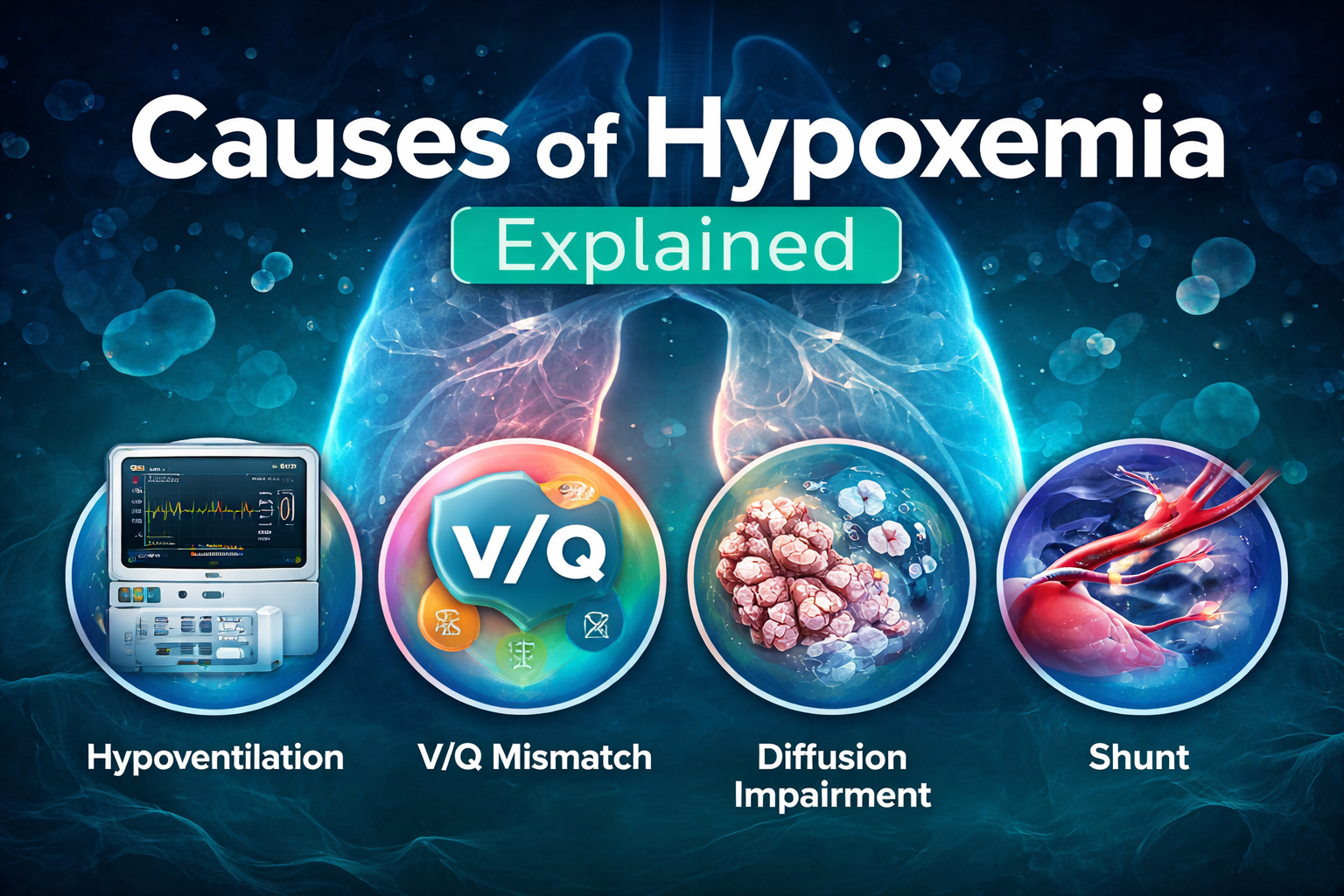
Causes of Hypoxemia Explained
Understanding the causes of hypoxemia is one of the most important skills in respiratory therapy, critical care, and bedside ABG interpretation. When a patient has a low PaO₂ or poor oxygenation, the next question is not just how bad is it? — it is why is it happening? In practice, most hypoxemia comes from a short list: V/Q mismatch, shunt, diffusion impairment, hypoventilation, or low inspired oxygen. This guide breaks them down in a student-friendly, clinically useful way.
For the full oxygenation workup, also see our A–a Gradient guide, our P/F Ratio guide, the ABG Interpretation Guide, the VBG vs ABG guide, and our Normal VBG Values page.
Quick Framework
When oxygenation is low, think through these five causes in order:
- V/Q mismatch — the most common cause
- Shunt — blood bypasses ventilated alveoli
- Diffusion impairment — oxygen has trouble crossing the membrane
- Hypoventilation — not moving enough air
- Low inspired oxygen — think altitude or wrong FiO₂
If you want to measure how severe the oxygenation problem is, start with the P/F Ratio. If you want to understand whether the problem is ventilation or gas exchange, add the A–a Gradient.
1. V/Q Mismatch
V/Q mismatch means ventilation and perfusion are both present, but they are not matched well. Some alveoli get air but not enough blood flow, while others get blood flow but not enough ventilation. This is the most common cause of hypoxemia in real clinical practice.
- Common examples: COPD, asthma, pneumonia, pulmonary edema, atelectasis
- Often improves with supplemental oxygen
- Usually causes an elevated A–a gradient
This is one reason the A–a Gradient calculator is so useful in hypoxemia workups.
2. Shunt
A shunt means blood reaches the arterial side without being exposed to functioning alveoli. In other words, perfusion is happening, but ventilation is not. This creates severe oxygenation problems.
- Common examples: ARDS, severe pneumonia, alveolar collapse, intracardiac right-to-left shunt
- Often does not correct well with oxygen alone
- Typically produces a high A–a gradient
Shunt physiology is especially important when interpreting poor oxygenation on an ABG or a very low P/F ratio.
3. Diffusion Impairment
Diffusion impairment occurs when oxygen has trouble crossing the alveolar-capillary membrane. This is less common than V/Q mismatch, but still classically tested in students and boards.
- Common examples: interstitial lung disease, pulmonary fibrosis, severe emphysema
- Often worsens with exercise
- Can elevate the A–a gradient
If you are learning oxygenation as part of ABG practice, compare this with the A–a Gradient guide and the P/F Ratio guide.
4. Hypoventilation
Hypoventilation means the patient is not moving enough air to eliminate CO₂ or bring in enough oxygen. This is different from a true gas exchange defect.
- Common examples: opioid overdose, CNS depression, neuromuscular weakness, obesity hypoventilation
- Often causes both hypoxemia and hypercapnia
- A–a gradient may be normal or near-normal
This is where a step-by-step ABG interpretation workflow becomes very helpful.
5. Low Inspired Oxygen
Sometimes the problem is not the lungs at all — the patient may simply not be breathing enough oxygen. This happens at high altitude or if the delivered FiO₂ is lower than expected.
- Classic example: high altitude
- A–a gradient is usually normal
- Improves when FiO₂ increases
This is one of the classic reasons a patient may be hypoxemic with a normal A–a Gradient.
How to Tell the Causes Apart
| Cause | A–a Gradient | Response to O₂ |
|---|---|---|
| V/Q mismatch | High | Usually improves |
| Shunt | High | Poor response |
| Diffusion impairment | High | Often improves |
| Hypoventilation | Normal or near-normal | Improves |
| Low inspired oxygen | Normal | Improves |
If you are a student, this table is the high-yield framework to memorize. In real life, the combination of an ABG, a calculated A–a gradient, and the patient's clinical context usually gives you the answer.
Practice & Related Tools
Related Guides
FAQ
What is the most common cause of hypoxemia?
The most common cause of hypoxemia is usually V/Q mismatch. This is seen in conditions like COPD, asthma, pneumonia, pulmonary edema, and atelectasis.
What causes hypoxemia with a normal A–a gradient?
Hypoventilation and low inspired oxygen are the classic causes of hypoxemia with a normal or near-normal A–a gradient.
What causes hypoxemia with an elevated A–a gradient?
V/Q mismatch, shunt, and diffusion impairment are the classic causes of hypoxemia with an elevated A–a gradient.