VBG Practice: Questions, Cases, and Interactive Simulator
Practice VBG interpretation with realistic venous blood gas cases. This guide combines VBG practice questions, a repeatable acid-base framework, and an interactive VBG simulator to help clinicians and students build fast, clinically useful pattern recognition.
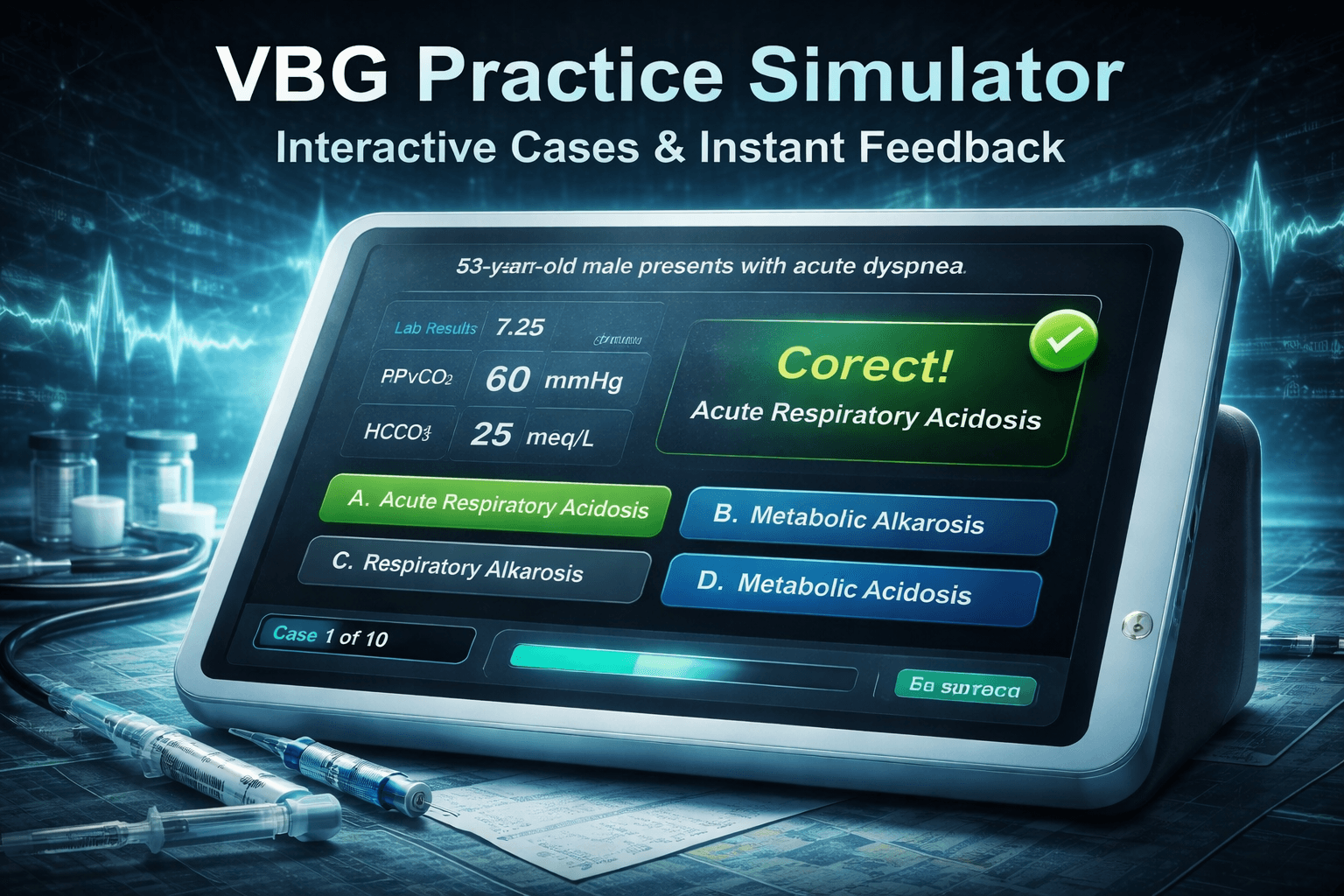
Practice VBGs Now (Interactive Simulator)
Launch VBGenius to generate venous blood gas cases, test yourself, and get instant feedback on acid-base status, primary disorder, and compensation.
Launch VBG Simulator →Try VBG Analyzer →How to Practice VBG Interpretation Effectively
VBG practice works best when you use a simple, repeatable framework instead of memorizing isolated number patterns. Start with pH, decide whether the case reflects acidosis, alkalosis, or a near-normal pH, then determine whether the primary disorder is respiratory, metabolic, or mixed.
Then assess compensation. In VBG interpretation, you are still training the same acid-base reasoning skills used in ABG analysis, but with venous values and the appropriate clinical context. Repeated exposure to realistic cases is what makes the pattern recognition stick. If you want instant interpretation feedback on real values, use the VBG Analyzer.
- 1. Start with pH: Decide whether the VBG shows acidosis, alkalosis, or a normal-range pH.
- 2. Identify the primary disorder: Determine whether the main process is respiratory, metabolic, or mixed.
- 3. Assess compensation: Decide whether compensation is absent, partial, or full.
- 4. Repeat with new cases: Use repetition to build speed and confidence.
VBG Practice Questions (Examples)
Use example cases like these to test your interpretation skills before jumping into the simulator. The goal is not just to memorize an answer, but to explain why the numbers fit a given acid-base pattern.
7.32 / 53 / 22
Practice question: Does this VBG suggest respiratory acidosis, metabolic acidosis, or a mixed pattern? Is compensation present?
7.48 / 30 / 22
Practice question: Is this alkalosis primarily respiratory or metabolic, and is the compensation appropriate?
7.29 / 60 / 27
Practice question: Could this pattern fit an acute hypercapnic process, and how would you classify the compensation?
7.38 / 49 / 28
Practice question: When the pH is near normal, what clues help you identify the primary disorder and whether compensation is complete?
When VBG is useful
VBGs are often useful for trending acid-base status, screening for hypercapnia, and evaluating metabolic disturbances, especially when an arterial sample is not immediately necessary.
For the full clinical comparison, read the VBG vs ABG guide.
If you already have a venous blood gas and want automated interpretation, try the VBG Analyzer.
When ABG is still needed
VBG practice strengthens acid-base reasoning, but it does not replace the clinical need for ABG sampling when precise oxygenation assessment, A–a gradient interpretation, or arterial PaO₂ data are important.
If you want to sharpen your arterial interpretation too, use ABGenius or review the ABG interpretation guide.
Related VBG and ABG resources
Frequently Asked Questions
What is the best way to practice VBGs?
The best way to practice VBG interpretation is repeated exposure to realistic cases with a consistent framework: evaluate pH, identify the primary disorder, and assess compensation.
What is a VBG simulator?
A VBG simulator is an interactive tool that generates venous blood gas cases and lets you practice interpretation in real time.
Is there a VBG analyzer?
Yes. The PulmTools VBG Analyzer helps interpret venous blood gases by evaluating pH, PvCO₂, HCO₃⁻, compensation patterns, and likely acid-base disorders.
Who should use VBG practice questions?
VBG practice questions are useful for respiratory therapists, nurses, physicians, students, and anyone learning acid-base interpretation.