VBG Calculator: How to Analyze and Interpret Venous Blood Gases Quickly
Use this guide to understand what a VBG calculator does, how a VBG analyzer helps you interpret pH, PvCO₂, and HCO₃⁻, and when to move from quick calculation to deeper clinical reasoning. If you want fast results, you can jump straight into the VBG Analyzer tool.
Use the VBG Calculator Now
Enter real venous blood gas values to get a fast interpretation of the primary disorder, compensation pattern, and clinical context.
What does a VBG calculator do?
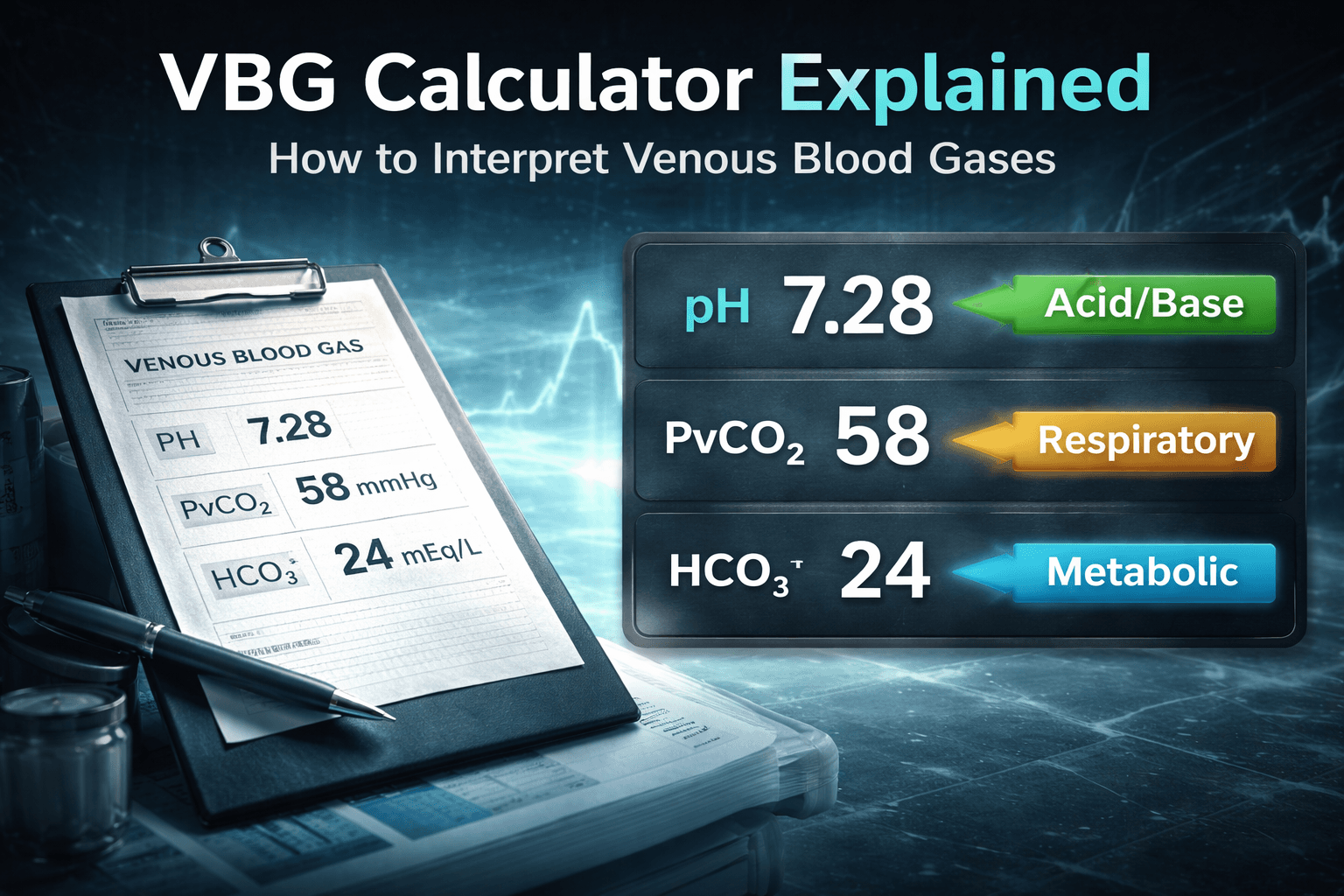
A VBG calculator takes the key venous blood gas values — pH, PvCO₂, and HCO₃⁻ — and helps you quickly determine the likely acid-base disorder and whether compensation is present.
For learners, a VBG calculator speeds up practice and reduces simple classification mistakes. For clinicians, it can support quick screening and trending of acid-base status. It does not replace clinical judgment, but it can make interpretation faster and more repeatable.
Before interpreting any venous blood gas, it helps to understand normal values and expected compensation patterns. Review the Normal VBG Values Guide for reference ranges, then reinforce those concepts with VBGenius.
How to interpret VBGs step by step
- 1. Check pH: Decide whether the patient has acidosis, alkalosis, or a near-normal pH.
- 2. Identify the primary disorder: Decide whether the main process is respiratory, metabolic, or mixed.
- 3. Assess compensation: Determine whether compensation is absent, partial, or full.
- 4. Interpret in context: Consider perfusion, ventilation, chronic CO₂ retention, shock states, and the overall patient story.
- 5. Decide whether ABG is needed: Use ABG when accurate arterial oxygenation data are important.
If you want a deeper walkthrough instead of a quick calculator result, read the VBG Interpretation Step-by-Step Guide.
Many learners also benefit from comparing venous and arterial sampling side by side. See the VBG vs ABG Guide and practice arterial interpretation in ABGenius.
When a VBG analyzer is most useful
A VBG analyzer is especially useful when you need quick support for acid-base screening, hypercapnia trending, metabolic disturbance review, or a second-pass read of values before stepping into a broader clinical discussion.
It is also useful for students building pattern recognition, especially when paired with an interactive study tool like VBGenius.
What a VBG calculator cannot replace
A calculator does not know the full patient story. It cannot replace clinical judgment, trending over time, or the need for an ABG when arterial oxygenation, PaO₂, or A–a gradient interpretation matter.
That is why the strongest workflow is: use a fast calculator first, then confirm your reasoning with deeper review, side-by-side comparison with VBG vs ABG, and deliberate practice.
VBG calculator examples
Here are simple examples of the kinds of patterns a VBG calculator helps classify quickly.
7.30 / 56 / 27
Pattern question: Is this respiratory acidosis, and does the bicarbonate suggest compensation has started?
7.47 / 32 / 23
Pattern question: Does this fit primary respiratory alkalosis with little or no compensation?
7.24 / 28 / 12
Pattern question: Is this metabolic acidosis with respiratory compensation?
7.38 / 50 / 29
Pattern question: Does a near-normal pH here suggest a fully compensated respiratory process?
Related VBG tools and guides
Related VBG resources
Learn the full step-by-step process in the VBG interpretation guide.
Review normal ranges in the normal VBG values guide.
Practice real cases with VBGenius.
Need fast interpretation? Use the VBG calculator.
Need arterial oxygenation analysis? See the ABG calculator guide.
Compare venous vs arterial interpretation in the VBG vs ABG guide.
Frequently Asked Questions
What is a VBG calculator?
A VBG calculator is a tool that helps interpret venous blood gas values by identifying likely acid-base disorders and compensation patterns.
What is the difference between a VBG calculator and VBG practice tool?
A VBG calculator is designed for quick interpretation of real values. A VBG practice tool gives you repeated training cases so you can build pattern recognition and speed.
When should I use a VBG analyzer instead of an ABG?
Use a VBG when acid-base screening, trending ventilation, or metabolic assessment are the main goals. Use an ABG when accurate arterial oxygenation data are important.
Can a VBG calculator identify mixed acid-base disorders?
A high-quality VBG analyzer can help identify patterns consistent with mixed disorders, but interpretation should always be confirmed using the full clinical picture and, when necessary, arterial blood gas data.
Where can I practice VBG interpretation?
You can practice interactive venous blood gas cases using VBGenius, which generates realistic VBG scenarios and provides instant feedback on acid-base status and compensation.