Mechanical ventilation
How to Measure Auto-PEEP on a Ventilator
Recognize air trapping on the flow waveform, check an end-expiratory hold, and calculate intrinsic PEEP with worked examples.
By PulmTools Editorial Team · · 6 min read
How do you calculate auto-PEEP?
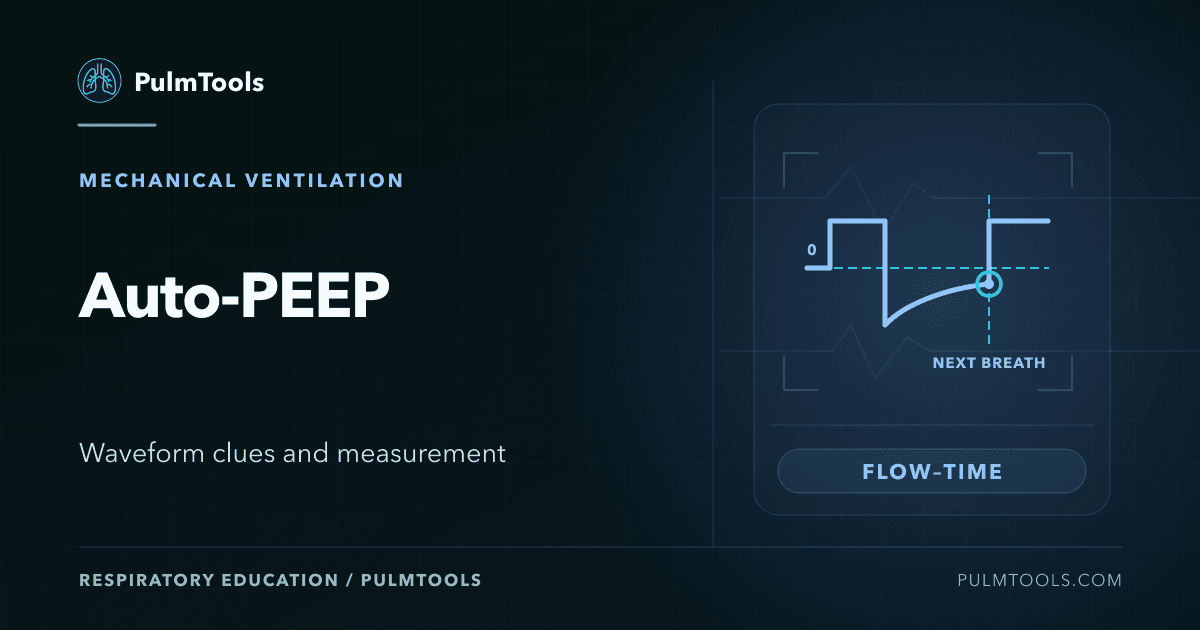
Subtract set PEEP from total PEEP measured during a valid end-expiratory hold. If total PEEP is 12 and set PEEP is 5, auto-PEEP is 7 cm H₂O. The flow waveform tells you when to suspect air trapping.
Spot air trapping on the flow waveform
Auto-PEEP, also called intrinsic PEEP, is pressure remaining above set PEEP at the end of expiration because the lungs have had insufficient time to empty. Obstructive disease and a shortened expiratory phase can both contribute.
Find the zero-flow line and look immediately before the next inspiration. On the convention shown here, expiratory flow is below zero. Flow still below the line when the next breath begins is a clue that expiration was interrupted.
The expiratory trace reaches zero and stays there briefly before the next inspiration starts.
The next breath starts while expiratory flow is still below the zero-flow line.
Original teaching tracings. Use the labeled zero-flow line on your ventilator because display conventions vary. See Hess’s review of expiratory flow and air trapping.
Measure total PEEP during an end-expiratory hold
- Check the conditions. Use the ventilator’s expiratory hold function according to the device instructions and local protocol. An interpretable static measurement requires a relaxed patient during the maneuver and a circuit without a significant leak.
- Read the stable pressure. During the hold, flow stops. The airway pressure should settle at a stable level, which represents measured total PEEP.
- Subtract the set value. Auto-PEEP equals measured total PEEP minus set PEEP, in cm H₂O.
With flow stopped, airway pressure settles at a stable plateau above set PEEP.
Expiratory muscle effort can drive airway pressure upward during the pause and invalidate the reading.
Coughing or active breathing can distort the pressure trace. Review the tracing for a stable plateau before using the reading. Even with a clean pause, airway closure can prevent some trapped regions from equilibrating with the airway opening, so measured auto-PEEP may underestimate their pressure. See Hess’s measurement figures and Hamilton Medical’s worked example.
Practice case
A passively ventilated adult has persistent end-expiratory flow. Both holds are valid. Calculate auto-PEEP and driving pressure from the three readings below.
- Set PEEP
- 5 cm H₂O
- Total PEEP
- 12 cm H₂O
- Plateau pressure
- 27 cm H₂O
Reveal the answer
Auto-PEEP: 12 − 5 = 7 cm H₂O.
Driving pressure: 27 − 12 = 15 cm H₂O.
Using set PEEP in place of total PEEP would give 22 cm H₂O and overstate the pressure change by 7 cm H₂O.
Common auto-PEEP questions
Does expiratory flow below zero tell me how much auto-PEEP is present?
It shows expiration is still in progress when the next breath begins. Estimate the pressure contribution with a valid end-expiratory hold. Expiratory airway closure can make the measured value underestimate regional air trapping.
Is an inspiratory hold the same as an expiratory hold?
An inspiratory hold is used to measure plateau pressure at end inspiration. An expiratory hold is used to measure total PEEP at end expiration. Both require attention to patient effort and the quality of the tracing.
What if the ventilator already displays intrinsic PEEP?
Check how the device derives the reading and whether it applies in the current mode. Some ventilators estimate intrinsic PEEP breath by breath. If you already have a valid total PEEP measurement, it includes the intrinsic component.
Continue with the Patient–Ventilator Assessment guide or the Mechanical Ventilation Troubleshooting reference.
Sources
- AARC Clinical Practice Guideline: Patient–Ventilator Assessment
Goodfellow et al., Respiratory Care, 2024. Recommendations for assessing PEEP, auto-PEEP and driving pressure.
- Respiratory Care Management of COPD Exacerbations
Dean R. Hess, Respiratory Care, 2023. Mechanics of air trapping, end-expiratory occlusion and the limits of the measurement.
- Measurement of AutoPEEP and Total PEEP
Hamilton Medical. A ventilator-specific example of reading the pause and subtracting set PEEP from total PEEP.