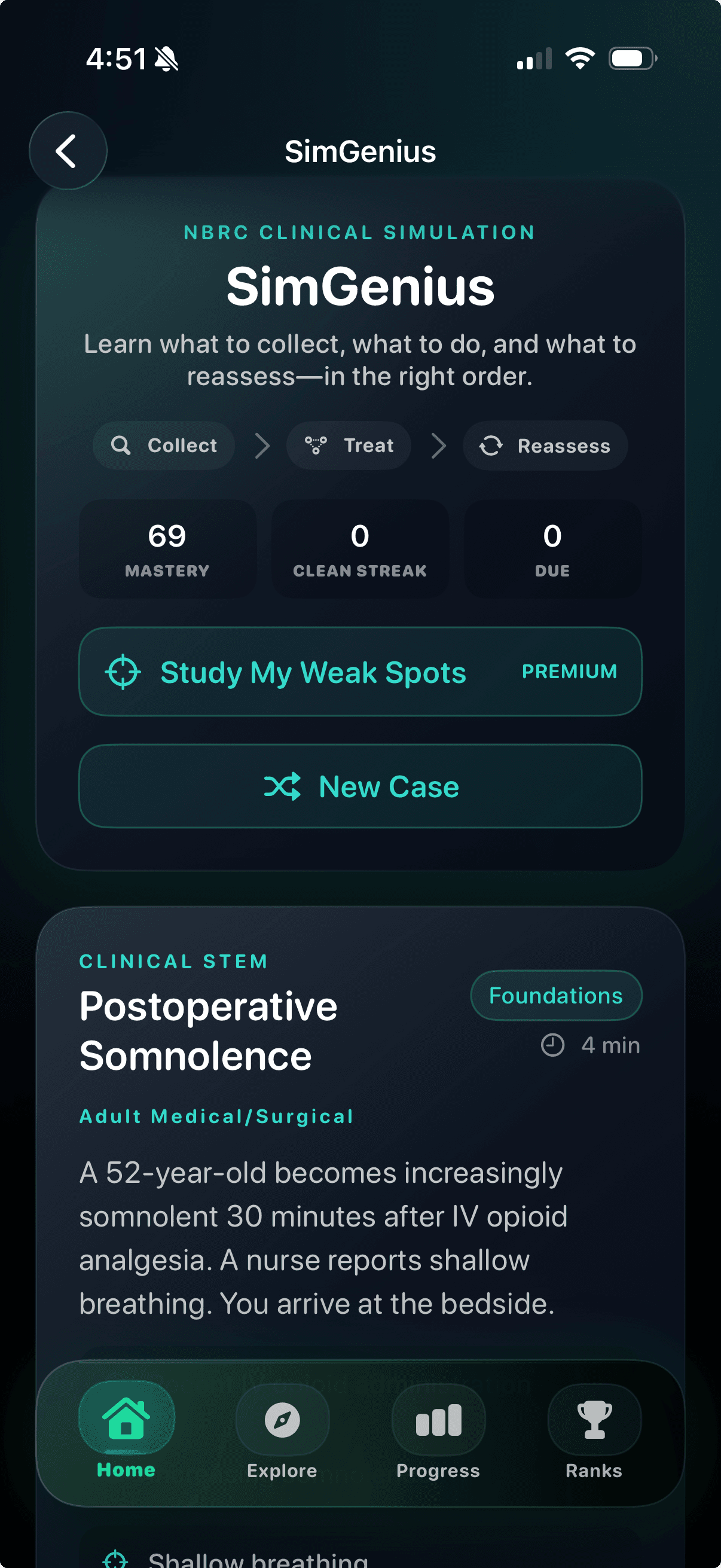
Learn the order
Practice the difference between information that matters now, data that can wait, and actions that would dangerously delay care.
20 clinically validated cases
20 Respiratory Therapy Clinical Simulations
Learn what to assess first, when to act, and how to correct the sequence when you miss.
SimGenius delivers original, source-cited cases for current NBRC Clinical Simulation Examination preparation and the Information Gathering, Decision Making, and clinical-judgment skills retained in the 2027 Respiratory Therapy Examination.
Clinically validated · version 6
Information Gathering · Priority 01
Which measurements are essential before changing ventilation?
Choose the single best next move.
This exercise teaches prioritization for respiratory credentialing examinations. Exam scenarios simplify clinical situations and may present decisions sequentially even when actions occur simultaneously or vary by protocol in practice. Follow current evidence, local policy, and clinical judgment in patient care.
PulmTools is not affiliated with or endorsed by the National Board for Respiratory Care (NBRC).
Practice the difference between information that matters now, data that can wait, and actions that would dangerously delay care.
Get concise feedback at the moment of error, then replay the entire case as a clean clinical sequence.
Immediate airway, breathing, circulation, and other time-critical threats stay ahead of lower-yield testing.
Free NBRC clinical simulation preparation
SimGenius is free NBRC CSE practice built around a deceptively difficult skill: choosing what to collect or do next. Each respiratory therapy clinical simulation asks you to recognize the immediate threat, select high-value information, act when enough evidence is available, and reassess the response.
The current NBRC Clinical Simulation Examination separates performance into Information Gathering and Decision Making. The NBRC says the current CSE contains 22 problems—20 scored problems and two pretest problems—with four hours of testing time. Its announced 2027 Respiratory Therapy Examination continues to measure clinical judgment through Information Gathering and Decision Making.
These are original, source-cited PulmTools cases rather than recalled examination questions. Every case in this RRT clinical simulation practice library has one defensible best answer at each checkpoint, targeted feedback for every option, and a corrective replay that shows the cleaner sequence.
How to practice for the NBRC CSE
Treat each checkpoint like the exam: collect focused information before selecting a management action.
Compare the tempting alternative with the best next move instead of memorizing only the correct letter.
Use corrective replay to rehearse Information Gathering, Decision Making, and reassessment in the right order.
Free respiratory therapy case library
Work through adult, neonatal, airway, ventilation, oxygenation, emergency, and chronic respiratory scenarios. Each link opens the selected case at the simulator.
Questions students ask
SimGenius is a free, independent NBRC CSE practice tool with 20 original respiratory therapy clinical simulations. It is not an official NBRC practice exam and does not reproduce secure or recalled test questions.
Work each case in sequence and choose only the information that changes immediate care. SimGenius labels lower-priority data, unsafe delays, and the best next move so you can learn what to collect first and what can wait.
SimGenius includes 20 source-cited respiratory therapy cases with three sequential checkpoints per case, immediate answer feedback, and an end-of-case corrective replay.
SimGenius is informed by public NBRC examination outlines and trains Information Gathering, Decision Making, and clinical sequencing. It is an independent PulmTools study tool and is not affiliated with or endorsed by the NBRC.
Yes. The NBRC has announced a single Respiratory Therapy Examination beginning in January 2027, and its published framework continues to assess clinical judgment through Information Gathering and Decision Making.
Each choice is classified as the best next move, useful later, low yield now, or an unsafe delay. Corrective replay then shows the ideal sequence and identifies exactly where the learner drifted.
Strengthen the calculations and pattern recognition that clinical simulations depend on.
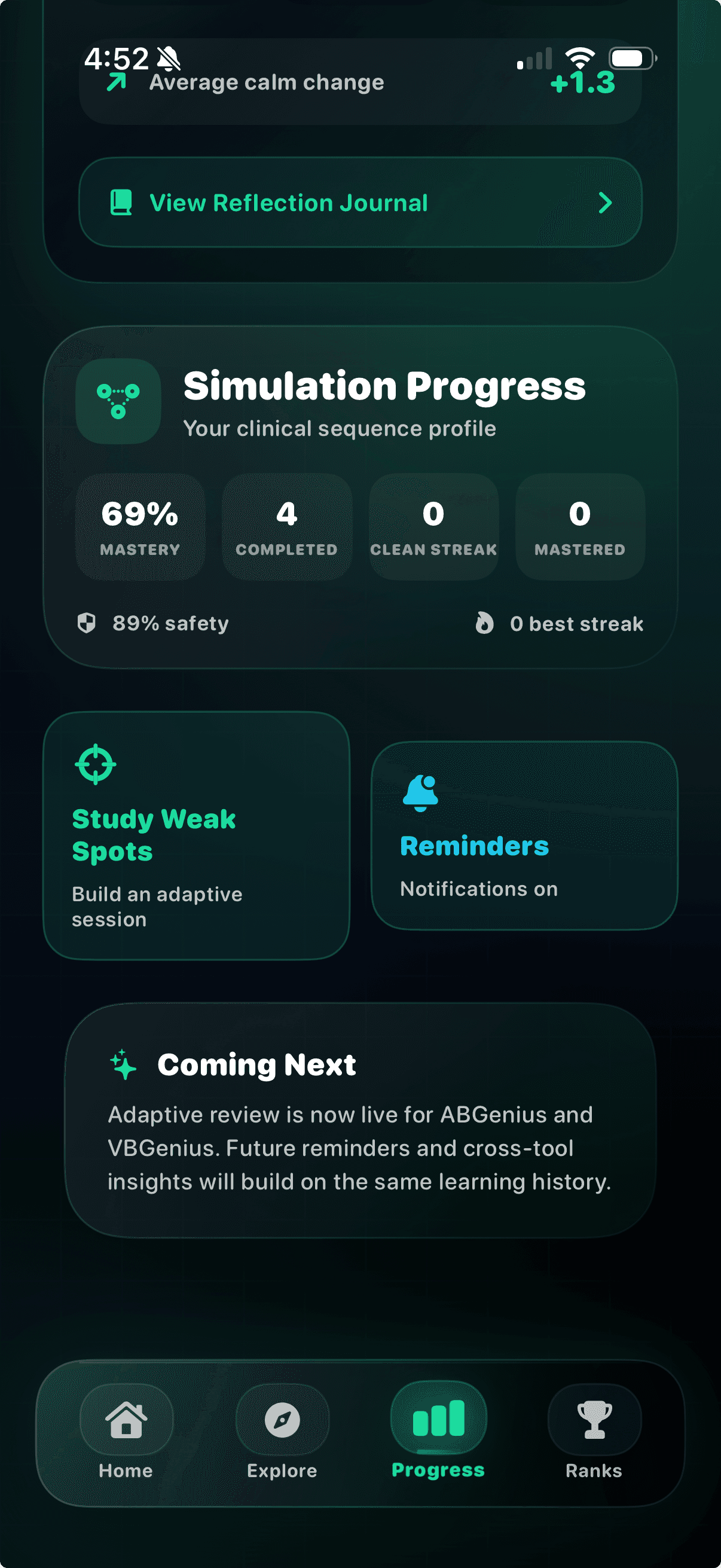
PulmTools Premium turns your SimGenius history into adaptive targeted practice, progress trends, and timely review reminders.
Target weak spots
Build adaptive sessions from the decisions you miss.
See your trends
Follow mastery, safety, clean streaks, and completed cases.
Review on time
Use smart reminders to keep priority sequencing fresh.