Oxygenation
SpO₂/FiO₂ Ratio (S/F Ratio): How to Calculate It and When to Use It for ARDS
The S/F ratio compares pulse oximeter saturation with the fraction of inspired oxygen. It can satisfy the oxygenation criterion in the Global ARDS definition when the saturation and respiratory support meet specific conditions.
By Sam D., RRT · · 5 min read
How to calculate the S/F ratio
S/F = SpO₂ (%) ÷ FiO₂
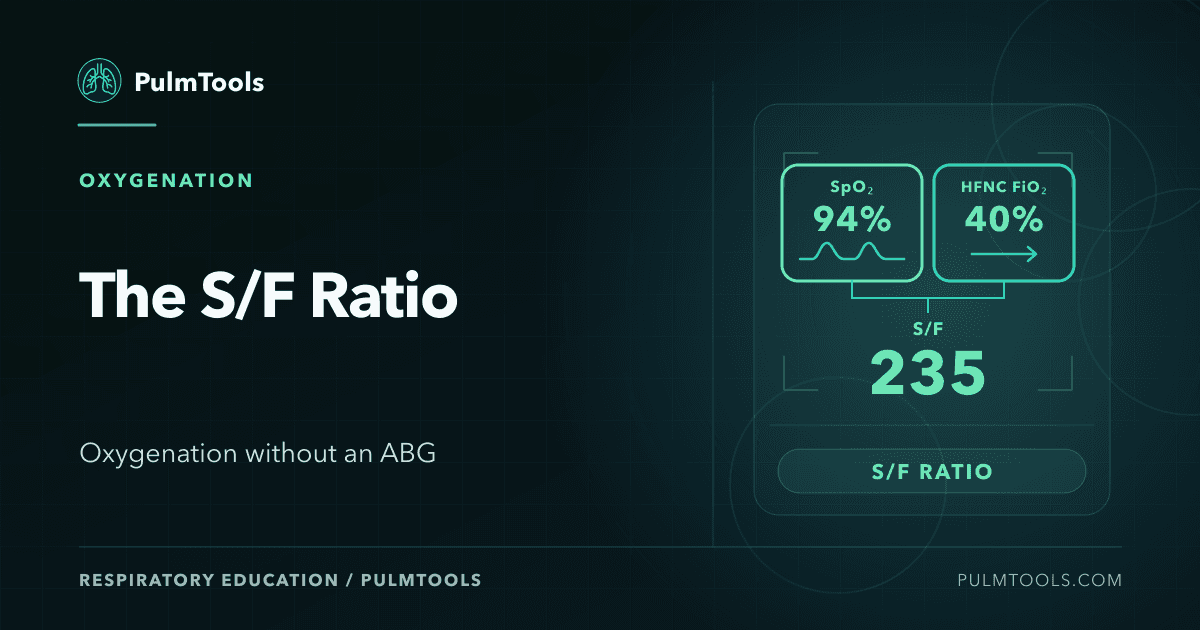
Enter SpO₂ as a whole percent and FiO₂ as a decimal. On high-flow nasal cannula (HFNC) at 40 L/min with SpO₂ 94% and FiO₂ 40%, divide 94 ÷ 0.40 = 235. The flow setting describes the respiratory support. FiO₂ goes in the denominator.
When the S/F ratio counts toward ARDS
The Global ARDS definition accepts a reliable S/F ratio of 315 or less when SpO₂ is 97% or less. For the nonintubated pathway, the patient must be on HFNC at 30 L/min or more or NIV/CPAP with at least 5 cm H₂O of end-expiratory pressure. The definition gives separate criteria for intubated patients and resource-limited settings. Global definition, Table 2
Also check for acute onset or worsening within one week of a predisposing event or new or worsening respiratory symptoms, compatible bilateral findings on imaging, and whether cardiac failure or fluid overload primarily explains the pulmonary edema. The ratio supplies the oxygenation criterion. Under the Berlin definition, oxygenation is assessed with PaO₂/FiO₂ and the required positive pressure. Berlin definition
When the S/F ratio can mislead
SpO₂ of 98% on FiO₂ 0.50
The arithmetic gives 196. At 98%, the oxygen–hemoglobin dissociation curve is flat enough that a similar saturation can represent very different PaO₂ values. The Global definition limits use of S/F to SpO₂ ≤97%. An arterial sample can provide a P/F ratio when needed. Global definition
SpO₂ of 92% on a low-flow cannula
A conventional nasal cannula supplies a flow in L/min. The patient’s inspiratory demand and room-air entrainment affect the delivered FiO₂. Substituting an estimate can create a precise-looking ratio from an uncertain denominator. The Global definition permits a specified estimate in its resource-limited pathway. Respiratory support review · Global definition, Table 2
Pair the reading with the current oxygen setting and a stable pulse-ox waveform. Motion, low perfusion and skin pigmentation can affect accuracy. If the reading conflicts with the clinical picture, verify it and consider an ABG. FDA pulse oximeter guidance
S/F ratio vs P/F ratio
| Feature | S/F ratio | P/F ratio |
|---|---|---|
| Formula | SpO₂ (%) ÷ FiO₂ | PaO₂ (mm Hg) ÷ FiO₂ |
| Measurement | Pulse oximeter | Arterial blood gas |
| Reported as | A number, e.g. 235 | mm Hg, e.g. 200 mm Hg |
| ARDS definitions | Global definition with SpO₂ ≤97% | Berlin and Global definitions |
| What to check | Reliable pulse-ox signal and usable FiO₂ | Arterial sample paired with current FiO₂ |
Use the thresholds for the definition and respiratory support that apply. The Global definition’s mild, moderate and severe bands are for intubated ARDS. The value of 235 in the HFNC example falls within the nonintubated oxygenation criterion. Global definition, Table 2
Practice case
Two days after developing pneumonia, a patient is on HFNC at 40 L/min with FiO₂ 0.40. At rest on stable settings, SpO₂ is 94% with a reliable waveform. Imaging and the cause of the edema still need review.
Which conclusion do these findings support?
- The oxygenation criterion for nonintubated Global ARDS is met.
- The patient has moderate ARDS by the Berlin definition.
- The saturation rules out an ARDS oxygenation abnormality.
Reveal the answer
A. The oxygenation criterion for nonintubated Global ARDS is met. The S/F ratio is 235, the SpO₂ is within the usable range, and HFNC meets the 30 L/min minimum. Imaging and the origin of the edema still need review before making the diagnosis. Global definition, Table 2
Keep learning
Put the reference into practice
Sources
- A New Global Definition of Acute Respiratory Distress Syndrome
Matthay et al., AJRCCM, 2024. Table 2 gives the oxygenation thresholds, requirements for respiratory support and conditions for measurement.
- Acute Respiratory Distress Syndrome: The Berlin Definition
ARDS Definition Task Force, JAMA, 2012. The original P/F-based Berlin criteria.
- A Clinical Guide to Non-invasive Respiratory Support in Acute Respiratory Failure
Review of respiratory support devices, including why delivered FiO₂ varies with conventional low-flow oxygen.
- Pulse Oximeters
FDA overview of pulse oximetry accuracy and factors such as circulation and skin pigmentation.