Rapid shallow breathing index, extubation readiness, and bedside limits
RSBI Extubation Criteria: What the Rapid Shallow Breathing Index Really Tells You
The rapid shallow breathing index (RSBI) remains one of the best-known bedside markers used during ventilator weaning and extubation assessment. It is simple, fast, and clinically useful — but it also has important limitations that can cause false reassurance when used alone.
This guide explains what RSBI means, how to calculate it, why the classic 105 threshold matters, and why extubation decisions still require a broader view of work of breathing, secretions, airway protection, oxygenation, and endurance.
What is the RSBI?
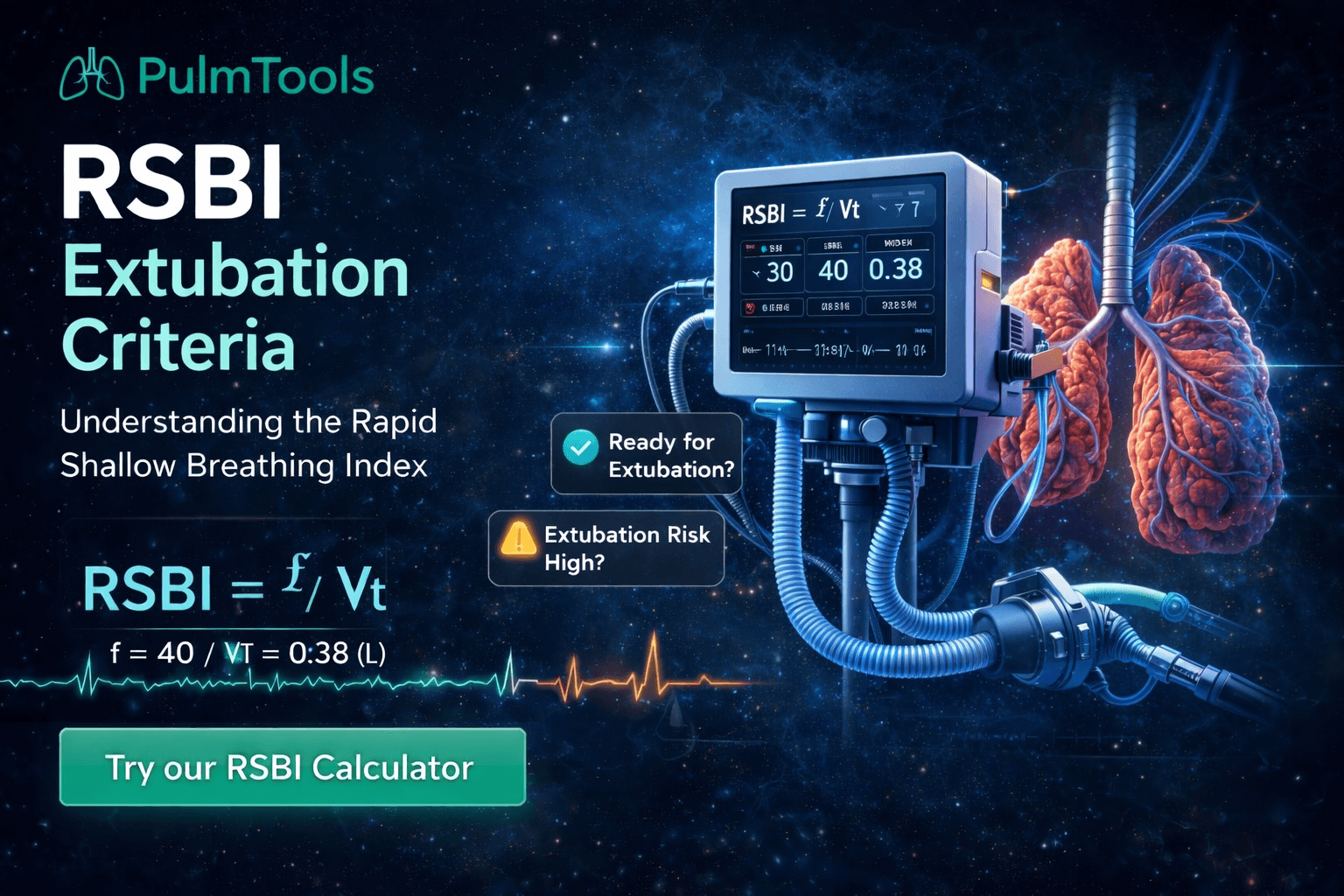
The rapid shallow breathing index is a simple way to describe how quickly and shallowly a patient is breathing. It compares respiratory rate to tidal volume in liters. In general, a lower RSBI suggests a more efficient spontaneous breathing pattern, while a higher RSBI suggests faster, shallower, and potentially less sustainable breathing.
The classic teaching threshold is RSBI < 105, which has long been associated with a greater likelihood of extubation success. That number is useful — but it is not magic, and it is definitely not the whole extubation decision.
If you want to calculate it directly, use the PulmTools RSBI Calculator. If you also need to interpret gas exchange, pair it with the ABG Analyzer or the P/F Ratio & Oxygenation Index tool.
How to calculate RSBI
The formula is straightforward:
RSBI = f / VT
where f is respiratory frequency in breaths per minute and VT is tidal volume in liters.
Example: if the respiratory rate is 40 and the tidal volume is 0.38 liters, the RSBI is about 105. That is right at the classic threshold and should prompt a careful look at the patient’s full extubation picture.
Use the PulmTools RSBI calculator if you want a quick bedside calculation without doing the math manually.
How to use RSBI clinically
- • Use it during a spontaneous breathing trial or a structured weaning assessment.
- • Interpret it alongside respiratory pattern, work of breathing, accessory muscle use, and endurance.
- • Confirm that oxygenation is acceptable. The P/F Ratio & Oxygenation Index tool and A–a Gradient calculator can help broaden that picture.
- • Make sure ventilation and acid-base status still make sense. The ABG Analyzer and ABG analysis guide are useful companions here.
- • Never treat RSBI as a stand-alone green light for extubation.
The limitations of RSBI as an extubation indicator
This is the part that matters most: RSBI can be useful without being sufficient. A single favorable number can create false confidence if the patient is barely hanging on in other ways.
A patient may have a low RSBI but still fail extubation if they cannot protect the airway, follow commands, or generate an effective cough.
Heavy secretion burden, weak clearance, or repeated suctioning needs can undermine extubation even when breathing mechanics look acceptable.
RSBI is often a snapshot. Some patients can produce a decent short-term number but fatigue over time once support is removed.
A reasonable RSBI does not guarantee acceptable oxygenation or ventilation. Pair it with ABG interpretation and oxygenation assessment when needed.
Mental status, hemodynamic stability, respiratory mechanics, underlying disease trajectory, and the reason for intubation still matter.
The 105 cutoff is useful, but not every patient above 105 fails and not every patient below 105 succeeds. The number supports judgment — it does not replace it.
A better way to think about RSBI
RSBI works best as a supporting signal. If the number is favorable, that should encourage you to look deeper — not stop thinking. Ask whether the patient is comfortable, maintaining acceptable gas exchange, protecting the airway, clearing secretions, and sustaining the breathing pattern over time.
In other words: RSBI can help you decide whether extubation looks reasonable, but it should not be the reason you extubate by itself.
How this fits into the PulmTools ventilation cluster
- • Use RSBI for rapid shallow breathing pattern assessment
- • Use Minute & Alveolar Ventilation for broader ventilation thinking
- • Use Dead Space Calculator if ventilation efficiency is a concern
- • Use IBW Calculator and ARDSNet Assistant when ventilator strategy also needs review
Frequently asked questions
What is a normal RSBI for extubation?
An RSBI below 105 is the classic teaching threshold associated with a higher likelihood of extubation success, but it should never be used in isolation. Clinical context, work of breathing, mental status, secretion burden, cough strength, and oxygenation still matter.
How do you calculate RSBI?
RSBI is calculated as respiratory frequency divided by tidal volume in liters: f / VT. For example, a respiratory rate of 30 with a tidal volume of 0.38 liters gives an RSBI of about 79.
Why can RSBI be misleading?
RSBI can look favorable even when a patient has weak cough, poor secretion clearance, altered mental status, marginal oxygenation, rising work of breathing, or poor endurance. It is a helpful signal, not a stand-alone extubation decision tool.
Is RSBI alone enough to decide extubation?
No. RSBI should be interpreted alongside spontaneous breathing trial performance, gas exchange, airway protection, secretion management, hemodynamics, and the overall clinical trajectory.