ABG Learning Guide
Best Resource for ABG Analysis
Looking for the best way to learn ABG interpretation? This guide breaks down what actually helps students improve at acid-base and arterial blood gas analysis, with practical examples, study strategy, and an interactive path to faster pattern recognition.
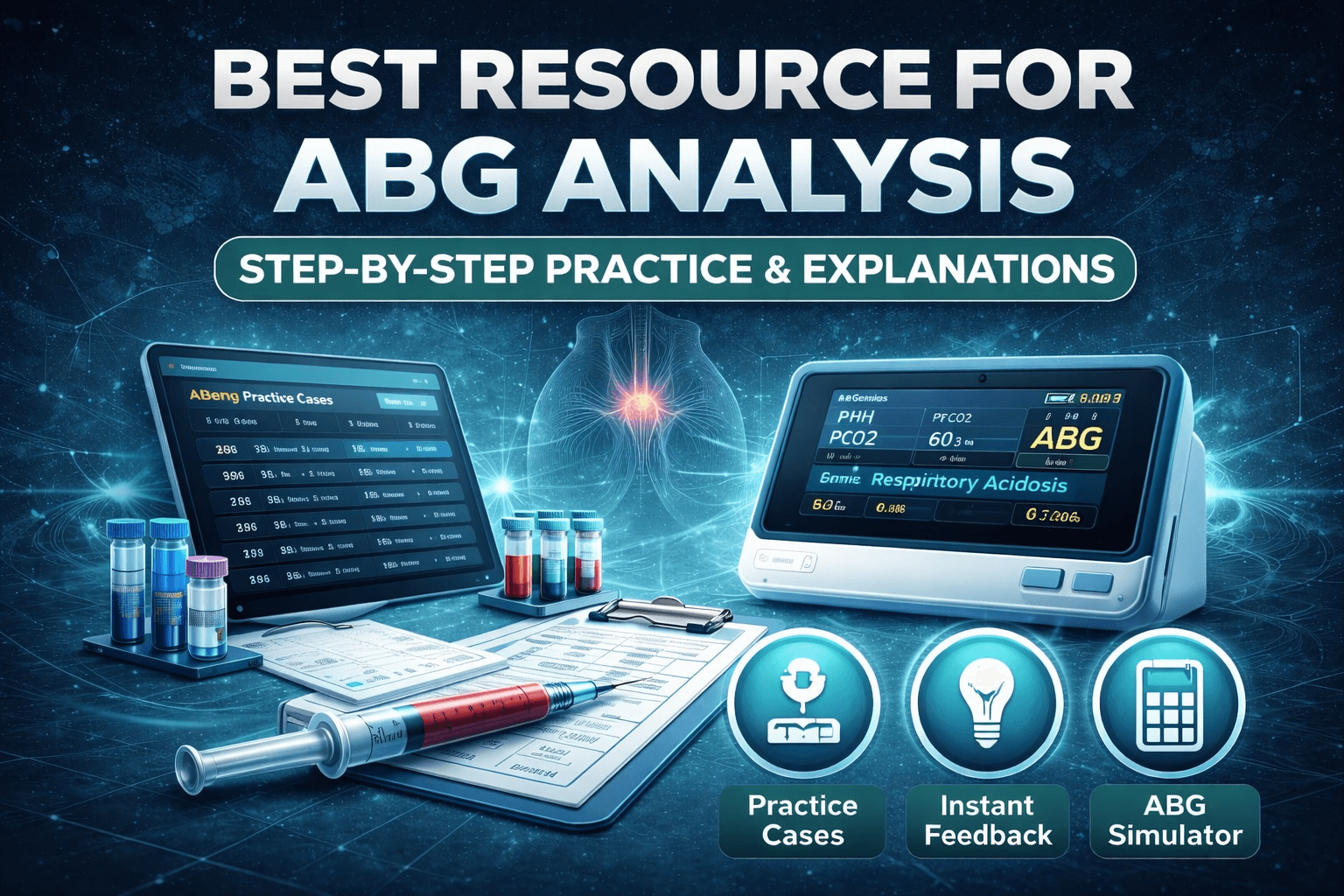
Why students keep searching for the best ABG resource
ABG interpretation feels difficult because it combines several clinical skills at once. You are not just reading numbers. You are identifying the primary acid-base disorder, checking whether compensation makes sense, and judging oxygenation status in the same moment.
That is why many students keep searching for the best resource for ABG analysis. They do not only want definitions. They want a way to practice until the patterns become obvious.
For most learners, the fastest improvement happens when strong explanations are paired with repeated case-based drills. That is also why interactive tools often outperform passive study alone.
Comparing the most common ABG study resources
Textbooks and review books
Books can build your foundation, but they are often slower for pattern recognition. They help with theory, yet many students still struggle when they face a new arterial blood gas question under pressure.
Video lessons
Videos are useful for first-pass learning, especially if acid-base disorders still feel confusing. The downside is that passive watching does not always translate into fast ABG interpretation on exams or clinical rotations.
Flashcards and notes
Flashcards can help you memorize rules, but ABG analysis is more than memorization. You need repeated exposure to pH, PaCO₂, HCO₃⁻, and oxygenation patterns until they start to feel intuitive.
Interactive ABG practice
For many students, the best resource for ABG analysis is guided practice with immediate feedback. That is where a tool like ABGenius stands out: it helps you apply concepts instead of just reading about them.
What actually works best for learning ABGs
The best resource for ABG analysis is usually not a single book, lecture, or cheat sheet. It is a study system that helps you do three things well: understand the rules, apply them to real ABG values, and get feedback immediately.
That is the advantage of using interactive ABG practice tools. When you see real ABG values, try to interpret them, and get instant feedback, your brain starts to recognize the patterns faster. This is why students who drill with interactive cases often improve more quickly than those who only read or watch.
Frequently Asked Questions about ABG resources
- What is the best resource for ABG analysis?
- The best resource is usually one that combines clear explanation with repeated practice. Many students learn faster when they use interactive ABG cases and immediate feedback instead of relying only on passive reading.
- What is the easiest way to learn ABG interpretation?
- A simple step-by-step process works best: check the pH, analyze PaCO₂, analyze HCO₃⁻, assess compensation, then classify oxygenation. Practicing many cases helps this process become automatic.
- Why do students struggle with acid-base and ABG analysis?
- ABGs combine multiple concepts at once, including acid-base balance, compensation, and oxygenation. Students often improve when they stop only reading about ABGs and start solving realistic examples repeatedly.
- Is ABGenius good for RT, nursing, and medical students?
- Yes. ABG practice tools are especially helpful for respiratory therapy students, nursing students, PA students, and medical students who want more repetition before exams, boards, or clinical training.